
Mind map
Multi-fidelity Prototyping of User Interfaces
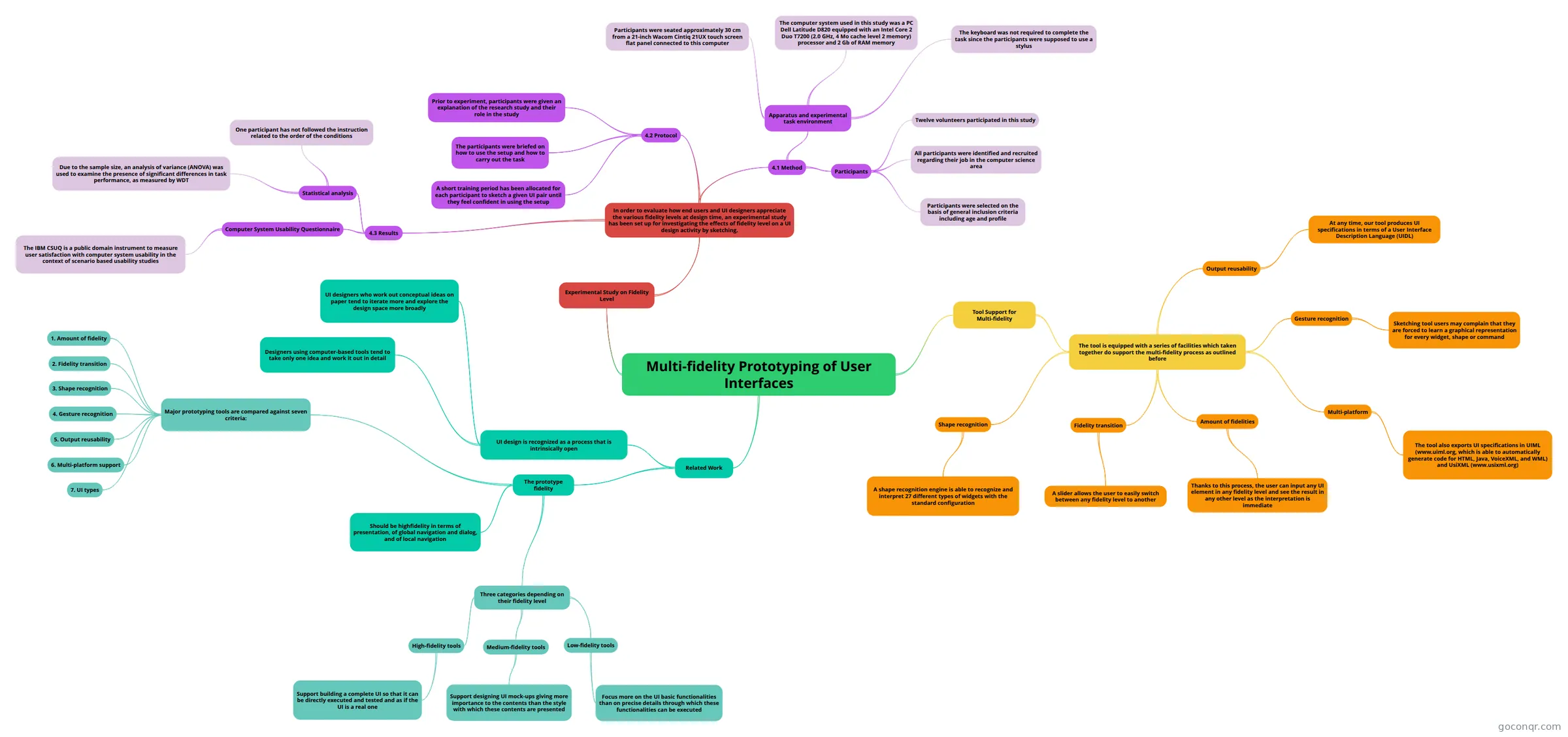
Mind map: Multi-fidelity prototyping of user interfaces
Map content
Multi-fidelity Prototyping of User Interfaces
Related Work
- UI design is recognized as a process that is intrinsically open
- UI designers who work out conceptual ideas on paper tend to iterate more and explore the design space more broadly
- Designers using computer-based tools tend to take only one idea and work it out in detail
- The prototype fidelity
- Should be highfidelity in terms of presentation, of global navigation and dialog, and of local navigation
- Three categories depending on their fidelity level
- High-fidelity tools
- Support building a complete UI so that it can be directly executed and tested and as if the UI is a real one
- Medium-fidelity tools
- Support designing UI mock-ups giving more importance to the contents than the style with which these contents are presented
- Low-fidelity tools
- Focus more on the UI basic functionalities than on precise details through which these functionalities can be executed
- High-fidelity tools
- Major prototyping tools are compared against seven criteria:
- 1. Amount of fidelity
- 2. Fidelity transition
- 3. Shape recognition
- 4. Gesture recognition
- 5. Output reusability
- 6. Multi-platform support
- 7. UI types
- UI design is recognized as a process that is intrinsically open
Tool Support for Multi-fidelity
- The tool is equipped with a series of facilities which taken together do support the multi-fidelity process as outlined before
- Shape recognition
- A shape recognition engine is able to recognize and interpret 27 different types of widgets with the standard configuration
- Fidelity transition
- A slider allows the user to easily switch between any fidelity level to another
- Amount of fidelities
- Thanks to this process, the user can input any UI element in any fidelity level and see the result in any other level as the interpretation is immediate
- Gesture recognition
- Sketching tool users may complain that they are forced to learn a graphical representation for every widget, shape or command
- Output reusability
- At any time, our tool produces UI specifications in terms of a User Interface Description Language (UIDL)
- Multi-platform
- The tool also exports UI specifications in UIML (www.uiml.org, which is able to automatically generate code for HTML, Java, VoiceXML, and WML) and UsiXML (www.usixml.org)
- Shape recognition
- The tool is equipped with a series of facilities which taken together do support the multi-fidelity process as outlined before
Experimental Study on Fidelity Level
- In order to evaluate how end users and UI designers appreciate the various fidelity levels at design time, an experimental study has been set up for investigating the effects of fidelity level on a UI design activity by sketching.
- 4.1 Method
- Participants
- Twelve volunteers participated in this study
- Participants were selected on the basis of general inclusion criteria including age and profile
- All participants were identified and recruited regarding their job in the computer science area
- Apparatus and experimental task environment
- The computer system used in this study was a PC Dell Latitude D820 equipped with an Intel Core 2 Duo T7200 (2.0 GHz, 4 Mo cache level 2 memory) processor and 2 Gb of RAM memory
- Participants were seated approximately 30 cm from a 21-inch Wacom Cintiq 21UX touch screen flat panel connected to this computer
- The keyboard was not required to complete the task since the participants were supposed to use a stylus
- Participants
- 4.2 Protocol
- Prior to experiment, participants were given an explanation of the research study and their role in the study
- The participants were briefed on how to use the setup and how to carry out the task
- A short training period has been allocated for each participant to sketch a given UI pair until they feel confident in using the setup
- 4.3 Results
- Statistical analysis
- One participant has not followed the instruction related to the order of the conditions
- Due to the sample size, an analysis of variance (ANOVA) was used to examine the presence of significant differences in task performance, as measured by WDT
- Computer System Usability Questionnaire
- The IBM CSUQ is a public domain instrument to measure user satisfaction with computer system usability in the context of scenario based usability studies
- Statistical analysis
- 4.1 Method
- In order to evaluate how end users and UI designers appreciate the various fidelity levels at design time, an experimental study has been set up for investigating the effects of fidelity level on a UI design activity by sketching.
Information
- Description
- Mind Map on Multi-fidelity Prototyping of User Interfaces, created by Mateo Córdova on 15/12/2019.
- Created by
- Mateo Córdova
- Views
- 0
- Rating