
Mind map
Forms of Intellectual Property
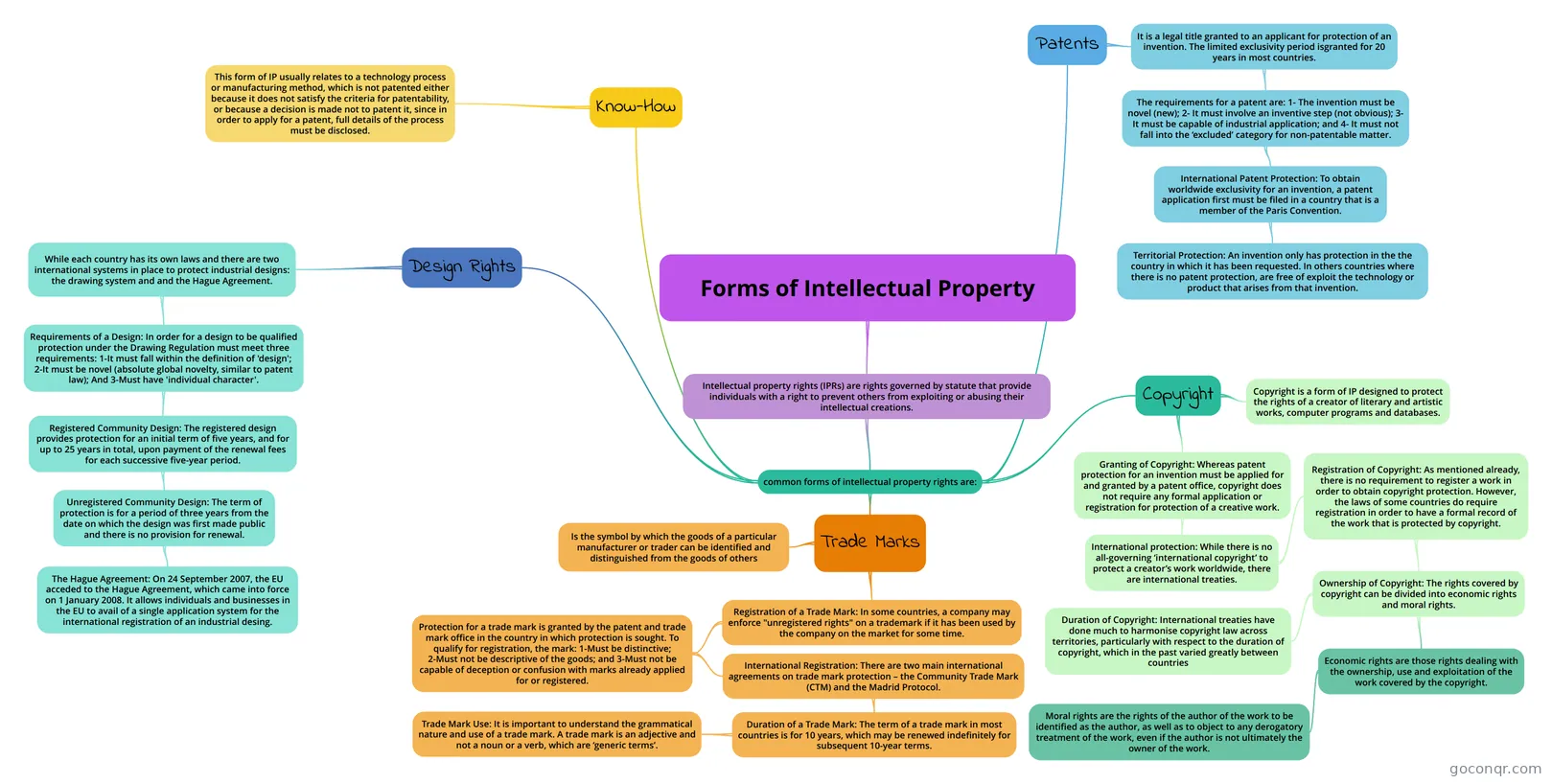
Mind map: Forms of intellectual property
Map content
Forms of Intellectual Property
Intellectual property rights (IPRs) are rights governed by statute that provide individuals with a right to prevent others from exploiting or abusing their intellectual creations.
- common forms of intellectual property rights are:
- Patents
- It is a legal title granted to an applicant for protection of an invention. The limited exclusivity period isgranted for 20 years in most countries.
- The requirements for a patent are: 1- The invention must be novel (new); 2- It must involve an inventive step (not obvious); 3- It must be capable of industrial application; and 4- It must not fall into the ‘excluded’ category for non-patentable matter.
- International Patent Protection: To obtain worldwide exclusivity for an invention, a patent application first must be filed in a country that is a member of the Paris Convention.
- Territorial Protection: An invention only has protection in the the country in which it has been requested. In others countries where there is no patent protection, are free of exploit the technology or product that arises from that invention.
- International Patent Protection: To obtain worldwide exclusivity for an invention, a patent application first must be filed in a country that is a member of the Paris Convention.
- The requirements for a patent are: 1- The invention must be novel (new); 2- It must involve an inventive step (not obvious); 3- It must be capable of industrial application; and 4- It must not fall into the ‘excluded’ category for non-patentable matter.
- It is a legal title granted to an applicant for protection of an invention. The limited exclusivity period isgranted for 20 years in most countries.
- Trade Marks
- Is the symbol by which the goods of a particular manufacturer or trader can be identified and distinguished from the goods of others
- Registration of a Trade Mark: In some countries, a company may enforce "unregistered rights" on a trademark if it has been used by the company on the market for some time.
- Protection for a trade mark is granted by the patent and trade mark office in the country in which protection is sought. To qualify for registration, the mark: 1-Must be distinctive; 2-Must not be descriptive of the goods; and 3-Must not be capable of deception or confusion with marks already applied for or registered.
- International Registration: There are two main international agreements on trade mark protection – the Community Trade Mark (CTM) and the Madrid Protocol.
- Duration of a Trade Mark: The term of a trade mark in most countries is for 10 years, which may be renewed indefinitely for subsequent 10-year terms.
- Trade Mark Use: It is important to understand the grammatical nature and use of a trade mark. A trade mark is an adjective and not a noun or a verb, which are ‘generic terms’.
- Duration of a Trade Mark: The term of a trade mark in most countries is for 10 years, which may be renewed indefinitely for subsequent 10-year terms.
- International Registration: There are two main international agreements on trade mark protection – the Community Trade Mark (CTM) and the Madrid Protocol.
- Protection for a trade mark is granted by the patent and trade mark office in the country in which protection is sought. To qualify for registration, the mark: 1-Must be distinctive; 2-Must not be descriptive of the goods; and 3-Must not be capable of deception or confusion with marks already applied for or registered.
- Copyright
- Copyright is a form of IP designed to protect the rights of a creator of literary and artistic works, computer programs and databases.
- Granting of Copyright: Whereas patent protection for an invention must be applied for and granted by a patent office, copyright does not require any formal application or registration for protection of a creative work.
- International protection: While there is no all-governing ‘international copyright’ to protect a creator’s work worldwide, there are international treaties.
- Registration of Copyright: As mentioned already, there is no requirement to register a work in order to obtain copyright protection. However, the laws of some countries do require registration in order to have a formal record of the work that is protected by copyright.
- Ownership of Copyright: The rights covered by copyright can be divided into economic rights and moral rights.
- Economic rights are those rights dealing with the ownership, use and exploitation of the work covered by the copyright.
- Moral rights are the rights of the author of the work to be identified as the author, as well as to object to any derogatory treatment of the work, even if the author is not ultimately the owner of the work.
- Duration of Copyright: International treaties have done much to harmonise copyright law across territories, particularly with respect to the duration of copyright, which in the past varied greatly between countries
- Economic rights are those rights dealing with the ownership, use and exploitation of the work covered by the copyright.
- Ownership of Copyright: The rights covered by copyright can be divided into economic rights and moral rights.
- Registration of Copyright: As mentioned already, there is no requirement to register a work in order to obtain copyright protection. However, the laws of some countries do require registration in order to have a formal record of the work that is protected by copyright.
- International protection: While there is no all-governing ‘international copyright’ to protect a creator’s work worldwide, there are international treaties.
- Design Rights
- While each country has its own laws and there are two international systems in place to protect industrial designs: the drawing system and and the Hague Agreement.
- Requirements of a Design: In order for a design to be qualified protection under the Drawing Regulation must meet three requirements: 1-It must fall within the definition of 'design'; 2-It must be novel (absolute global novelty, similar to patent law); And 3-Must have 'individual character'.
- Registered Community Design: The registered design provides protection for an initial term of five years, and for up to 25 years in total, upon payment of the renewal fees for each successive five-year period.
- Unregistered Community Design: The term of protection is for a period of three years from the date on which the design was first made public and there is no provision for renewal.
- The Hague Agreement: On 24 September 2007, the EU acceded to the Hague Agreement, which came into force on 1 January 2008. It allows individuals and businesses in the EU to avail of a single application system for the international registration of an industrial desing.
- Unregistered Community Design: The term of protection is for a period of three years from the date on which the design was first made public and there is no provision for renewal.
- Registered Community Design: The registered design provides protection for an initial term of five years, and for up to 25 years in total, upon payment of the renewal fees for each successive five-year period.
- Requirements of a Design: In order for a design to be qualified protection under the Drawing Regulation must meet three requirements: 1-It must fall within the definition of 'design'; 2-It must be novel (absolute global novelty, similar to patent law); And 3-Must have 'individual character'.
- While each country has its own laws and there are two international systems in place to protect industrial designs: the drawing system and and the Hague Agreement.
- Know-How
- This form of IP usually relates to a technology process or manufacturing method, which is not patented either because it does not satisfy the criteria for patentability, or because a decision is made not to patent it, since in order to apply for a patent, full details of the process must be disclosed.
- Patents
- common forms of intellectual property rights are:
Information
- Description
- ingles Mind Map on Forms of Intellectual Property, created by Eliceo Castro Fori on 21/02/2020.
- Created by
- Eliceo Castro Fori
- Views
- 0
- Rating
More on Types of Intellectual Property