
Mind map
FORMS OF INTELLECTUAL PROPERTY
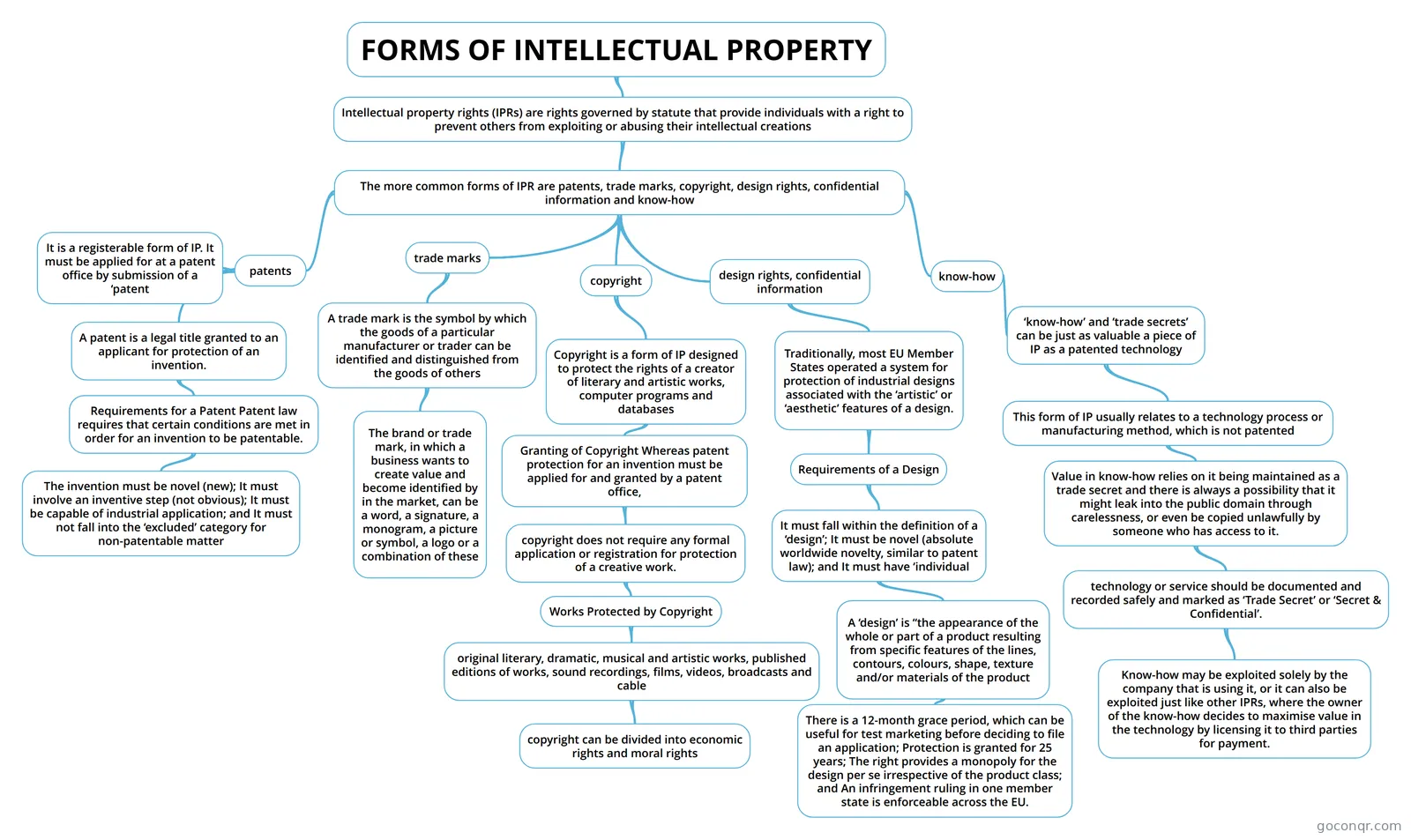
Mind map: Forms of intellectual property
Map content
FORMS OF INTELLECTUAL PROPERTY
Intellectual property rights (IPRs) are rights governed by statute that provide individuals with a right to prevent others from exploiting or abusing their intellectual creations
- The more common forms of IPR are patents, trade marks, copyright, design rights, confidential information and know-how
- patents
- A patent is a legal title granted to an applicant for protection of an invention.
- Requirements for a Patent Patent law requires that certain conditions are met in order for an invention to be patentable.
- The invention must be novel (new); It must involve an inventive step (not obvious); It must be capable of industrial application; and It must not fall into the ‘excluded’ category for non-patentable matter
- Requirements for a Patent Patent law requires that certain conditions are met in order for an invention to be patentable.
- It is a registerable form of IP. It must be applied for at a patent office by submission of a ‘patent
- A patent is a legal title granted to an applicant for protection of an invention.
- trade marks
- A trade mark is the symbol by which the goods of a particular manufacturer or trader can be identified and distinguished from the goods of others
- The brand or trade mark, in which a business wants to create value and become identified by in the market, can be a word, a signature, a monogram, a picture or symbol, a logo or a combination of these
- A trade mark is the symbol by which the goods of a particular manufacturer or trader can be identified and distinguished from the goods of others
- copyright
- Copyright is a form of IP designed to protect the rights of a creator of literary and artistic works, computer programs and databases
- Granting of Copyright Whereas patent protection for an invention must be applied for and granted by a patent office,
- copyright does not require any formal application or registration for protection of a creative work.
- Works Protected by Copyright
- original literary, dramatic, musical and artistic works, published editions of works, sound recordings, films, videos, broadcasts and cable
- copyright can be divided into economic rights and moral rights
- original literary, dramatic, musical and artistic works, published editions of works, sound recordings, films, videos, broadcasts and cable
- Works Protected by Copyright
- copyright does not require any formal application or registration for protection of a creative work.
- Granting of Copyright Whereas patent protection for an invention must be applied for and granted by a patent office,
- Copyright is a form of IP designed to protect the rights of a creator of literary and artistic works, computer programs and databases
- design rights, confidential information
- Traditionally, most EU Member States operated a system for protection of industrial designs associated with the ‘artistic’ or ‘aesthetic’ features of a design.
- Requirements of a Design
- It must fall within the definition of a ‘design’; It must be novel (absolute worldwide novelty, similar to patent law); and It must have ‘individual
- A ‘design’ is “the appearance of the whole or part of a product resulting from specific features of the lines, contours, colours, shape, texture and/or materials of the product
- There is a 12-month grace period, which can be useful for test marketing before deciding to file an application; Protection is granted for 25 years; The right provides a monopoly for the design per se irrespective of the product class; and An infringement ruling in one member state is enforceable across the EU.
- A ‘design’ is “the appearance of the whole or part of a product resulting from specific features of the lines, contours, colours, shape, texture and/or materials of the product
- It must fall within the definition of a ‘design’; It must be novel (absolute worldwide novelty, similar to patent law); and It must have ‘individual
- Requirements of a Design
- Traditionally, most EU Member States operated a system for protection of industrial designs associated with the ‘artistic’ or ‘aesthetic’ features of a design.
- know-how
- ‘know-how’ and ‘trade secrets’ can be just as valuable a piece of IP as a patented technology
- This form of IP usually relates to a technology process or manufacturing method, which is not patented
- Value in know-how relies on it being maintained as a trade secret and there is always a possibility that it might leak into the public domain through carelessness, or even be copied unlawfully by someone who has access to it.
- technology or service should be documented and recorded safely and marked as ‘Trade Secret’ or ‘Secret & Confidential’.
- Know-how may be exploited solely by the company that is using it, or it can also be exploited just like other IPRs, where the owner of the know-how decides to maximise value in the technology by licensing it to third parties for payment.
- technology or service should be documented and recorded safely and marked as ‘Trade Secret’ or ‘Secret & Confidential’.
- Value in know-how relies on it being maintained as a trade secret and there is always a possibility that it might leak into the public domain through carelessness, or even be copied unlawfully by someone who has access to it.
- This form of IP usually relates to a technology process or manufacturing method, which is not patented
- ‘know-how’ and ‘trade secrets’ can be just as valuable a piece of IP as a patented technology
- patents
- The more common forms of IPR are patents, trade marks, copyright, design rights, confidential information and know-how
Information
- Description
- Mind Map on FORMS OF INTELLECTUAL PROPERTY, created by Jonathan Guerrero on 07/03/2020.
- Created by
- Jonathan Guerrero
- Views
- 2
- Rating
More on Types of Intellectual Property