
Mind map
SYNTAX
Map content
SYNTAX
Syntax rules tell us how words form groups and are hierarchically ordered in a sentence.
- 3. GENERATIVE GRAMMAR
- Is a set of formal rules used to generate or define the membership of an infinite set of grammatical sentences in a language.
- -Syntactic Structure
- -- The grammar will generate all the well-formed syntactic structures
- -- We have a limited number of rules that helps us to generate an infinitive number of well-formed sentences.
- --Deep and surface structure
- -- I cooked Tacos -- Tacos were cooked by me.
- They have a surface form because one is passive and the other is active, but in the case of deep structure they actually have the same idea.
- -- I cooked Tacos -- Tacos were cooked by me.
- --Sentences structures
- --We could say that the sentence “The cat ate the food” is based on the template Det—N—V—Det—N
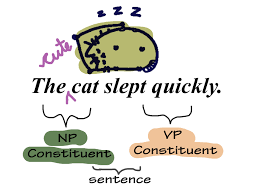
- --This sentence can actually be separated into several groups: [[The] [cat]] [[ate] [[the] [food]]
- --We could say that the sentence “The cat ate the food” is based on the template Det—N—V—Det—N
- 4. CONSTITUENTS AND CONSTITUENCY TESTS
- 1. Stand-alone test 2. Replacement 3. Movement test 4. Ellipsis / Deletion (for verbs) 5. Coordination/ Conjunction 6. Modification
- 6. THREE DIAGRAMS
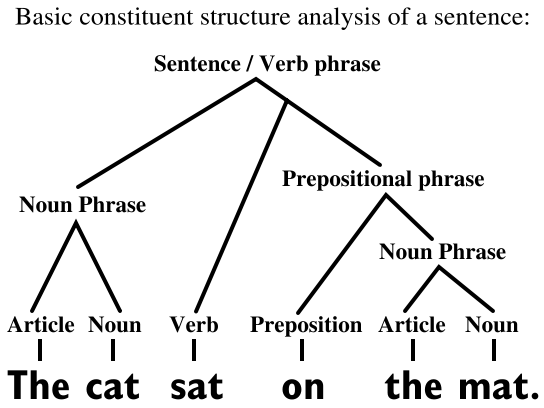
- --A tree diagram is a way of representing the hierarchical nature of a structure in a graphical form.
- •This tree is formed using the following rules: S-NP VP NP-Det N VP -V NP
- •Recursive rules are rules in which a phrasal category can contain itself
- •Such as an NP containing another NP or a VP containing a VP ETC. •Recursive rules allow a grammar to generate an infinite number of sentences
- •Recursive rules are rules in which a phrasal category can contain itself
- •This tree is formed using the following rules: S-NP VP NP-Det N VP -V NP
- --A tree diagram is a way of representing the hierarchical nature of a structure in a graphical form.
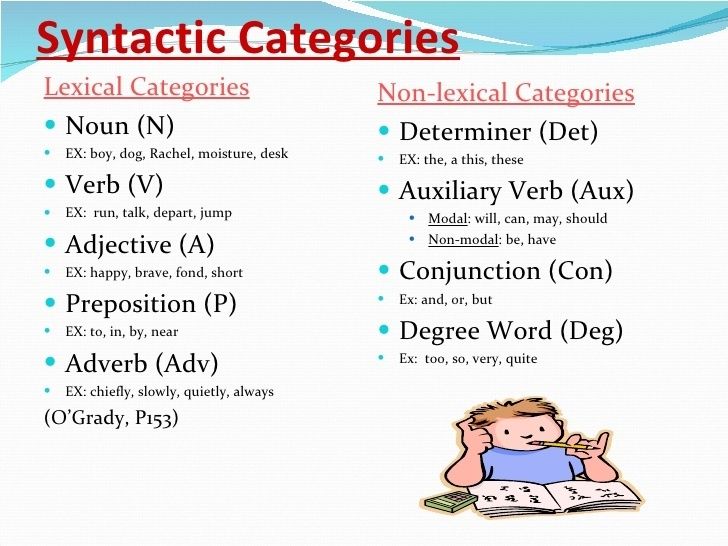
- 5. SYNTACTIC CATEGORIES
- is a family of expressions that can substitute for one another without loss of grammaticality.
- Example: The dog sat on the floor. All the phrases that are immerging in a noun phrase it is consider a family of expressions. It means that “the dog” can be replaced from another noun phrase.
- We have three different kinds of categories in Syntax:
- --Phrasal categories: NP, VP, PP, AP, Adv P --Lexical categories: Noun, Verb, Preposition, Adjective, Adverb --Functional categories: Auxiliary verbs and Determiners.
- We have three different kinds of categories in Syntax:
- Example: The dog sat on the floor. All the phrases that are immerging in a noun phrase it is consider a family of expressions. It means that “the dog” can be replaced from another noun phrase.
- is a family of expressions that can substitute for one another without loss of grammaticality.
- 3. GENERATIVE GRAMMAR
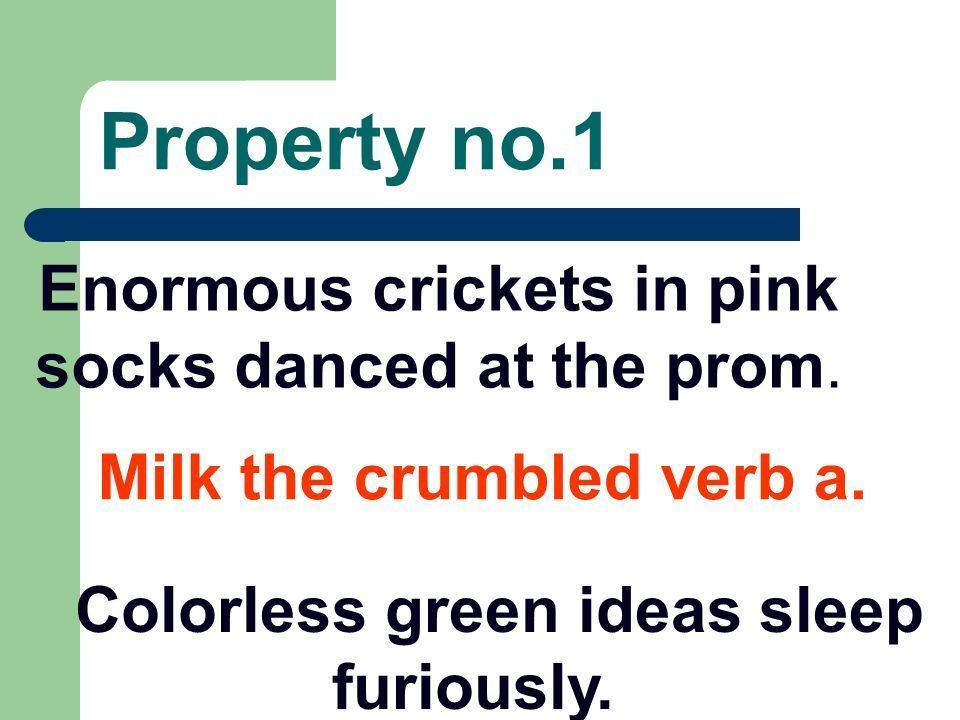
2. WHAT GRAMMATICALITY IS NOT BASED ON
- -- Meaningfulness
- You can judge a sentence even if a sentence you have not heard before thanks to the grammatical rules.
- -- Truthfulness
- You can determine if the sentence is ok or not even if it is the first time listening this sentence. Grammar is not based on meaning something can be untruth, but this is grammatical correct.
- -- Meaningfulness
1. WHAT THE SYNTAX RULES DO
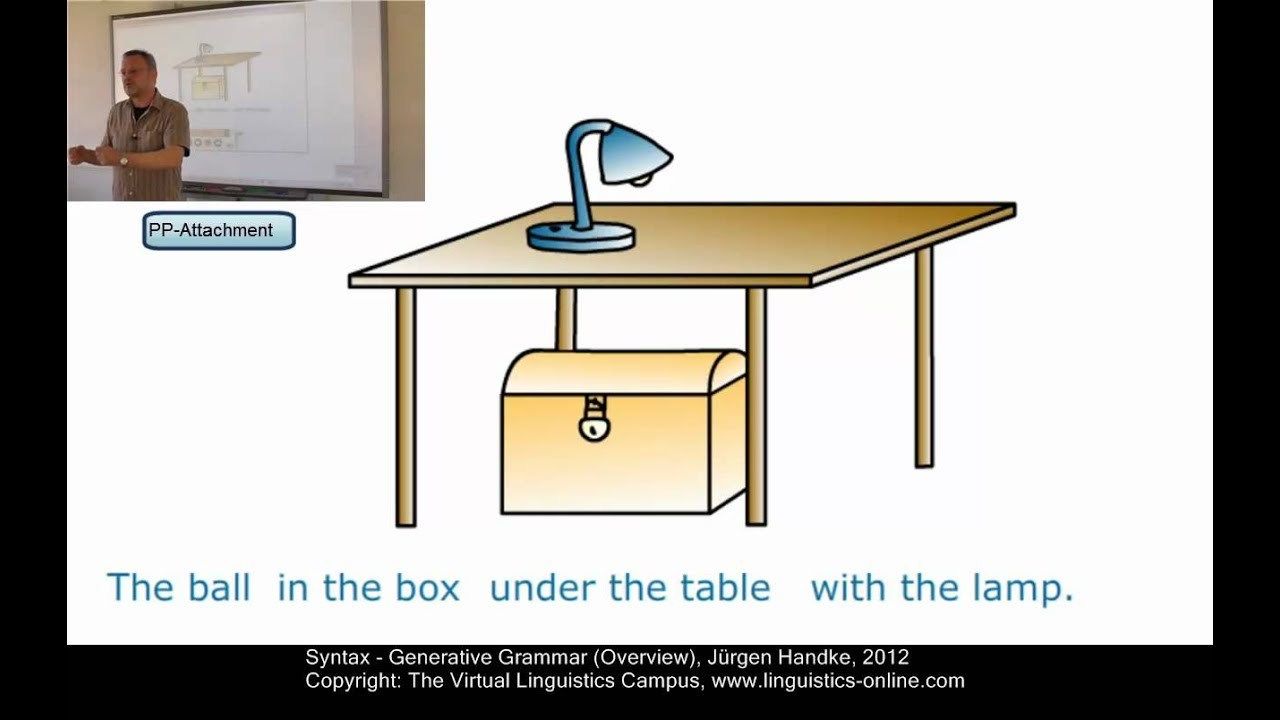
- --Structurally ambiguous sentences can often be humorous.
- Sentences can have double interpretation, sometimes it can be due to grammatical punctuation, but in other cases is the idea you get.
- Ex: The cat chased the mouse until it stumbled and fell. (Which fell, the cat or the mouse?)
- Sentences can have double interpretation, sometimes it can be due to grammatical punctuation, but in other cases is the idea you get.
- --The meaning depends on how the words in the sentence are grouped
- Ex: The captain ordered the [old [men and women]] off the ship
- --Structurally ambiguous sentences can often be humorous.
Images and files in the map

Information
- Description
- Mind Map on SYNTAX, created by Idania Alfaro on 11/04/2020.
- Created by
- Idania Alfaro
- Views
- 15
- Rating