
Mind map
BILINGUALISM AND BILINGUAL EDUCATION
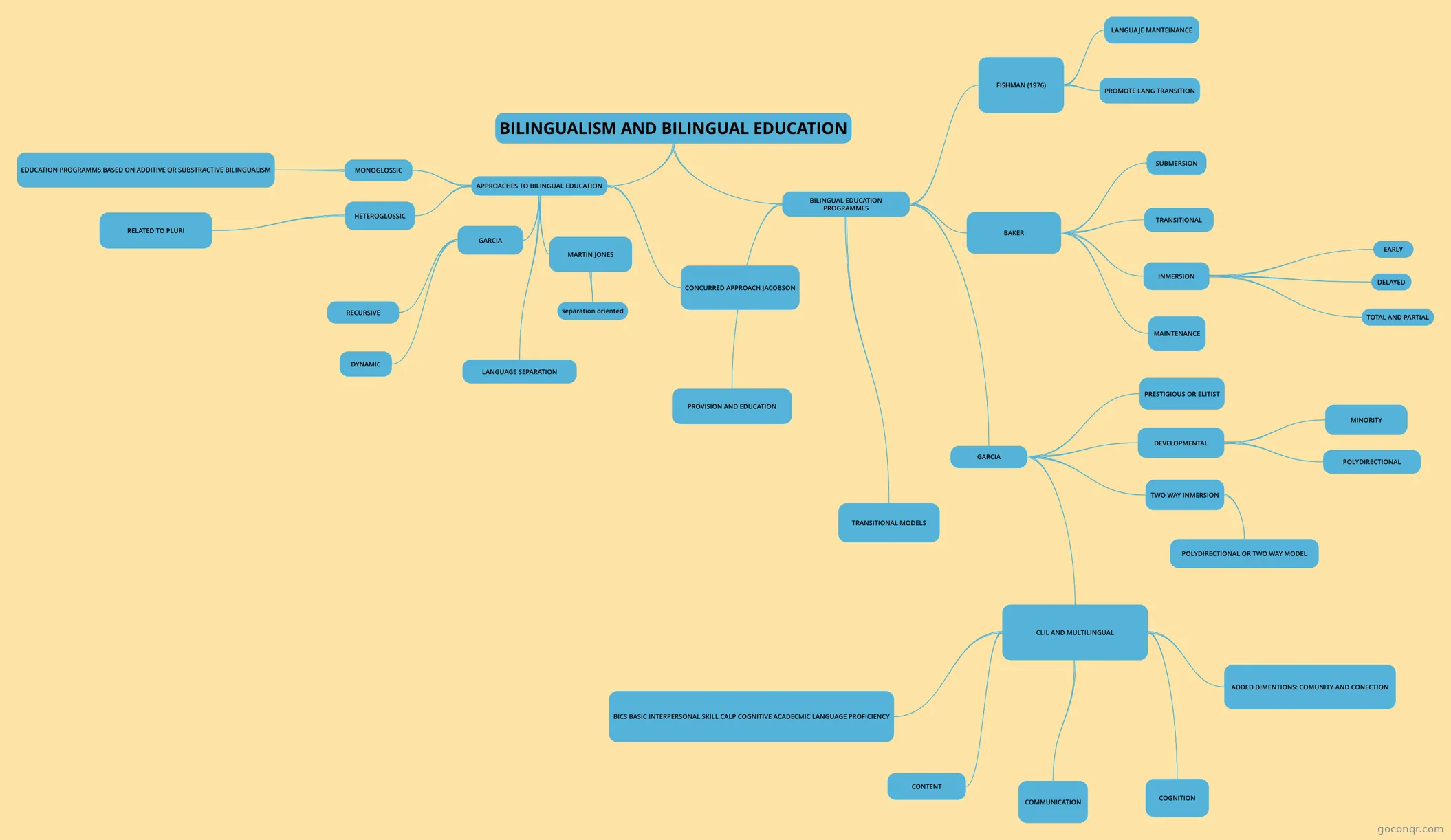
Mind map: Bilingualism and bilingual education
Map content
BILINGUALISM AND BILINGUAL EDUCATION
APPROACHES TO BILINGUAL EDUCATION
- The social context in which the different approaches and models have been developing has undergone numerous changes in the course of time.
- HETEROGLOSSIC
- heteroglossic models are related to plurilingualism and translanguaging.
- RELATED TO PLURI
- MONOGLOSSIC
- is for learners to develop proficiency in two languages from a monolingual perspective, i.e. languages are taught separately.
- EDUCATION PROGRAMMS BASED ON ADDITIVE OR SUBSTRACTIVE BILINGUALISM
- GARCIA
- RECURSIVE
- bilingualism is developed after the language practices of a community have been suppressed
- DYNAMIC
- is related to multilingual practices in which languages, on a plurilingual basis, are used for distinct purposes. It refers to the learner’s varying degrees of abilities as well as to uses of multiple language practices which aim at people being functional regarding global understanding and intercultural communication.
- RECURSIVE
- MARTIN JONES
- separation oriented
- Languages can be separated according to topic, person, time and place, different languages can be used as media of instruction on different days of the week or at different times of the day
- separation oriented
- CONCURRED APPROACH JACOBSON
- MULTILINGUALISM ORIENTED multiple languages in the same classroom
- LANGUAGE SEPARATION
- Allocating different languages to different contexts can be related to the argument usually found in sociolinguistic research that ‘for a minority language to survive, it must have separate and distinct uses in society’
BILINGUAL EDUCATION PROGRAMMES
- The different models of bilingual education are related to a number of variables. aim to promote different degrees of bilingualism among students.
- FISHMAN (1976)
- LANGUAJE MANTEINANCE
- INCLUDE EDUC PROGRAMMES IN TWO DIFF LANG AND THE MAIN GOAL IS LANGUAJE MANTEINANCE AND DEVELOPMENT OF THE LEARNERS L1 AND CULTURAL IDENTITY
- PROMOTE LANG TRANSITION
- LANGUAJE MANTEINANCE
- BAKER
- SUBMERSION
- the instruction is carried out in a majority L2 but the students speak minority languages, the model is referred to as submersion primary goal is cultural assimilation and monolingualism subtractive language learning environments that neglect the student’s minority L1 and focus on the use and the importance of the majority language
- TRANSITIONAL
- They are subtractive-natured bilingual programmes that only make use of the child’ L1 during the first years while he or she is learning the L2 or the environmental majority language. They are usually temporary and bring about permanent monolingualism. They are addressed to migrants and their primary goal is using L1 with a view to facilitating access to L2 or the language of the host country
- INMERSION
- MOST SUCCESFUL A programme where linguistic majority children with a high-status mother tongue voluntarily choose (among existing alternatives) to be instructed through the medium of a foreign (minority) language
- EARLY
- CHILDREN foreignlanguage from the very beginning of their education at pre-school level.
- DELAYED
- starts at some point in elementary or primary school.
- TOTAL AND PARTIAL
- TOTAL consists in teaching up to 100% of the curriculum through the medium of a foreign language PARTIAL aforeign language of instruction is used in a percentage between 50% and 90%.
- MAINTENANCE
- The primary goal in this type of additive bilingualism programmes is try and preserve the minority language spoken at home during the acquisition process of the majority language. These models are usually based on delivering subjects in two different languages as well as on including the cultural component.
- SUBMERSION
- GARCIA
- PRESTIGIOUS OR ELITIST
- Prestigious bilingual education has traditionally been associated with the idea of language as cultural or symbolic capital to be used on the market of social interaction
- DEVELOPMENTAL
- Within the scope of additive bilingualism we can can also find ‘Heritage Language Education’ or ‘Development maintenance’ bilingual education, which offers minority language children instruction in their L1
- MINORITY
- POLYDIRECTIONAL
- TWO WAY INMERSION
- POLYDIRECTIONAL OR TWO WAY MODEL
- created to build on linguistic heterogeneity of different social contexts. This question of heterogeneity has to do with the presence in schools of students with different language profiles, who have to develop different language practices because of the multilingualism of their social context.
- POLYDIRECTIONAL OR TWO WAY MODEL
- CLIL AND MULTILINGUAL
- CLIL models typically consist in teaching and learning curricular content through CLIL refers to any dual-focused educational programme in which an additional language is used as a medium in the teaching and learning of non-language content. CLIL is based on language acquisition rather than on language learning
- CONTENT
- COMMUNICATION
- COGNITION
- ADDED DIMENTIONS: COMUNITY AND CONECTION
- BICS BASIC INTERPERSONAL SKILL CALP COGNITIVE ACADECMIC LANGUAGE PROFICIENCY
- PRESTIGIOUS OR ELITIST
- TRANSITIONAL MODELS
- PROVISION AND EDUCATION
- supports the consideration of bilinguals as an integrated whole rather than the sum of two separate monolinguals in one person
Information
- Description
- Mind Map on BILINGUALISM AND BILINGUAL EDUCATION, created by Jazmin Maria on 13/04/2020.
- Created by
- Jazmin Maria
- Views
- 0
- Rating
More on Bilingual Education Models and Programmes