
Mind map
SAB4_#128 #129 Perform Quality Risk Analysis
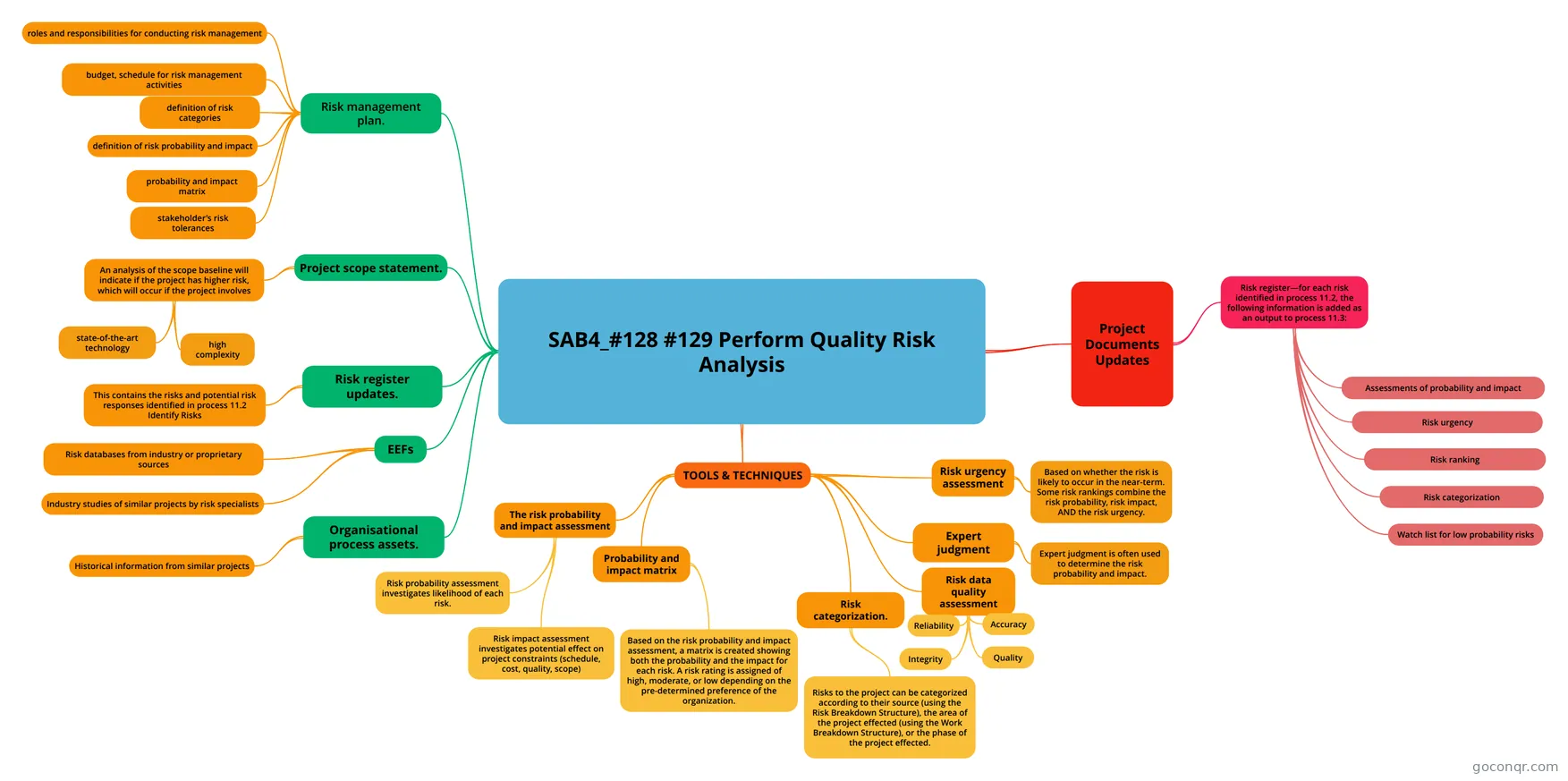
Mind map: Perform Qualitative Risk Analysis
Map content
SAB4_#128 #129 Perform Quality Risk Analysis
- The main inputs comes from the risk management plan, the framework set up as part of process 11.1 for all risk management activities on the project, and the risk register, which contains the output of the last process. At this stage, the risk register contains a list of the identified risks and possibly some potential risk responses (although these will be fully developed in the last planning process for risk management, process 11.5 Plan Risk Responses).
Risk management plan.
- Because this is in affect a risk management strategy document for the project, it will clarify the overall approach that needs to be taken to risk management on this particular project as well as stating how much risk is acceptable and who should be involved in carrying out the qualitative risk analysis of the project risks.
- probability and impact matrix
- roles and responsibilities for conducting risk management
- budget, schedule for risk management activities
- definition of risk categories
- definition of risk probability and impact
- stakeholder’s risk tolerances
Project scope statement.
- This key document describes both the project and product deliverables along with the objectives of the project and to the requirements, along with the constraints and assumptions. When it was first created within the define scope process, it also included all the identified risks known at that time, and these will be used along with the other information within this document for qualitative risk analysis.
- An analysis of the scope baseline will indicate if the project has higher risk, which will occur if the project involves
- high complexity
- state-of-the-art technology
Risk register updates.
- This is the only output from this process. Prior to qualitative risk analysis, the risk register contains a list of all of the risks, but now extra information can be added to the risk register including the priority of urgency of each risk, their categorisation and any trends of have been observed while carrying out this process.
- This contains the risks and potential risk responses identified in process 11.2 Identify Risks
Organisational process assets.
- These will include aspects such as tools to help carry out qualitative risk analysis, policies, procedures and guidelines for risk management, and historical information including lessons learned from previous similar projects.
- Historical information from similar projects
EEFs
- Industry studies of similar projects by risk specialists
- Risk databases from industry or proprietary sources
TOOLS & TECHNIQUES
- The main tool is taking each risk identified in the last process and assessing the risk probability, the risk impact, and for some organizations, the risk urgency. These two or three factors are then combined in a matrix, the risk probability and impact matrix, which will the risk rating for each risk. This risk rating is taken from the product of the probability, the impact, and possibly the urgency of the project. Usually, these three factors are measured on a scale from 0 to 1.0 or from 0 to 10. The purpose of this ranking of the risks is so that they can be grouped as a low, moderate, or high-level risk. The purpose of this grouping is to figure out the general approach to the risks: will they be avoided, mitigated, transferred, or accepted in the case of negative risks (threats), or will they be exploited, enhanced, shared, or accepted in the case of positive risks (opportunities)?
- Risk categorization.
- The risk breakdown structure (RBS) is the normal way to help structure and organize all identified risks into appropriate categories, and these will assist in determining which aspects of the project have the highest degree of uncertainty.
- Risks to the project can be categorized according to their source (using the Risk Breakdown Structure), the area of the project effected (using the Work Breakdown Structure), or the phase of the project effected.
- Probability and impact matrix
- Based on the risk probability and impact assessment, a matrix is created showing both the probability and the impact for each risk. A risk rating is assigned of high, moderate, or low depending on the pre-determined preference of the organization.
- Sometimes, the low risks are put in a watch list for further monitoring during the course of the project
- Based on the risk probability and impact assessment, a matrix is created showing both the probability and the impact for each risk. A risk rating is assigned of high, moderate, or low depending on the pre-determined preference of the organization.
- Risk data quality assessment
- This tool or technique evaluates the risk data to objectively determine whether it is accurate and of acceptable quality. For example if the data used to determine the risk of developing a piece of software, then the sources of such data (such as the number of times that rework was required), should be re-evaluated to determine if it was sufficient to estimate that particular risk’s probability of occurring and its impact.
- Integrity
- Quality
- Reliability
- Accuracy
- Risk urgency assessment
- This refers to when the risks are likely to happen and is sometimes called proximity. Such urgent risks require an immediate attention and action as they are likely to occur in the immediate future. Some form of agreed and recognized time scale should be used here.
- Based on whether the risk is likely to occur in the near-term. Some risk rankings combine the risk probability, risk impact, AND the risk urgency.
- The risk probability and impact assessment
- These two tools and techniques assist in determining what the highest priorities should be by the evaluation of the likelihood of each risk occurring, and its potential impact on the project. Both the likelihood and impact are given a ranking category such as low, low to medium, medium, medium to high, and high. These may be accompanied by a numeric evaluation, in this case 1 to 5. Probability and impact for each risk is multiplied together to give it an individual risk score which is then used to determine and set the risk priority within qualitative risk analysis.
- Risk probability assessment investigates likelihood of each risk.
- Risk impact assessment investigates potential effect on project constraints (schedule, cost, quality, scope)
- Expert judgment
- This could come from the project manager or the team, or external to the project or the performing organization. It should be used whenever sufficient knowledge, skills, experience or expertise is needed. In this case expert judgement would relate to knowledge of typical risks for this project, or experience of probability and impact for particular risks.
- Expert judgment is often used to determine the risk probability and impact.
Project Documents Updates
- As with all of the risk management planning processes, the risk register is a place where the risks identified in process 11.2 will have more and more information attached to them in the course of processes 11.3-11.5. In the case of this process 11.3, Perform Qualitative Risk Analysis, the risk categorization (what is the source of the risk, what activities on the project is it most associated with, etc.), and the risk probability, impact, and urgency, and then their combination in the risk probability and impact matrix, are the important additions to the risk register.
- Risk register—for each risk identified in process 11.2, the following information is added as an output to process 11.3:
- Watch list for low probability risks
- Risk urgency
- Assessments of probability and impact
- Risk ranking
- Risk categorization
Information
- Description
- Mind Map on SAB4_#128 #129 Perform Quality Risk Analysis, created by gustavosotop on 14/03/2015.
- Created by
- gustavosotop
- Views
- 16
- Rating
More on Qualitative and Quantitative Risk Analysis