
Mind map
Qualitative Case Study Methodology: Study Design and Implementation for Novice Researchers
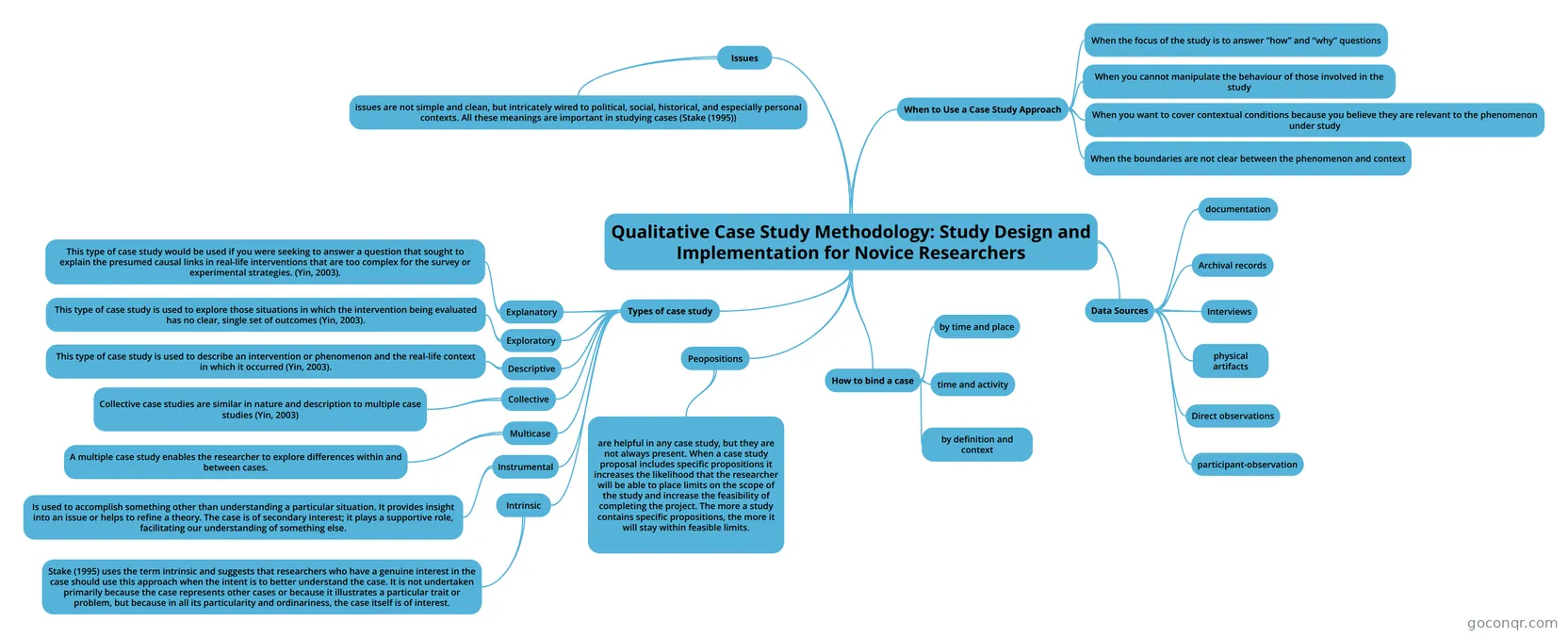
Mind map: Qualitative case study methodology
Map content
Qualitative Case Study Methodology: Study Design and Implementation for Novice Researchers
When to Use a Case Study Approach
- When the focus of the study is to answer “how” and “why” questions
- When you cannot manipulate the behaviour of those involved in the study
- When you want to cover contextual conditions because you believe they are relevant to the phenomenon under study
- When the boundaries are not clear between the phenomenon and context
How to bind a case
- by time and place
- time and activity
- by definition and context
Types of case study
- Explanatory
- This type of case study would be used if you were seeking to answer a question that sought to explain the presumed causal links in real-life interventions that are too complex for the survey or experimental strategies. (Yin, 2003).
- Exploratory
- This type of case study is used to explore those situations in which the intervention being evaluated has no clear, single set of outcomes (Yin, 2003).
- Descriptive
- This type of case study is used to describe an intervention or phenomenon and the real-life context in which it occurred (Yin, 2003).
- Multicase
- A multiple case study enables the researcher to explore differences within and between cases.
- Intrinsic
- Stake (1995) uses the term intrinsic and suggests that researchers who have a genuine interest in the case should use this approach when the intent is to better understand the case. It is not undertaken primarily because the case represents other cases or because it illustrates a particular trait or problem, but because in all its particularity and ordinariness, the case itself is of interest.
- Instrumental
- Is used to accomplish something other than understanding a particular situation. It provides insight into an issue or helps to refine a theory. The case is of secondary interest; it plays a supportive role, facilitating our understanding of something else.
- Collective
- Collective case studies are similar in nature and description to multiple case studies (Yin, 2003)
- Explanatory
Peopositions
- are helpful in any case study, but they are not always present. When a case study proposal includes specific propositions it increases the likelihood that the researcher will be able to place limits on the scope of the study and increase the feasibility of completing the project. The more a study contains specific propositions, the more it will stay within feasible limits.
Issues
- issues are not simple and clean, but intricately wired to political, social, historical, and especially personal contexts. All these meanings are important in studying cases (Stake (1995))
Data Sources
- documentation
- Archival records
- Interviews
- physical artifacts
- Direct observations
- participant-observation
Information
- Description
- Mind Map on Qualitative Case Study Methodology: Study Design and Implementation for Novice Researchers, created by Yeison Andres on 12/05/2020.
- Created by
- Yeison Andres
- Views
- 4
- Rating