
Mind map
Study Design and Implementation for Novice Researchers
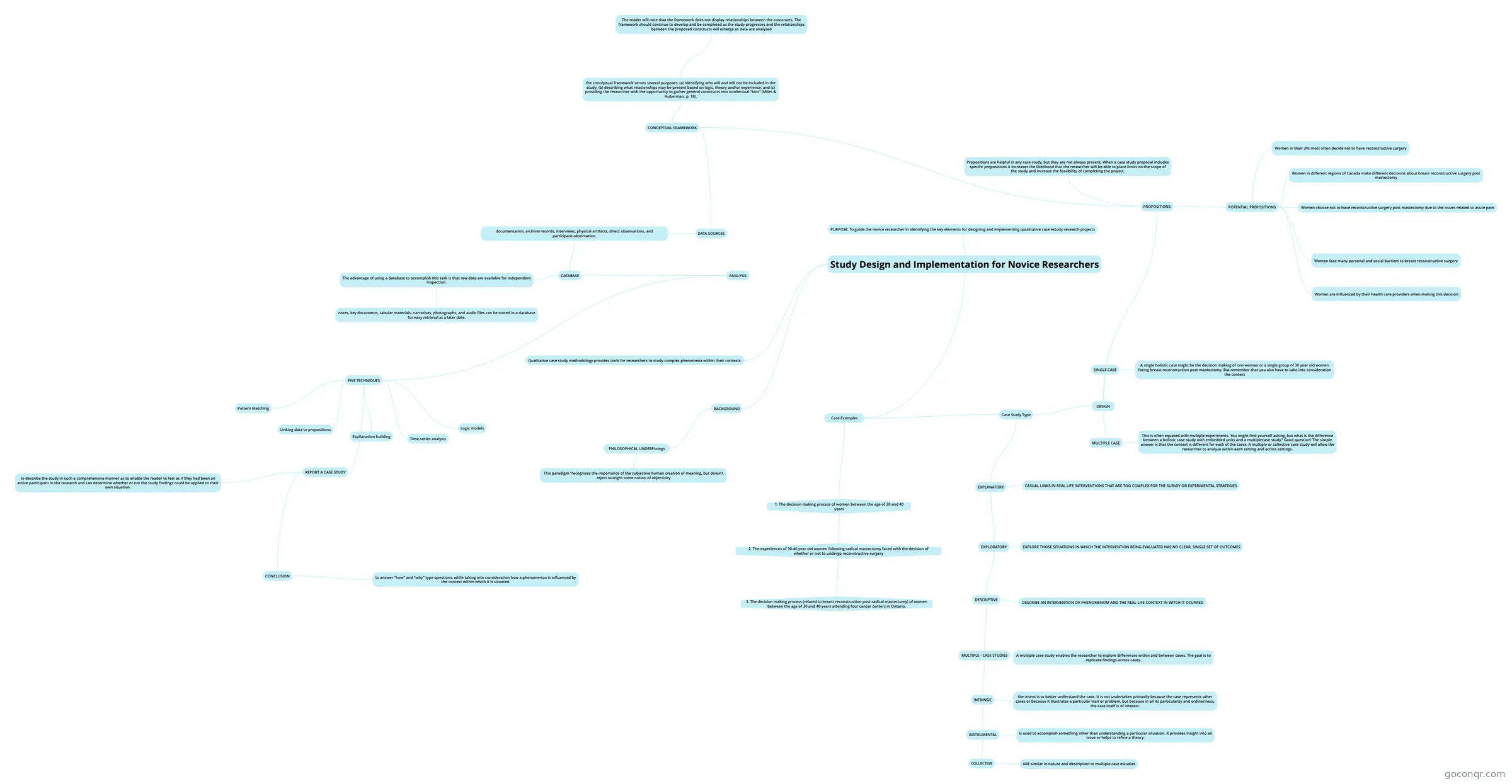
Mind map: Study design and implementation for novice researchers
Map content
Study Design and Implementation for Novice Researchers
Qualitative case study methodology provides tools for researchers to study complex phenomena within their contexts.
PURPOSE: To guide the novice researcher in identifying the key elements for designing and implementing quialitative case estudy research projects
BACKGROUND
- PHILOSOPHICAL UNDERPInings
- This paradigm “recognizes the importance of the subjective human creation of meaning, but doesn’t reject outright some notion of objectivity
- PHILOSOPHICAL UNDERPInings
Case Examples
- 1. The decision making process of women between the age of 30 and 40 years
- 2. The experiences of 30-40 year old women following radical mastectomy faced with the decision of whether or not to undergo reconstructive surgery
- 3. The decision making process (related to breast reconstruction post-radical mastectomy) of women between the age of 30 and 40 years attending four cancer centers in Ontario.
- 2. The experiences of 30-40 year old women following radical mastectomy faced with the decision of whether or not to undergo reconstructive surgery
- Case Study Type
- EXPLANATORY
- CASUAL LINKS IN REAL LIFE INTERVENTIONS THAT ARE TOO COMPLEX FOR THE SURVEY OR EXPERIMENTAL STRATEGIES
- EXPLORATORY
- EXPLORE THOSE SITUATIONS IN WHICH THE INTERVENTION BEING EVALUATED HAS NO CLEAR, SINGLE SET OF OUTCOMES
- DESCRIPTIVE
- DESCRIBE AN INTERVENTION OR PHENOMENOM AND THE REAL-LIFE CONTEXT IN WITCH IT OCURRED
- MULTIPLE - CASE STUDIES
- A multiple case study enables the researcher to explore differences within and between cases. The goal is to replicate findings across cases.
- INTRINSIC
- the intent is to better understand the case. It is not undertaken primarily because the case represents other cases or because it illustrates a particular trait or problem, but because in all its particularity and ordinariness, the case itself is of interest.
- INSTRUMENTAL
- Is used to accomplish something other than understanding a particular situation. It provides insight into an issue or helps to refine a theory.
- COLLECTIVE
- ARE similar in nature and description to multiple case estudies
- DESIGN
- SINGLE CASE
- A single holistic case might be the decision making of one woman or a single group of 30 year old women facing breast reconstruction post-mastectomy. But remember that you also have to take into consideration the context
- MULTIPLE CASE
- This is often equated with multiple experiments. You might find yourself asking, but what is the difference between a holistic case study with embedded units and a multiplecase study? Good question! The simple answer is that the context is different for each of the cases. A multiple or collective case study will allow the researcher to analyze within each setting and across settings.
- PROPOSITIONS
- Propositions are helpful in any case study, but they are not always present. When a case study proposal includes specific propositions it increases the likelihood that the researcher will be able to place limits on the scope of the study and increase the feasibility of completing the project.
- POTENTIAL PREPOSITIONS
- Women in their 30s most often decide not to have reconstructive surgery
- Women choose not to have reconstructive surgery post mastectomy due to the issues related to acute pain
- Women face many personal and social barriers to breast reconstructive surgery
- Women are influenced by their health care providers when making this decision
- Women in different regions of Canada make different decisions about breast reconstructive surgery post mastectomy
- CONCEPTUAL FRAMEWORK
- the conceptual framework serves several purposes: (a) identifying who will and will not be included in the study; (b) describing what relationships may be present based on logic, theory and/or experience; and (c) providing the researcher with the opportunity to gather general constructs into intellectual “bins” (Miles & Huberman, p. 18).
- The reader will note that the framework does not display relationships between the constructs. The framework should continue to develop and be completed as the study progresses and the relationships between the proposed constructs will emerge as data are analyzed
- DATA SOURCES
- documentation, archival records, interviews, physical artifacts, direct observations, and participant-observation.
- DATABASE
- The advantage of using a database to accomplish this task is that raw data are available for independent inspection.
- notes, key documents, tabular materials, narratives, photographs, and audio files can be stored in a database for easy retrieval at a later date.
- ANALYSIS
- FIVE TECHNIQUES
- Pattern Matching
- Linking data to propositions
- Expllanation building
- Time-series analysis
- Logic models
- REPORT A CASE STUDY
- to describe the study in such a comprehensive manner as to enable the reader to feel as if they had been an active participant in the research and can determine whether or not the study findings could be applied to their own situation.
- CONCLUSION
- to answer “how” and “why” type questions, while taking into consideration how a phenomenon is influenced by the context within which it is situated.
- FIVE TECHNIQUES
- The advantage of using a database to accomplish this task is that raw data are available for independent inspection.
- DATABASE
- documentation, archival records, interviews, physical artifacts, direct observations, and participant-observation.
- the conceptual framework serves several purposes: (a) identifying who will and will not be included in the study; (b) describing what relationships may be present based on logic, theory and/or experience; and (c) providing the researcher with the opportunity to gather general constructs into intellectual “bins” (Miles & Huberman, p. 18).
- SINGLE CASE
- EXPLANATORY
- 1. The decision making process of women between the age of 30 and 40 years
Information
- Description
- Mind Map on Study Design and Implementation for Novice Researchers, created by German Rodiguez on 13/05/2020.
- Created by
- German Rodiguez
- Views
- 0
- Rating