
Mind map
THE TRIGONOMETRIC CIRCLE
Map content
THE TRIGONOMETRIC CIRCLE
It is a circle that coincides with the origin of the Cartesian plane,with this circle you can obtain the trigonometric ratios for determine angles
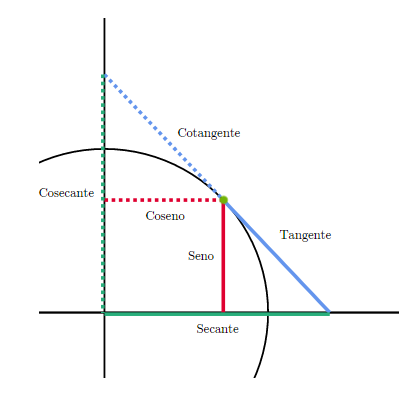
- Cosine of angle a: from the angle a and r the point p is obtained and it is done towards the x axis
- Sine of angle a: it is the same as cosine only it is towards the y-axis
- Tangent of angle a: a ray EC is drawn tangent to the circumference by the point E that touches the ray OD the segment EC is formed
- Tangent of angle a: a ray EC is drawn tangent to the circumference by the point E that touches the ray OD the segment EC is formed
- Sine of angle a: it is the same as cosine only it is towards the y-axis
- FIRST QUADRANT: sing parameter sine + cosine + tangent + cotangent
- SECOND QUADRANT: parameter sign sine + cosine - tangent - cotangent
- THIRD QUADRANT: parameter sign sine - cosine - tangent + cotangent
- FOURTH QUADRANT: parameters sign sine - cosine + tangent - cotangent
- FOURTH QUADRANT: parameters sign sine - cosine + tangent - cotangent
- THIRD QUADRANT: parameter sign sine - cosine - tangent + cotangent
- SECOND QUADRANT: parameter sign sine + cosine - tangent - cotangent
- Cosine of angle a: from the angle a and r the point p is obtained and it is done towards the x axis
ANGLE IN NOrMAL POSITION
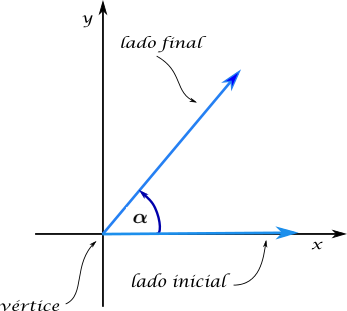
- It is said to be in a normal position because they have a rectangular coordinate system, the angles have a vertex at the origin of the coordinate system and a positive ray on the x axis
- It is said to be in a normal position because they have a rectangular coordinate system, the angles have a vertex at the origin of the coordinate system and a positive ray on the x axis
Trigonometric functions of a point in the trigonometric circle
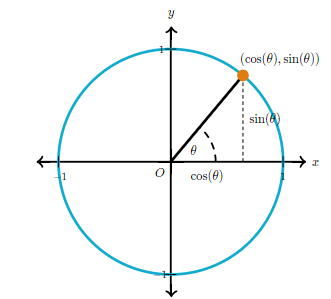
- allows us to extend the domain of sine and cosine to all real numbers. The process to determine the sine or cosine for any thetaθtheta angle is as follows:
- 1- Starting at (1,0) (1,0) left parenthesis, 1, comma, 0, right parenthesis, we move along the circle in a counter-clockwise direction until the angle between your position, origin and X positive axis equals thetaθtheta.
- 2-sin(θ)sine, paréntesis izquierdo, theta, paréntesis derecho es igual a la coordenada Y de tu punto, y cos(theta) cos(θ)cosine, paréntesis izquierdo, igual theta, paréntesis derecho es a la coordenada X.
- 2-sin(θ)sine, paréntesis izquierdo, theta, paréntesis derecho es igual a la coordenada Y de tu punto, y cos(theta) cos(θ)cosine, paréntesis izquierdo, igual theta, paréntesis derecho es a la coordenada X.
- Appendix: all trigonometric reasons in the unit circle, use the movable point to see how the lengths of the ratios change according to the angle
- 1- Starting at (1,0) (1,0) left parenthesis, 1, comma, 0, right parenthesis, we move along the circle in a counter-clockwise direction until the angle between your position, origin and X positive axis equals thetaθtheta.
- allows us to extend the domain of sine and cosine to all real numbers. The process to determine the sine or cosine for any thetaθtheta angle is as follows:
Coterminal angles
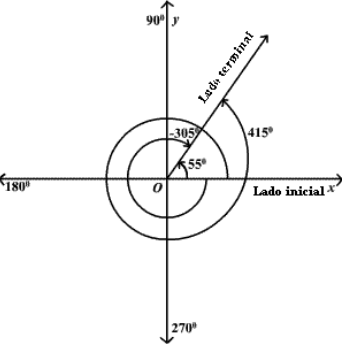
- Coterminal angles are standard position angles. In other words, two or more angles are coterminal when they have the same starting side and the same ending side.
- The difference between two to more coterminal angles is the number of turns on the starting side. To find a positive coterminal angle and a negative coterminal angle with a given angle, you can add and subtract 360 ° if the angle is measured in degrees or 2π if the angle is measured in radians.
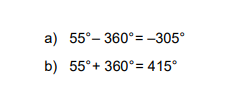
- find a positive coterminal angle and a negative coterminal angle with a 55 degree angle
- An angle of -365 degrees and an angle of 415 degrees are coterminal with an angle of 55 degrees.
- find a positive coterminal angle and a negative coterminal angle with a 55 degree angle
- The difference between two to more coterminal angles is the number of turns on the starting side. To find a positive coterminal angle and a negative coterminal angle with a given angle, you can add and subtract 360 ° if the angle is measured in degrees or 2π if the angle is measured in radians.
- Coterminal angles are standard position angles. In other words, two or more angles are coterminal when they have the same starting side and the same ending side.
reference angles
- To find the value of a certain trigonometric function for these angles we must use the so-called reference angle, which is formed on the terminal side of an angle, leaving the axis of the coordinates x or x, either positive or negative, and they must be less of 90 degrees, that is to say an obtuse angle, this so that from this angle we can find the value of the trigonometric functions for the angle greater than 90 degrees that we were originally asked to do.
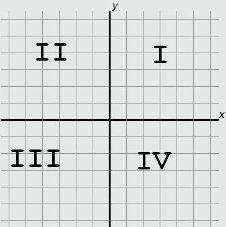
- The two axes of the Cartesian plane divide it into four parts called quadrants, which are listed counterclockwise, always starting from the positive x-axis of the xs
- I: first quadrant II: second quadrant III: third quadrant IV: fourth quadrant
- if they ask us to calculate csc210 degrees we proceed like this • We look at which quadrant 210 is in and realize that it is in the third quadrant. • We look for the reference angle for this quadrant so x r = 210 degrees minus 180
- degrees equal to 30 degrees. • This means that csc210 degrees = csc 30 degrees = -2 and it is negative because in the third quadrant the cosecant function is negative.
- if they ask us to calculate csc210 degrees we proceed like this • We look at which quadrant 210 is in and realize that it is in the third quadrant. • We look for the reference angle for this quadrant so x r = 210 degrees minus 180
- I: first quadrant II: second quadrant III: third quadrant IV: fourth quadrant
- The two axes of the Cartesian plane divide it into four parts called quadrants, which are listed counterclockwise, always starting from the positive x-axis of the xs
- To find the value of a certain trigonometric function for these angles we must use the so-called reference angle, which is formed on the terminal side of an angle, leaving the axis of the coordinates x or x, either positive or negative, and they must be less of 90 degrees, that is to say an obtuse angle, this so that from this angle we can find the value of the trigonometric functions for the angle greater than 90 degrees that we were originally asked to do.
Images and files in the map
Information
- Description
- Mind Map on THE TRIGONOMETRIC CIRCLE, created by valentina salcedo on 25/05/2020.
- Created by
- valentina salcedo
- Views
- 4
- Rating