
Mind map
Communicative Language Teaching (CLT) by Jack C. Richards, 2006
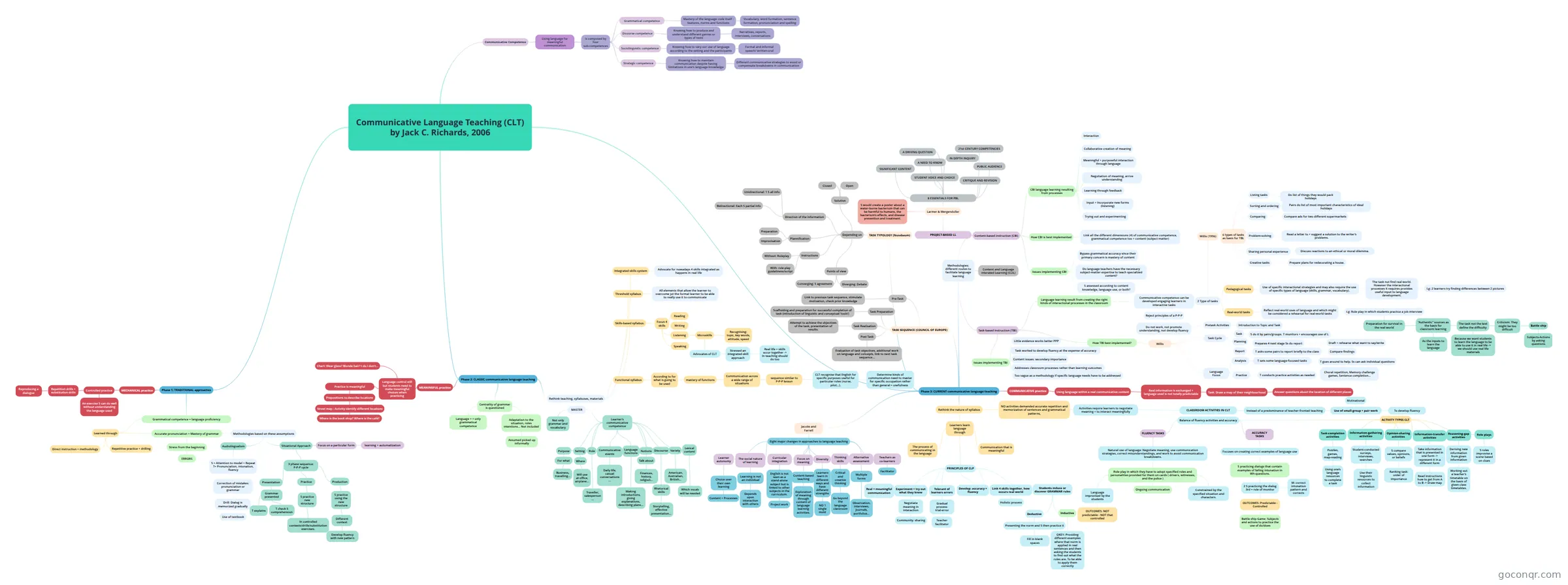
Mind map: Communicative Language Teaching by Jack C. Richards
Map content
Communicative Language Teaching (CLT) by Jack C. Richards, 2006
Phase 1: TRADITIONAL approaches
- Grammatical competence = language proficiency
- Learned through
- Direct instruction + methodology
- Repetitive practice + drilling
- Accurate pronunciation + Mastery of grammar
- Stress from the beginning
- ERRORS
- Methodologies based on these assumptions
- Audiolingualism
- S = Attention to model + Repeat T= Pronunciation, intonation, fluency
- Correction of mistakes: pronunciation or grammar
- Drill: Dialog is memorized gradually
- Use of textbook
- Drill: Dialog is memorized gradually
- Correction of mistakes: pronunciation or grammar
- S = Attention to model + Repeat T= Pronunciation, intonation, fluency
- Situational Approach
- 3 phase sequence: P-P-P cycle
- Presentation
- Grammar presented
- T explains
- T check S comprehension
- Grammar presented
- Practice
- S practice new structure
- In controlled contexts/drills/substitution exercises.
- S practice new structure
- Production
- S practice using the new structure
- Different context
- Develop fluency with new pattern
- Different context
- S practice using the new structure
- Presentation
- Focus on a particular form
- learning + automatization
- 3 phase sequence: P-P-P cycle
- Audiolingualism
- Stress from the beginning
- Learned through
- MECHANICAL practice
- Controlled practice
- An exercise S can do well without understanding the language used
- Repetition drills + substitution drills
- Reproducing a dialogue
- Controlled practice
- Grammatical competence = language proficiency
Phase 2: CLASSIC communicative language teaching
- Centrality of grammar is questioned
- Language = + only grammatical competence
- Adaptation to the situation, roles intentions... Not included
- Assumed picked up informally
- Rethink teaching, syllabuses, materials
- MASTER
- Not only grammar and vocabulary
- Learner’s communicative competence
- Purpose
- For what
- Business, travelling...
- For what
- Setting
- Where
- Will use at office, airplane...
- Where
- Role
- Traveller, salesperson ...
- Communicative events
- Daily life, casual conversations ...
- Language functions
- Making introductions, giving explanations, describing plans...
- Notions
- Talk about
- Finances, history, religion…
- Talk about
- Discourse
- Rhetorical skills
- Storytelling, effective presentation…
- Rhetorical skills
- Variety
- American, Australian, British…
- Lexical content
- Which vocab will be needed
- Purpose
- Skills-based syllabus:
- Focus 4 skills
- Reading
- Writing
- Listening
- Microskills
- Recognising: topic, key words, attitude, speed
- Advocates of CLT
- Stressed an integrated-skill approach
- Real life = skills occur together -> In teaching should do too
- Stressed an integrated-skill approach
- Microskills
- Speaking
- Focus 4 skills
- Functional syllabus
- According to for what is going to be used
- mastery of functions
- Communication across a wide range of situations
- sequence similar to P-P-P lesson
- CLT recognise that English for specific purposes useful for particular roles (nurse, pilot…).
- Determine kinds of communication need to master for specific occupation rather than general = usefulness
- CLT recognise that English for specific purposes useful for particular roles (nurse, pilot…).
- sequence similar to P-P-P lesson
- Communication across a wide range of situations
- mastery of functions
- According to for what is going to be used
- Threshold syllabus
- All elements that allow the learner to overcome jut the formal learner to be able to really use it to communicate
- Integrated skills system
- Advocate for nowadays 4 skills integrated as happens in real life
- MASTER
- MEANINGFUL practice
- Language control still but students need to make meaningful choices when practicing
- Practice is meaningful
- Prepositions to describe locations
- Street map : Activity identify different locations
- Where is the book shop? Where is the café?
- Street map : Activity identify different locations
- Prepositions to describe locations
- Chart: Wear glass? Blonde hair? I do I don't...
- Practice is meaningful
- Language control still but students need to make meaningful choices when practicing
- Centrality of grammar is questioned
Phase 3: CURRENT communicative language teaching
- Rethink the nature of syllabus
- Learners learn language through
- The process of communicating in the language
- Communication that is meaningful
- PRINCIPLES OF CLP
- Real + meaningful communication
- Experiment + try out what they know
- Negotiate meaning in interaction
- Community: sharing
- Negotiate meaning in interaction
- Tolerant of learners errors
- Gradual process: trial-error
- Teacher facilitator
- Gradual process: trial-error
- Develop: accuracy + fluency
- Link 4 skills together, how occurs real world
- Holistic process
- Students induce or discover GRAMMAR rules
- Deductive
- Presenting the norm and S then practice it
- Fill in blank spaces
- Presenting the norm and S then practice it
- Inductive
- OKEY: Providing different examples where that norm is applied in real sentences and then asking the students to find out what the rules are. To be able to apply them correctly
- Deductive
- NO activities demanded accurate repetition and memorization of sentences and grammatical patterns,
- Activities require learners to negotiate meaning + to interact meaningfully
- CLASSROOM ACTIVITIES IN CLT
- Balance of fluency activities and accuracy
- FLUENCY TASKS
- Natural use of language: Negotiate meaning, use communication strategies, correct misunderstandings, and work to avoid communication breakdowns.
- Role play in which they have to adopt specified roles and personalities provided for them on cards ( drivers, witnesses, and the police )
- Language improvised by the students
- OUTCOMES: NOT predictable - NOT that controlled
- Constrained by the specified situation and characters.
- Ongoing communication
- Language improvised by the students
- Role play in which they have to adopt specified roles and personalities provided for them on cards ( drivers, witnesses, and the police )
- Natural use of language: Negotiate meaning, use communication strategies, correct misunderstandings, and work to avoid communication breakdowns.
- ACCURACY TASKS
- Focuses on creating correct examples of language use
- S practicing dialogs that contain examples of falling intonation in Wh-questions.
- 2 S practicing the dialog 3rd = role of monitor
- M: correct intonation pattern and corrects
- OUTCOMES: Predictable - Controlled
- Battle ship Game: Subjects and actions to practice the use of do/does
- 2 S practicing the dialog 3rd = role of monitor
- S practicing dialogs that contain examples of falling intonation in Wh-questions.
- Focuses on creating correct examples of language use
- ACTIVITY TYPES CLT
- Task-completion activities
- Puzzles, games, map-reading
- Using one’s language resources to complete a task
- Puzzles, games, map-reading
- Information-gathering activities
- Student-conducted surveys, interviews, searches
- Use their linguistic resources to collect information
- Student-conducted surveys, interviews, searches
- Opinion-sharing activities
- S compare values, opinions, or beliefs
- Ranking task: order of importance
- S compare values, opinions, or beliefs
- Information-transfer activities
- Take information that is presented in one form -> represent it in a different form
- Read instructions how to get from A to B -> Draw map
- Take information that is presented in one form -> represent it in a different form
- Reasoning-gap activities
- Deriving new information from given information
- Working out a teacher’s timetable on the basis of given class timetables.
- Deriving new information from given information
- Role plays
- S roles improvise a scene based on clues
- Task-completion activities
- FLUENCY TASKS
- Instead of a predominance of teacher-fronted teaching
- Use of small-group + pair work
- To develop fluency
- Motivational
- Use of small-group + pair work
- Balance of fluency activities and accuracy
- CLASSROOM ACTIVITIES IN CLT
- Activities require learners to negotiate meaning + to interact meaningfully
- Learners learn language through
- COMMUNICATIVE practice
- Using language within a real communicative context
- Real information is exchanged + language used is not totally predictable
- Task: Draw a map of their neighbourhood
- Answer questions about the location of different places
- Task: Draw a map of their neighbourhood
- Real information is exchanged + language used is not totally predictable
- Using language within a real communicative context
- Jacobs and Farrell
- Eight major changes in approaches to language teaching
- Learner autonomy
- Choice over their own learning
- Content + Processes
- Choice over their own learning
- The social nature of learning
- Learning is not an individual
- Depends upon interaction with others
- Learning is not an individual
- Curricular integration
- English is not seen as a stand-alone subject but is linked to other subjects in the curriculum.
- Project work
- English is not seen as a stand-alone subject but is linked to other subjects in the curriculum.
- Focus on meaning
- Content-based teaching
- Exploration of meaning through content of language learning activities.
- Content-based teaching
- Diversity
- Learners learn in different ways and have different strengths
- NO 1 single mold
- Learners learn in different ways and have different strengths
- Thinking skills
- Critical and creative thinking
- Go beyond the language classroom
- Critical and creative thinking
- Alternative assessment
- Multiple forms
- Observation, interviews, journals, portfolios...
- Multiple forms
- Teachers as co-learners
- Facilitator
- Learner autonomy
- Eight major changes in approaches to language teaching
- Methodologies: different routes to facilitate language learning
- Content-based instruction (CBI)
- CBI language learning resulting from processes
- Interaction
- Collaborative creation of meaning
- Meaningful + purposeful interaction through language
- Negotiation of meaning, arrive understanding
- Learning through feedback
- Input + Incorporate new forms (listening)
- Trying out and experimenting
- Issues implementing CBI
- Bypass grammatical accuracy since their primary concern is mastery of content
- Do language teachers have the necessary subject-matter expertise to teach specialized content?
- S assessed according to content knowledge, language use, or both?
- How CBI is best implemented
- Link all the different dimensions (4) of communicative competence, grammatical competence too + content (subject matter)
- PROJECT-BASED LL
- Larmer & Mergendoller
- 8 ESSENTIALS FOR PBL
- SIGNIFICANT CONTENT
- A NEED TO KNOW
- A DRIVING QUESTION
- STUDENT VOICE AND CHOICE
- 21st CENTURY COMPETENCIES
- IN DEPTH INQUIRY
- CRITIQUE AND REVISION
- PUBLIC AUDIENCE
- S would create a poster about a water-borne bacterium that can be harmful to humans, the bacterium’s effects, and disease prevention and treatment.
- 8 ESSENTIALS FOR PBL
- Larmer & Mergendoller
- CBI language learning resulting from processes
- Task-based instruction (TBI)
- Language learning result from creating the right kinds of interactional processes in the classroom
- Communicative competence can be developed engaging learners in interactive tasks
- 2 Type of tasks
- Pedagogical tasks
- Use of specific interactional strategies and may also require the use of specific types of language (skills, grammar, vocabulary).
- The task not find real world. However the interactional processes it requires provides useful input to language development.
- I.g: 2 learners try finding differences between 2 pictures
- The task not find real world. However the interactional processes it requires provides useful input to language development.
- Use of specific interactional strategies and may also require the use of specific types of language (skills, grammar, vocabulary).
- Real-world tasks
- Reflect real-world uses of language and which might be considered a rehearsal for real-world tasks
- I.g: Role play in which students practice a job interview
- Preparation for survival in the real world
- "Authentic” sources as the basis for classroom learning
- The task not the text define the difficulty
- Because we want students to learn the language to be able to use it in real life -> we should use real life materials
- Criticism: They might be too difficult
- Battle ship
- Subjects-Actions by asking questions
- Battle ship
- As the inputs to learn the language
- The task not the text define the difficulty
- "Authentic” sources as the basis for classroom learning
- Preparation for survival in the real world
- I.g: Role play in which students practice a job interview
- Reflect real-world uses of language and which might be considered a rehearsal for real-world tasks
- Willis (1996)
- 6 types of tasks as basis for TBL
- Listing tasks
- Do list of things they would pack holidays
- Sorting and ordering
- Pairs do list of most important characteristics of ideal holidays
- Comparing
- Compare ads for two different supermarkets
- Problem-solving
- Read a letter to + suggest a solution to the writer’s problems.
- Sharing personal experience
- Discuss reactions to an ethical or moral dilemma.
- Creative tasks
- Prepare plans for redecorating a house.
- Listing tasks
- 6 types of tasks as basis for TBL
- Pedagogical tasks
- Reject principles of a P-P-P
- Do not work, not promote understanding, not develop fluency
- 2 Type of tasks
- Communicative competence can be developed engaging learners in interactive tasks
- How TBI best implemented?
- Willis
- Pretask Activities
- Introduction to Topic and Task
- Task Cycle
- Task
- S do it by pairs/groups. T monitors + encourages use of L
- Planning
- Prepares 4 next stage Ss do report
- Draft + rehearse what want to say/write
- Prepares 4 next stage Ss do report
- Report
- T asks some pairs to report briefly to the class
- Compare findings
- T asks some pairs to report briefly to the class
- Task
- Language Focus
- Analysis
- T sets some language-focused tasks
- T goes around to help. Ss can ask individual questions
- T sets some language-focused tasks
- Practice
- T conducts practice activities as needed
- Choral repetition, Memory challenge games, Sentence completion...
- T conducts practice activities as needed
- Analysis
- Pretask Activities
- Willis
- Issues implementing TBI
- Little evidence works better PPP
- Task worked to develop fluency at the expense of accuracy
- Content issues: secondary importance
- Addresses classroom processes rather than learning outcomes
- Too vague as a methodology if specific language needs have to be addressed
- Language learning result from creating the right kinds of interactional processes in the classroom
- Content and Language interated Learning (CLIL)
- Content-based instruction (CBI)
- TASK SEQUENCE (COUNCIL OF EUROPE)
- Pre-Task
- Link to previous task sequence, stimulate motivation, check prior knowledge
- Task Preparation
- Scaffolding and preparation for successful completion of task (introduction of linguistic and conceptual ‘tools’)
- Task Realisation
- Attempt to achieve the objectives of the task, presentation of results.
- Post Task
- Evaluation of task objectives, additional work on language and concepts, link to next task sequence…
- Pre-Task
- TASK TYPOLOGY (Nussbaum)
- Depending on
- Solution
- Open
- Closed
- Direction of the information
- Unidirectional: 1 S all info
- Bidirectional: Each S partial info
- Plannification
- Preparation
- Improvisation
- Instructions
- With: role-play guideliness/script
- Without: Roleplay
- Points of view
- Converging: S agreement
- Diverging: Debate
- Solution
- Depending on
- Rethink the nature of syllabus
Communicative Competence
- Using language for meaningful communication
- is composed by four sub-competences
- Grammatical competence
- Mastery of the language code itself : features, norms and functions
- Vocabulary, word formation, sentence formation, pronunciation and spelling
- Mastery of the language code itself : features, norms and functions
- Dicourse competence
- Knowing how to produce and understand different genres or types of texts
- Narratives, reports, interviews, conversations
- Knowing how to produce and understand different genres or types of texts
- Sociolinguistic competence
- Knowing how to vary our use of language according to the setting and the participants
- Formal and informal speech/ written-oral
- Knowing how to vary our use of language according to the setting and the participants
- Strategic competence
- Knowing how to maintain communication despite having limitations in one’s language knowledge
- Different communicative strategies to avoid or compensate breakdowns in communication
- Knowing how to maintain communication despite having limitations in one’s language knowledge
- Grammatical competence
- is composed by four sub-competences
- Using language for meaningful communication
Information
- Description
- Mind Map on Communicative Language Teaching (CLT) by Jack C. Richards, 2006, created by Laura Ferrer Rodríguez on 12/06/2020.
- Created by
- Laura Ferrer Rodríguez
- Views
- 1
- Rating
More on Communicative Language Teaching