
Mind map
SAB5#56_Develop_Schedule
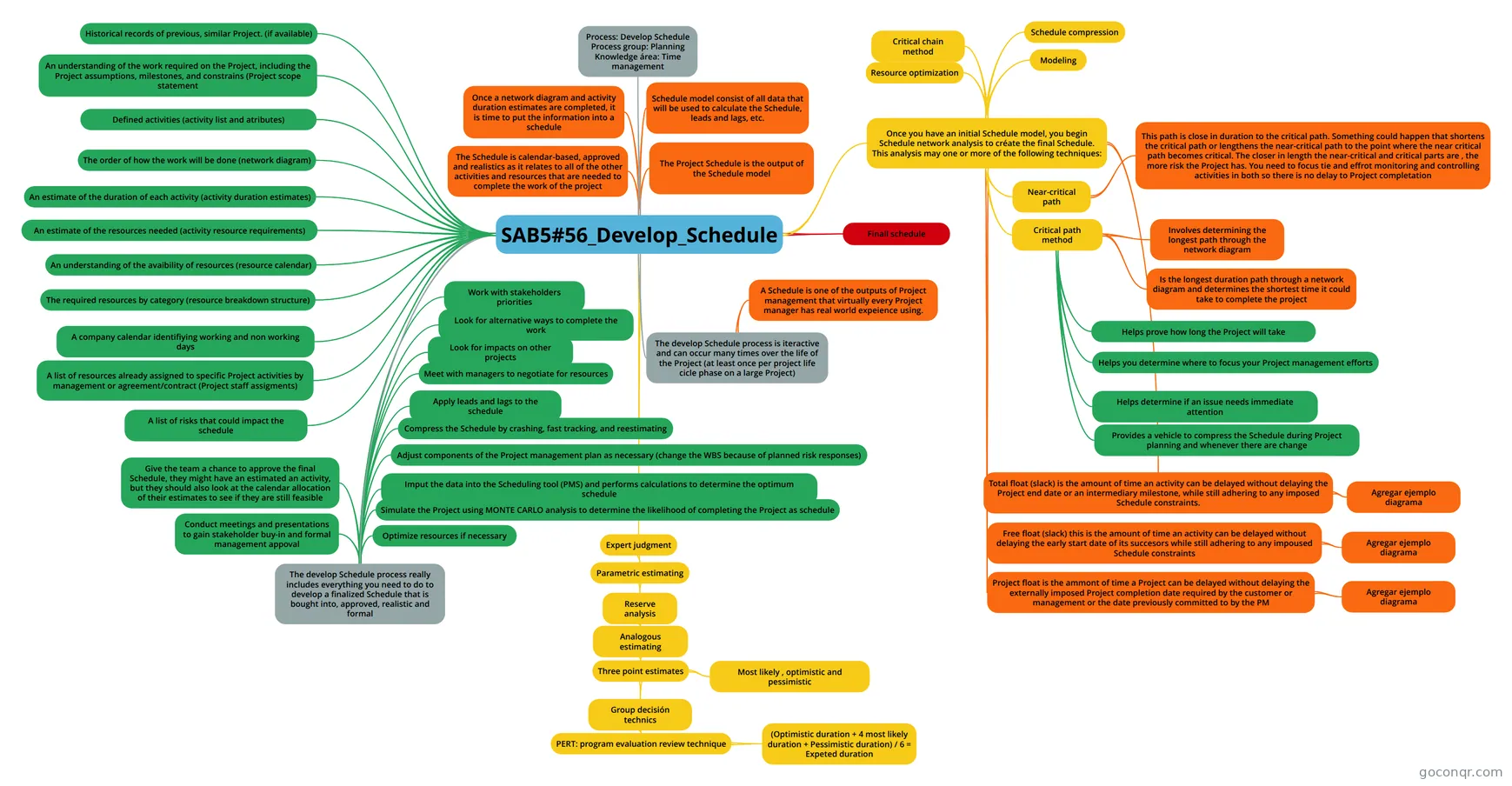
Mind map: Develop schedule process
Map content
SAB5#56_Develop_Schedule
Process: Develop Schedule Process group: Planning Knowledge área: Time management
Once a network diagram and activity duration estimates are completed, it is time to put the information into a schedule
Schedule model consist of all data that will be used to calculate the Schedule, leads and lags, etc.
The Project Schedule is the output of the Schedule model
The Schedule is calendar-based, approved and realistics as it relates to all of the other activities and resources that are needed to complete the work of the project
Historical records of previous, similar Project. (if available)
An understanding of the work required on the Project, including the Project assumptions, milestones, and constrains (Project scope statement
Defined activities (activity list and atributes)
The order of how the work will be done (network diagram)
An estimate of the duration of each activity (activity duration estimates)
An estimate of the resources needed (activity resource requirements)
An understanding of the avaibility of resources (resource calendar)
The required resources by category (resource breakdown structure)
A company calendar identifiying working and non working days
A list of resources already assigned to specific Project activities by management or agreement/contract (Project staff assigments)
A list of risks that could impact the schedule
The develop Schedule process really includes everything you need to do to develop a finalized Schedule that is bought into, approved, realistic and formal
- Work with stakeholders priorities
- Look for alternative ways to complete the work
- Look for impacts on other projects
- Meet with managers to negotiate for resources
- Apply leads and lags to the schedule
- Compress the Schedule by crashing, fast tracking, and reestimating
- Adjust components of the Project management plan as necessary (change the WBS because of planned risk responses)
- Imput the data into the Scheduling tool (PMS) and performs calculations to determine the optimum schedule
- Simulate the Project using MONTE CARLO analysis to determine the likelihood of completing the Project as schedule
- Optimize resources if necessary
- Give the team a chance to approve the final Schedule, they might have an estimated an activity, but they should also look at the calendar allocation of their estimates to see if they are still feasible
- Conduct meetings and presentations to gain stakeholder buy-in and formal management appoval
The develop Schedule process is iteractive and can occur many times over the life of the Project (at least once per project life cicle phase on a large Project)
- A Schedule is one of the outputs of Project management that virtually every Project manager has real world expeience using.
Once you have an initial Schedule model, you begin Schedule network analysis to créate the final Schedule. This analysis may one or more of the following techniques:
- Critical path method
- Involves determining the longest path through the network diagram
- Is the longest duration path through a network diagram and determines the shortest time it could take to complete the project
- Helps prove how long the Project will take
- Helps you determine where to focus your Project management efforts
- Helps determine if an issue needs immediate attention
- Provides a vehicle to compress the Schedule during Project planning and whenever there are change
- Schedule compression
- Modeling
- Resource optimization
- Critical chain method
- Near-critical path
- This path is close in duration to the critical path. Something could happen that shortens the critical path or lengthens the near-critical path to the point where the near critical path becomes critical. The closer in length the near-critical and critical parts are , the more risk the Project has. You need to focus tie and effrot monitoring and controlling activities in both so there is no delay to Project completation
- Total float (slack) is the amount of time an activity can be delayed without delaying the Project end date or an intermediary milestone, while still adhering to any imposed Schedule constraints.
- Agregar ejemplo diagrama
- Free float (slack) this is the amount of time an activity can be delayed without delaying the early start date of its succesors while still adhering to any impoused Schedule constraints
- Agregar ejemplo diagrama
- Project float is the ammont of time a Project can be delayed without delaying the externally imposed Project completion date required by the customer or management or the date previously committed to by the PM
- Agregar ejemplo diagrama
- Critical path method
Expert judgment
- Parametric estimating
- Reserve analysis
- Analogous estimating
- Three point estimates
- Most likely , optimistic and pessimistic
- Group decisión technics
- PERT: program evaluation review technique
- (Optimistic duration + 4 most likely duration + Pessimistic duration) / 6 = Expeted duration
- PERT: program evaluation review technique
- Three point estimates
- Analogous estimating
- Reserve analysis
- Parametric estimating
Finall schedule
Information
- Description
- Mind Map on SAB5#56_Develop_Schedule, created by Israel Miranda Torres on 18/04/2015.
- Created by
- Israel Miranda Torres
- Views
- 13
- Rating