
Mind map
Glucose metabolism
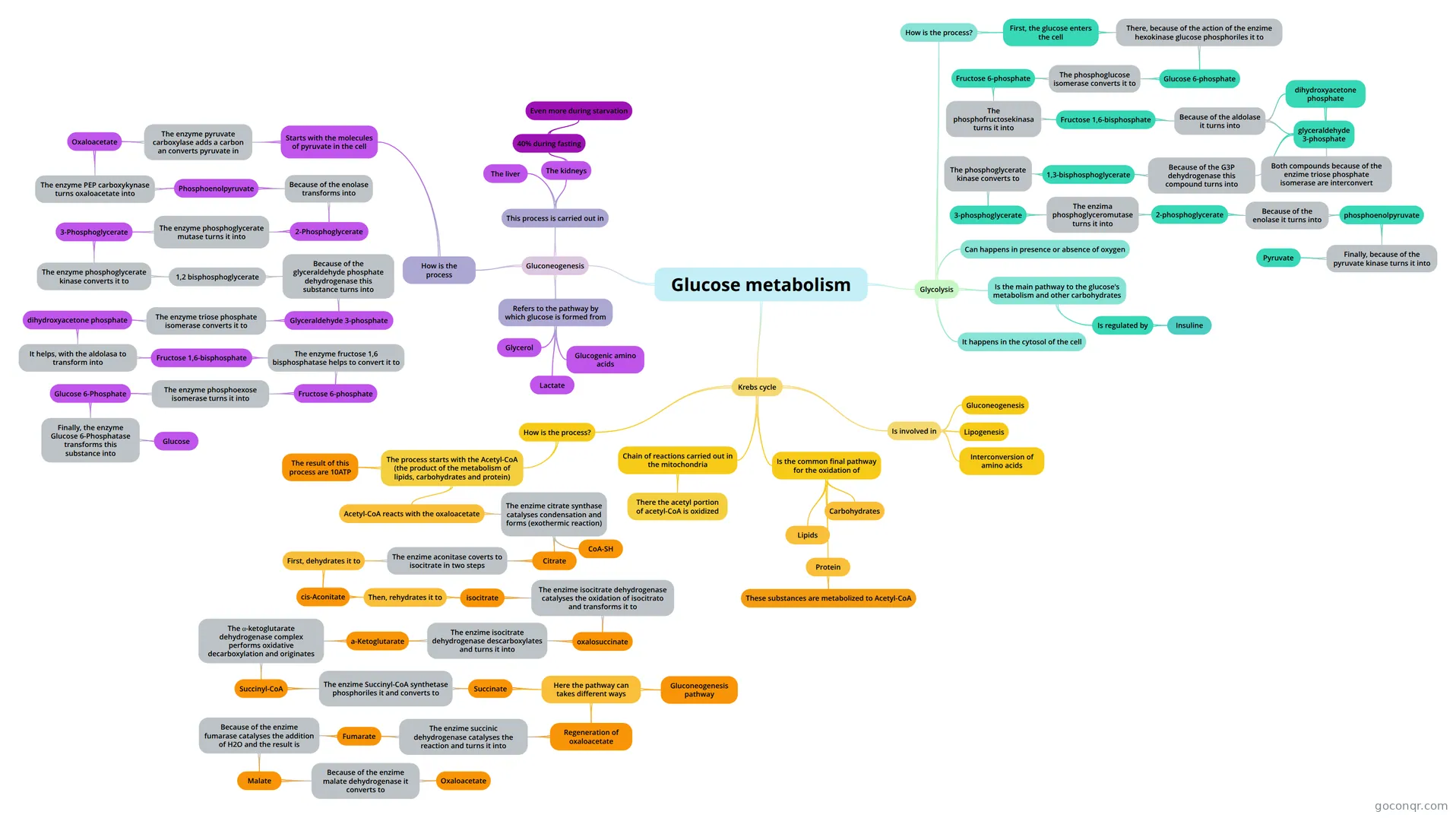
Mind map: Glucose metabolism
Map content
Glucose metabolism
Gluconeogenesis
- Refers to the pathway by which glucose is formed from
- Glycerol
- Lactate
- Glucogenic amino acids
- This process is carried out in
- The liver
- The kidneys
- 40% during fasting
- Even more during starvation
- 40% during fasting
- How is the process
- Starts with the molecules of pyruvate in the cell
- The enzyme pyruvate carboxylase adds a carbon an converts pyruvate in
- Oxaloacetate
- The enzyme PEP carboxykynase turns oxaloacetate into
- Phosphoenolpyruvate
- Because of the enolase transforms into
- 2-Phosphoglycerate
- The enzyme phosphoglycerate mutase turns it into
- 3-Phosphoglycerate
- The enzyme phosphoglycerate kinase converts it to
- 1,2 bisphosphoglycerate
- Because of the glyceraldehyde phosphate dehydrogenase this substance turns into
- Glyceraldehyde 3-phosphate
- The enzyme triose phosphate isomerase converts it to
- dihydroxyacetone phosphate
- It helps, with the aldolasa to transform into
- Fructose 1,6-bisphosphate
- The enzyme fructose 1,6 bisphosphatase helps to convert it to
- Fructose 6-phosphate
- The enzyme phosphoexose isomerase turns it into
- Glucose 6-Phosphate
- Finally, the enzyme Glucose 6-Phosphatase transforms this substance into
- Glucose
- Finally, the enzyme Glucose 6-Phosphatase transforms this substance into
- Glucose 6-Phosphate
- The enzyme phosphoexose isomerase turns it into
- Fructose 6-phosphate
- The enzyme fructose 1,6 bisphosphatase helps to convert it to
- Fructose 1,6-bisphosphate
- It helps, with the aldolasa to transform into
- dihydroxyacetone phosphate
- The enzyme triose phosphate isomerase converts it to
- Glyceraldehyde 3-phosphate
- Because of the glyceraldehyde phosphate dehydrogenase this substance turns into
- 1,2 bisphosphoglycerate
- The enzyme phosphoglycerate kinase converts it to
- 3-Phosphoglycerate
- The enzyme phosphoglycerate mutase turns it into
- 2-Phosphoglycerate
- Because of the enolase transforms into
- Phosphoenolpyruvate
- The enzyme PEP carboxykynase turns oxaloacetate into
- Oxaloacetate
- The enzyme pyruvate carboxylase adds a carbon an converts pyruvate in
- Starts with the molecules of pyruvate in the cell
- Refers to the pathway by which glucose is formed from
Glycolysis
- Is the main pathway to the glucose's metabolism and other carbohydrates
- Is regulated by
- Insuline
- Is regulated by
- It happens in the cytosol of the cell
- Can happens in presence or absence of oxygen
- How is the process?
- First, the glucose enters the cell
- There, because of the action of the enzime hexokinase glucose phosphoriles it to
- Glucose 6-phosphate
- The phosphoglucose isomerase converts it to
- Fructose 6-phosphate
- The phosphofructosekinasa turns it into
- Fructose 1,6-bisphosphate
- Because of the aldolase it turns into
- dihydroxyacetone phosphate
- Both compounds because of the enzime triose phosphate isomerase are interconvert
- glyceraldehyde 3-phosphate
- Because of the G3P dehydrogenase this compound turns into
- 1,3-bisphosphoglycerate
- The phosphoglycerate kinase converts to
- 3-phosphoglycerate
- The enzima phosphoglyceromutase turns it into
- 2-phosphoglycerate
- Because of the enolase it turns into
- phosphoenolpyruvate
- Finally, because of the pyruvate kinase turns it into
- Pyruvate
- Finally, because of the pyruvate kinase turns it into
- phosphoenolpyruvate
- Because of the enolase it turns into
- 2-phosphoglycerate
- The enzima phosphoglyceromutase turns it into
- 3-phosphoglycerate
- The phosphoglycerate kinase converts to
- 1,3-bisphosphoglycerate
- Because of the G3P dehydrogenase this compound turns into
- dihydroxyacetone phosphate
- Because of the aldolase it turns into
- Fructose 1,6-bisphosphate
- The phosphofructosekinasa turns it into
- Fructose 6-phosphate
- The phosphoglucose isomerase converts it to
- Glucose 6-phosphate
- There, because of the action of the enzime hexokinase glucose phosphoriles it to
- First, the glucose enters the cell
- Is the main pathway to the glucose's metabolism and other carbohydrates
Krebs cycle
- Chain of reactions carried out in the mitochondria
- There the acetyl portion of acetyl-CoA is oxidized
- Is the common final pathway for the oxidation of
- Carbohydrates
- Lipids
- Protein
- These substances are metabolized to Acetyl-CoA
- Is involved in
- Gluconeogenesis
- Lipogenesis
- Interconversion of amino acids
- How is the process?
- The process starts with the Acetyl-CoA (the product of the metabolism of lipids, carbohydrates and protein)
- Acetyl-CoA reacts with the oxaloacetate
- The enzime citrate synthase catalyses condensation and forms (exothermic reaction)
- Citrate
- The enzime aconitase coverts to isocitrate in two steps
- First, dehydrates it to
- cis-Aconitate
- Then, rehydrates it to
- isocitrate
- The enzime isocitrate dehydrogenase catalyses the oxidation of isocitrato and transforms it to
- oxalosuccinate
- The enzime isocitrate dehydrogenase descarboxylates and turns it into
- a-Ketoglutarate
- The α-ketoglutarate dehydrogenase complex performs oxidative decarboxylation and originates
- Succinyl-CoA
- The enzime Succinyl-CoA synthetase phosphoriles it and converts to
- Succinate
- Here the pathway can takes different ways
- Gluconeogenesis pathway
- Regeneration of oxaloacetate
- The enzime succinic dehydrogenase catalyses the reaction and turns it into
- Fumarate
- Because of the enzime fumarase catalyses the addition of H2O and the result is
- Malate
- Because of the enzime malate dehydrogenase it converts to
- Oxaloacetate
- Because of the enzime malate dehydrogenase it converts to
- Malate
- Because of the enzime fumarase catalyses the addition of H2O and the result is
- Fumarate
- The enzime succinic dehydrogenase catalyses the reaction and turns it into
- Here the pathway can takes different ways
- Succinate
- The enzime Succinyl-CoA synthetase phosphoriles it and converts to
- Succinyl-CoA
- The α-ketoglutarate dehydrogenase complex performs oxidative decarboxylation and originates
- a-Ketoglutarate
- The enzime isocitrate dehydrogenase descarboxylates and turns it into
- oxalosuccinate
- The enzime isocitrate dehydrogenase catalyses the oxidation of isocitrato and transforms it to
- isocitrate
- Then, rehydrates it to
- cis-Aconitate
- First, dehydrates it to
- The enzime aconitase coverts to isocitrate in two steps
- CoA-SH
- Citrate
- The enzime citrate synthase catalyses condensation and forms (exothermic reaction)
- The result of this process are 10ATP
- Acetyl-CoA reacts with the oxaloacetate
- The process starts with the Acetyl-CoA (the product of the metabolism of lipids, carbohydrates and protein)
- Chain of reactions carried out in the mitochondria
Information
- Description
- Mind Map on Glucose metabolism, created by Juan Sebastian Hincapie Monroy on 02/10/2020.
- Created by
- Juan Sebastian Hincapie Monroy
- Views
- 2
- Rating