
Mind map
Teorías de la evolución
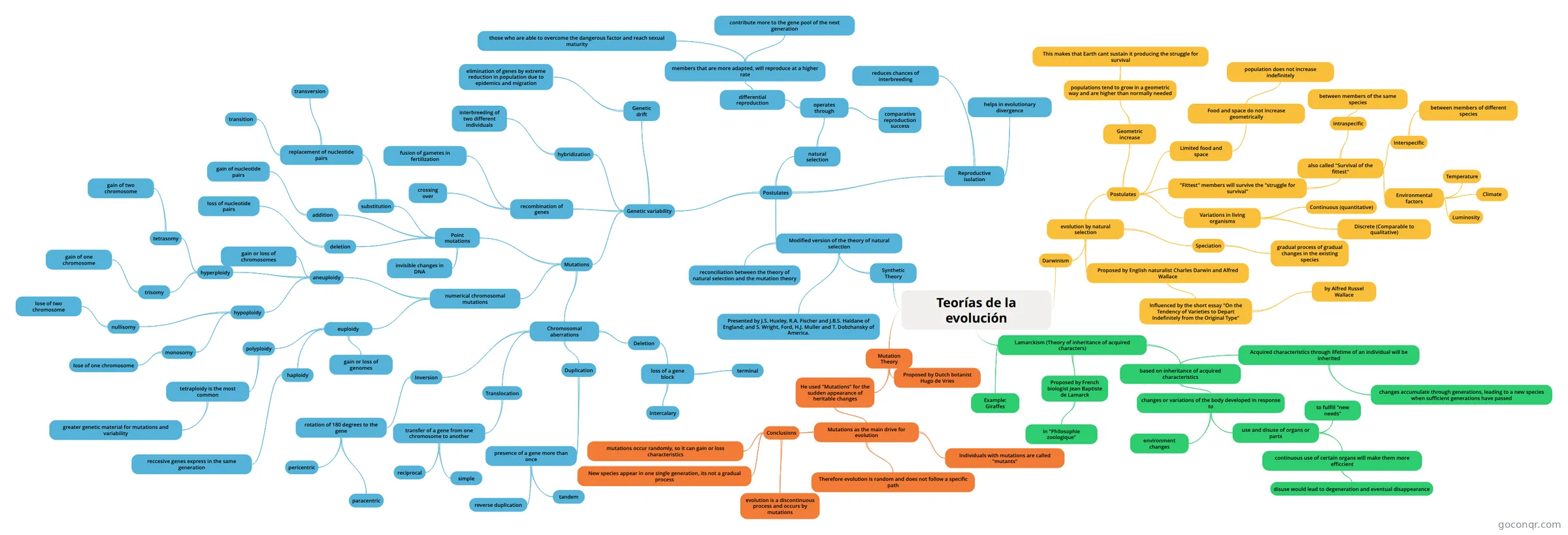
Mind map: Theories of evolution
Map content
Teorías de la evolución
Darwinism
- evolution by natural selection
- Proposed by English naturalist Charles Darwin and Alfred Wallace
- Influenced by the short essay "On the Tendency of Varieties to Depart Indefinitely from the Original Type"
- by Alfred Russel Wallace
- Influenced by the short essay "On the Tendency of Varieties to Depart Indefinitely from the Original Type"
- Postulates
- "Fittest" members will survive the "struggle for survival"
- also called "Survival of the fittest"
- Intraspecific
- between members of the same species
- Interspecific
- between members of different species
- Environmental factors
- Temperature
- Climate
- Luminosity
- Intraspecific
- also called "Survival of the fittest"
- Variations in living organisms
- Continuous (quantitative)
- Discrete (Comparable to qualitative)
- Geometric increase
- populations tend to grow in a geometric way and are higher than normally needed
- This makes that Earth cant sustain it producing the struggle for survival
- populations tend to grow in a geometric way and are higher than normally needed
- Limited food and space
- Food and space do not increase geometrically
- population does not increase indefinitely
- Food and space do not increase geometrically
- "Fittest" members will survive the "struggle for survival"
- Speciation
- gradual process of gradual changes in the existing species
- Proposed by English naturalist Charles Darwin and Alfred Wallace
- evolution by natural selection
Lamarckism (Theory of inheritance of acquired characters)
- Proposed by French biologist Jean Baptiste de Lamarck
- in "Philosophie zoologique"
- based on inheritance of acquired characteristics
- changes or variations of the body developed in response to
- environment changes
- use and disuse of organs or parts
- to fulfill "new needs"
- continuous use of certain organs will make them more efficcient
- disuse would lead to degeneration and eventual disappearance
- Acquired characteristics through lifetime of an individual will be inherited
- changes accumulate through generations, leading to a new species when sufficient generations have passed
- changes or variations of the body developed in response to
- Example: Giraffes
- Proposed by French biologist Jean Baptiste de Lamarck
Mutation Theory
- Proposed by Dutch botanist Hugo de Vries
- He used "Mutations" for the sudden appearance of heritable changes
- Mutations as the main drive for evolution
- Therefore evolution is random and does not follow a specific path
- Conclusions
- evolution is a discontinuous process and occurs by mutations
- mutations occur randomly, so it can gain or loss characteristics
- New species appear in one single generation, its not a gradual process
- Individuals with mutations are called "mutants"
- Mutations as the main drive for evolution
Synthetic Theory
- Modified version of the theory of natural selection
- reconciliation between the theory of natural selection and the mutation theory
- Presented by J.S. Huxley, R.A. Fischer and J.B.S. Haldane of England; and S. Wright, Ford, H.J. Muller and T. Dobzhansky of America.
- Postulates
- Genetic variability
- Mutations
- Chromosomal aberrations
- Deletion
- loss of a gene block
- terminal
- Intercalary
- loss of a gene block
- Duplication
- presence of a gene more than once
- tandem
- reverse duplication
- presence of a gene more than once
- Translocation
- transfer of a gene from one chromosome to another
- simple
- reciprocal
- transfer of a gene from one chromosome to another
- Inversion
- rotation of 180 degrees to the gene
- paracentric
- pericentric
- rotation of 180 degrees to the gene
- Deletion
- numerical chromosomal mutations
- euploidy
- gain or loss of genomes
- haploidy
- reccesive genes express in the same generation
- polyploidy
- tetraploidy is the most common
- greater genetic material for mutations and variability
- tetraploidy is the most common
- aneuploidy
- gain or loss of chromosomes
- hypoploidy
- monosomy
- lose of one chromosome
- nullisomy
- lose of two chromosome
- monosomy
- hyperploidy
- trisomy
- gain of one chromosome
- tetrasomy
- gain of two chromosome
- trisomy
- euploidy
- Point mutations
- invisible changes in DNA
- addition
- gain of nucleotide pairs
- deletion
- loss of nucleotide pairs
- substitution
- replacement of nucleotide pairs
- transition
- transversion
- replacement of nucleotide pairs
- Chromosomal aberrations
- recombination of genes
- crossing over
- fusion of gametes in fertilization
- hybridization
- interbreeding of two different individuals
- Genetic drift
- elimination of genes by extreme reduction in population due to epidemics and migration
- Mutations
- natural selection
- operates through
- differential reproduction
- members that are more adapted, will reproduce at a higher rate
- contribute more to the gene pool of the next generation
- those who are able to overcome the dangerous factor and reach sexual maturity
- members that are more adapted, will reproduce at a higher rate
- comparative reproduction success
- differential reproduction
- operates through
- Reproductive isolation
- reduces chances of interbreeding
- helps in evolutionary divergence
- Genetic variability
- Modified version of the theory of natural selection
Information
- Description
- Mind Map on Teorías de la evolución, created by Santiago Poveda on 14/12/2020.
- Created by
- Santiago Poveda
- Views
- 1
- Rating