
Mind map
Method, Methodology, Language Teaching, 1L and 2L theories
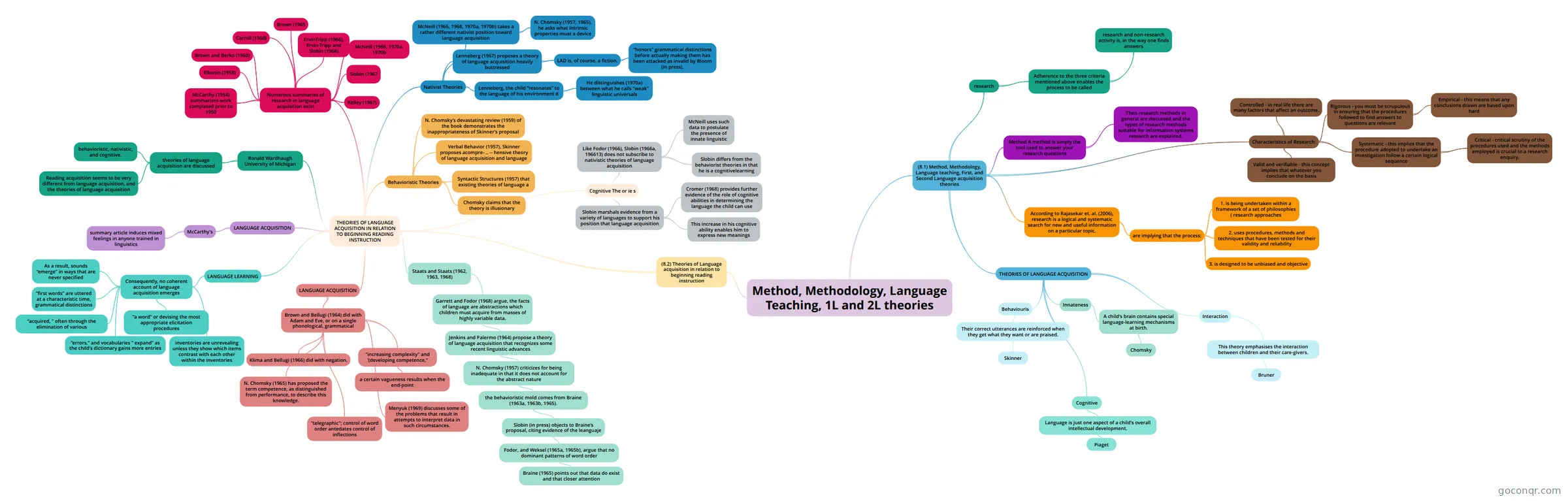
Mind map: Method, methodology, language teaching and language acquisition theories
Map content
Method, Methodology, Language Teaching, 1L and 2L theories
(8.2) Theories of Language acquisition in relation to beginning reading instruction
- THEORIES OF LANGUAGE ACQUISITION IN RELATION TO BEGINNING READING INSTRUCTION
- Ronald Wardhaugh University of Michigan
- theories of language acquisition are discussed
- behavioristic, nativistic, and cognitive.
- Reading acquisition seems to be very different from language acquisition, and the theories of language acquisition
- theories of language acquisition are discussed
- Numerous summaries of research in language acquisition exist
- McCarthy (1954) summarizes work completed prior to 1950
- Elkonin (1958)
- Brown and Berko (1960)
- Carroll (1960)
- Brown (1965
- ErvinTripp (1966), Ervin-Tripp and Slobin (1966)
- McNeill (1966, 1970a, 1970b
- Slobin (1967
- Kelley (1967)
- LANGUAGE ACQUISITION
- McCarthy's
- summary article induces mixed feelings in anyone trained in linguistics
- McCarthy's
- LANGUAGE LEARNING
- Consequently, no coherent account of language acquisition emerges
- As a result, sounds “emerge” in ways that are never specified
- “first words” are uttered at a characteristic time, grammatical distinctions
- “acquired, ” often through the elimination of various
- “errors,” and vocabularies ‘‘ expand” as the child’s dictionary gains more entries
- “a word” or devising the most appropriate elicitation procedures
- inventories are unrevealing unless they show which items contrast with each other within the inventories
- Consequently, no coherent account of language acquisition emerges
- LANGUAGE ACQUISITION
- Brown and Bellugi (1964) did with Adam and Eve, or on a single phonological, grammatical
- Klima and Bellugi (1966) did with negation.
- N. Chomsky (1965) has proposed the term competence, as distinguished from performance, to describe this knowledge.
- “increasing complexity” and ‘(developing competence,”
- a certain vagueness results when the end-point
- Menyuk (1969) discusses some of the problems that result in attempts to interpret data in such circumstances.
- “telegraphic”; control of word order antedates control of inflections
- Brown and Bellugi (1964) did with Adam and Eve, or on a single phonological, grammatical
- Behavioristic Theories
- Verbal Behavior (1957), Skinner proposes acompre- .. -- hensive theory of language acquisition and language
- N. Chomsky’s devastating review (1959) of the book demonstrates the inappropriateness of Skinner’s proposal
- Syntactic Structures (1957) that existing theories of language a
- Chomsky claims that the theory is illusionary
- Staats and Staats (1962, 1963, 1968)
- Garrett and Fodor (1968) argue, the facts of language are abstractions which children must acquire from masses of highly variable data.
- Jenkins and Palermo (1964) propose a theory of language acquisition that recognizes some recent linguistic advances
- N. Chomsky (1957) criticizes for being inadequate in that it does not account for the abstract nature
- the behavioristic mold comes from Braine (1963a, 1963b, 1965).
- Slobin (in press) objects to Braine’s proposal, citing evidence of the leanguaje
- Fodor, and Weksel (1965a, 1965b), argue that no dominant patterns of word order
- Braine (1965) points out that data do exist and that closer attention
- Fodor, and Weksel (1965a, 1965b), argue that no dominant patterns of word order
- Slobin (in press) objects to Braine’s proposal, citing evidence of the leanguaje
- the behavioristic mold comes from Braine (1963a, 1963b, 1965).
- N. Chomsky (1957) criticizes for being inadequate in that it does not account for the abstract nature
- Jenkins and Palermo (1964) propose a theory of language acquisition that recognizes some recent linguistic advances
- Garrett and Fodor (1968) argue, the facts of language are abstractions which children must acquire from masses of highly variable data.
- Nativist Theories
- Lenneberg (1967) proposes a theory of language acquisition heavily buttressed
- LAD is, of course, a fiction.
- “honors” grammatical distinctions before actually making them has been attacked as invalid by Bloom (in press).
- LAD is, of course, a fiction.
- Lenneberg, the child “resonates” to the language of his environment d
- He distinguishes (1970a) between what he calls “weak” linguistic universals
- McNeill (1966, 1968, 1970a, 1970b) takes a rather different nativist position toward language acquisition
- N. Chomsky (1957, 1965), he asks what intrinsic properties must a device
- Lenneberg (1967) proposes a theory of language acquisition heavily buttressed
- Cognitive The or ie s
- Like Fodor (1966), Slobin (1966a, 196613) does not subscribe to nativistic theories of language acquisition
- McNeill uses such data to postulate the presence of innate linguistic
- Slobin differs from the behaviorist theories in that he is a cognitivelearning
- Slobin marshals evidence from a variety of languages to support his position that language acquisition
- Cromer (1968) provides further evidence of the role of cognitive abilities in determining the language the child can use
- This increase in his cognitive ability enables him to express new meanings
- Like Fodor (1966), Slobin (1966a, 196613) does not subscribe to nativistic theories of language acquisition
- Ronald Wardhaugh University of Michigan
- THEORIES OF LANGUAGE ACQUISITION IN RELATION TO BEGINNING READING INSTRUCTION
(8.1) Method, Methodology, Language teaching, First, and Second Language acquisition theories
- Method A method is simply the tool used to answer your research questions
- Then research methods in general are discussed and the types of research methods suitable for information systems research are explained.
- According to Rajasekar et. al. (2006), research is a logical and systematic search for new and useful information on a particular topic.
- are implying that the process:
- 1. is being undertaken within a framework of a set of philosophies ( research approaches
- 2. uses procedures, methods and techniques that have been tested for their validity and reliability
- 3. is designed to be unbiased and objective
- are implying that the process:
- research
- Adherence to the three criteria mentioned above enables the process to be called
- research and non-research activity is, in the way one finds answers
- Adherence to the three criteria mentioned above enables the process to be called
- Characteristics of Research:
- Controlled - in real life there are many factors that affect an outcome.
- Rigorous - you must be scrupulous in ensuring that the procedures followed to find answers to questions are relevant
- Empirical - this means that any conclusions drawn are based upon hard
- Systematic - this implies that the procedure adopted to undertake an investigation follow a certain logical sequence
- Critical - critical scrutiny of the procedures used and the methods employed is crucial to a research enquiry.
- Valid and verifiable - this concept implies that whatever you conclude on the basis
- THEORIES OF LANGUAGE ACQUISITION
- Behaviouris
- Their correct utterances are reinforced when they get what they want or are praised.
- Skinner
- Their correct utterances are reinforced when they get what they want or are praised.
- Innateness
- A child's brain contains special language-learning mechanisms at birth.
- Chomsky
- A child's brain contains special language-learning mechanisms at birth.
- Cognitive
- Language is just one aspect of a child's overall intellectual development.
- Piaget
- Language is just one aspect of a child's overall intellectual development.
- Interaction
- This theory emphasises the interaction between children and their care-givers.
- Bruner
- This theory emphasises the interaction between children and their care-givers.
- Behaviouris
- Method A method is simply the tool used to answer your research questions
Information
- Description
- Mind Map on Method, Methodology, Language Teaching, 1L and 2L theories, created by ZULAY TOAPANTA on 31/01/2021.
- Created by
- ZULAY TOAPANTA
- Views
- 10
- Rating
More on Theories of Language Acquisition