
Mind map
How to teach Speaking
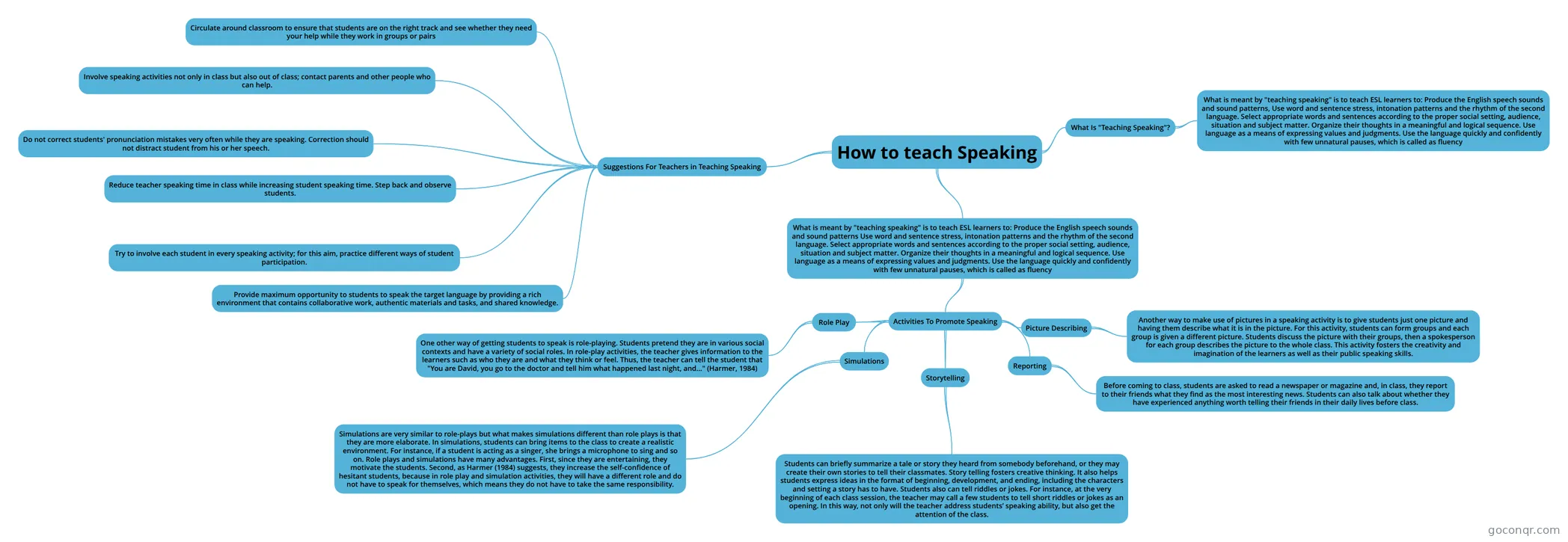
Mind map: How to teach speaking
Map content
How to teach Speaking
What Is "Teaching Speaking"?
- What is meant by "teaching speaking" is to teach ESL learners to: Produce the English speech sounds and sound patterns, Use word and sentence stress, intonation patterns and the rhythm of the second language. Select appropriate words and sentences according to the proper social setting, audience, situation and subject matter. Organize their thoughts in a meaningful and logical sequence. Use language as a means of expressing values and judgments. Use the language quickly and confidently with few unnatural pauses, which is called as fluency
What is meant by "teaching speaking" is to teach ESL learners to: Produce the English speech sounds and sound patterns Use word and sentence stress, intonation patterns and the rhythm of the second language. Select appropriate words and sentences according to the proper social setting, audience, situation and subject matter. Organize their thoughts in a meaningful and logical sequence. Use language as a means of expressing values and judgments. Use the language quickly and confidently with few unnatural pauses, which is called as fluency
- Activities To Promote Speaking
- Role Play
- One other way of getting students to speak is role-playing. Students pretend they are in various social contexts and have a variety of social roles. In role-play activities, the teacher gives information to the learners such as who they are and what they think or feel. Thus, the teacher can tell the student that "You are David, you go to the doctor and tell him what happened last night, and…" (Harmer, 1984)
- Simulations
- Simulations are very similar to role-plays but what makes simulations different than role plays is that they are more elaborate. In simulations, students can bring items to the class to create a realistic environment. For instance, if a student is acting as a singer, she brings a microphone to sing and so on. Role plays and simulations have many advantages. First, since they are entertaining, they motivate the students. Second, as Harmer (1984) suggests, they increase the self-confidence of hesitant students, because in role play and simulation activities, they will have a different role and do not have to speak for themselves, which means they do not have to take the same responsibility.
- Picture Describing
- Another way to make use of pictures in a speaking activity is to give students just one picture and having them describe what it is in the picture. For this activity, students can form groups and each group is given a different picture. Students discuss the picture with their groups, then a spokesperson for each group describes the picture to the whole class. This activity fosters the creativity and imagination of the learners as well as their public speaking skills.
- Storytelling
- Students can briefly summarize a tale or story they heard from somebody beforehand, or they may create their own stories to tell their classmates. Story telling fosters creative thinking. It also helps students express ideas in the format of beginning, development, and ending, including the characters and setting a story has to have. Students also can tell riddles or jokes. For instance, at the very beginning of each class session, the teacher may call a few students to tell short riddles or jokes as an opening. In this way, not only will the teacher address students’ speaking ability, but also get the attention of the class.
- Reporting
- Before coming to class, students are asked to read a newspaper or magazine and, in class, they report to their friends what they find as the most interesting news. Students can also talk about whether they have experienced anything worth telling their friends in their daily lives before class.
- Role Play
- Activities To Promote Speaking
Suggestions For Teachers in Teaching Speaking
- Try to involve each student in every speaking activity; for this aim, practice different ways of student participation.
- Do not correct students' pronunciation mistakes very often while they are speaking. Correction should not distract student from his or her speech.
- Reduce teacher speaking time in class while increasing student speaking time. Step back and observe students.
- Provide maximum opportunity to students to speak the target language by providing a rich environment that contains collaborative work, authentic materials and tasks, and shared knowledge.
- Involve speaking activities not only in class but also out of class; contact parents and other people who can help.
- Circulate around classroom to ensure that students are on the right track and see whether they need your help while they work in groups or pairs
Information
- Description
- Ingles Mind Map on How to teach Speaking, created by Carlos Daniel on 09/02/2021.
- Created by
- Carlos Daniel
- Views
- 0
- Rating
More on Teaching Listening and Speaking