
Mind map
Chapter II Croos-cultural variations in Consumer Behavior
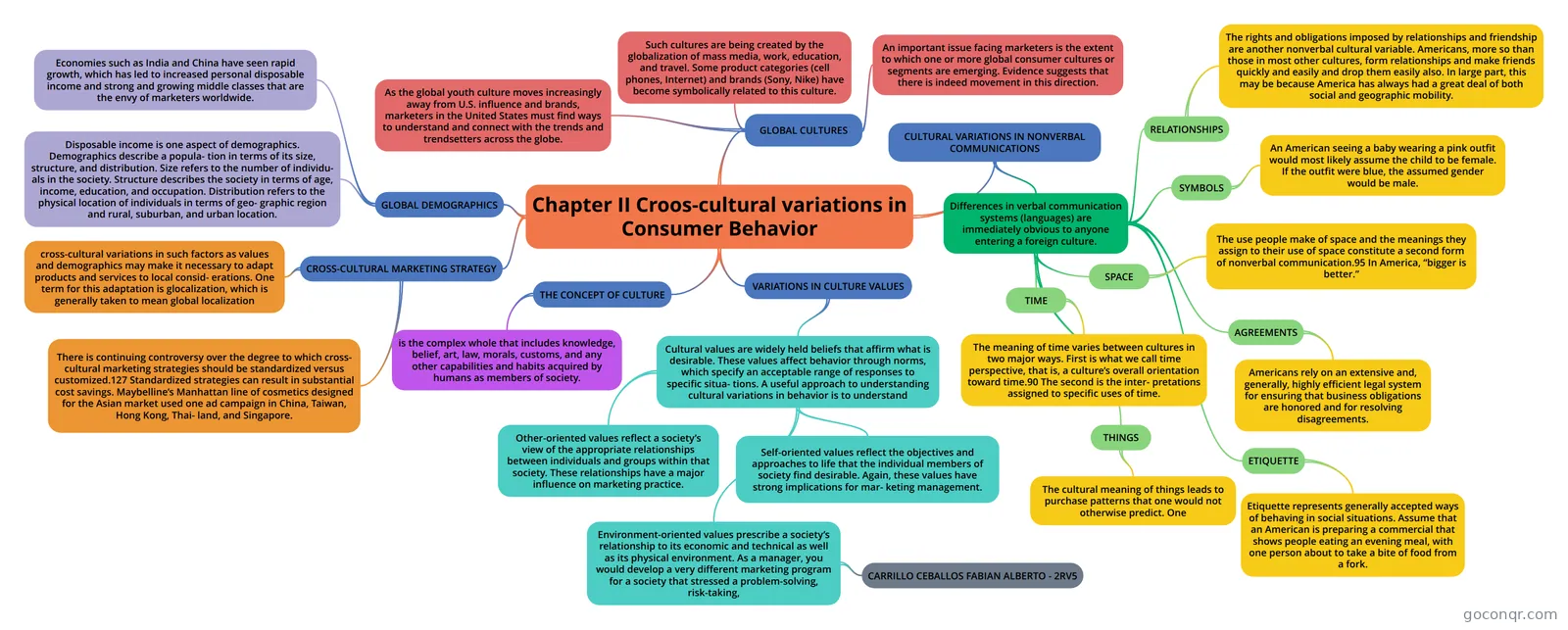
Mind map: Cross-cultural variations in consumer behavior
Map content
Chapter II Croos-cultural variations in Consumer Behavior
THE CONCEPT OF CULTURE
- is the complex whole that includes knowledge, belief, art, law, morals, customs, and any other capabilities and habits acquired by humans as members of society.
VARIATIONS IN CULTURE VALUES
- Cultural values are widely held beliefs that affirm what is desirable. These values affect behavior through norms, which specify an acceptable range of responses to specific situa- tions. A useful approach to understanding cultural variations in behavior is to understand
- Other-oriented values reflect a society’s view of the appropriate relationships between individuals and groups within that society. These relationships have a major influence on marketing practice.
- Environment-oriented values prescribe a society’s relationship to its economic and technical as well as its physical environment. As a manager, you would develop a very different marketing program for a society that stressed a problem-solving, risk-taking,
- CARRILLO CEBALLOS FABIAN ALBERTO - 2RV5
- Self-oriented values reflect the objectives and approaches to life that the individual members of society find desirable. Again, these values have strong implications for mar- keting management.
- Cultural values are widely held beliefs that affirm what is desirable. These values affect behavior through norms, which specify an acceptable range of responses to specific situa- tions. A useful approach to understanding cultural variations in behavior is to understand
CULTURAL VARIATIONS IN NONVERBAL COMMUNICATIONS
- Differences in verbal communication systems (languages) are immediately obvious to anyone entering a foreign culture.
- TIME
- The meaning of time varies between cultures in two major ways. First is what we call time perspective, that is, a culture’s overall orientation toward time.90 The second is the inter- pretations assigned to specific uses of time.
- SPACE
- The use people make of space and the meanings they assign to their use of space constitute a second form of nonverbal communication.95 In America, “bigger is better.”
- SYMBOLS
- An American seeing a baby wearing a pink outfit would most likely assume the child to be female. If the outfit were blue, the assumed gender would be male.
- RELATIONSHIPS
- The rights and obligations imposed by relationships and friendship are another nonverbal cultural variable. Americans, more so than those in most other cultures, form relationships and make friends quickly and easily and drop them easily also. In large part, this may be because America has always had a great deal of both social and geographic mobility.
- AGREEMENTS
- Americans rely on an extensive and, generally, highly efficient legal system for ensuring that business obligations are honored and for resolving disagreements.
- THINGS
- The cultural meaning of things leads to purchase patterns that one would not otherwise predict. One
- ETIQUETTE
- Etiquette represents generally accepted ways of behaving in social situations. Assume that an American is preparing a commercial that shows people eating an evening meal, with one person about to take a bite of food from a fork.
- TIME
- Differences in verbal communication systems (languages) are immediately obvious to anyone entering a foreign culture.
GLOBAL CULTURES
- An important issue facing marketers is the extent to which one or more global consumer cultures or segments are emerging. Evidence suggests that there is indeed movement in this direction.
- Such cultures are being created by the globalization of mass media, work, education, and travel. Some product categories (cell phones, Internet) and brands (Sony, Nike) have become symbolically related to this culture.
- As the global youth culture moves increasingly away from U.S. influence and brands, marketers in the United States must find ways to understand and connect with the trends and trendsetters across the globe.
GLOBAL DEMOGRAPHICS
- Economies such as India and China have seen rapid growth, which has led to increased personal disposable income and strong and growing middle classes that are the envy of marketers worldwide.
- Disposable income is one aspect of demographics. Demographics describe a popula- tion in terms of its size, structure, and distribution. Size refers to the number of individu- als in the society. Structure describes the society in terms of age, income, education, and occupation. Distribution refers to the physical location of individuals in terms of geo- graphic region and rural, suburban, and urban location.
CROSS-CULTURAL MARKETING STRATEGY
- cross-cultural variations in such factors as values and demographics may make it necessary to adapt products and services to local consid- erations. One term for this adaptation is glocalization, which is generally taken to mean global localization
- There is continuing controversy over the degree to which cross- cultural marketing strategies should be standardized versus customized.127 Standardized strategies can result in substantial cost savings. Maybelline’s Manhattan line of cosmetics designed for the Asian market used one ad campaign in China, Taiwan, Hong Kong, Thai- land, and Singapore.
Information
- Description
- Mind Map on Chapter II Croos-cultural variations in Consumer Behavior, created by ccfabiann 01 on 24/04/2021.
- Created by
- ccfabiann 01
- Views
- 4
- Rating
More on Cultural influences on consumer behaviour