
Mind map
Cooperative language learning
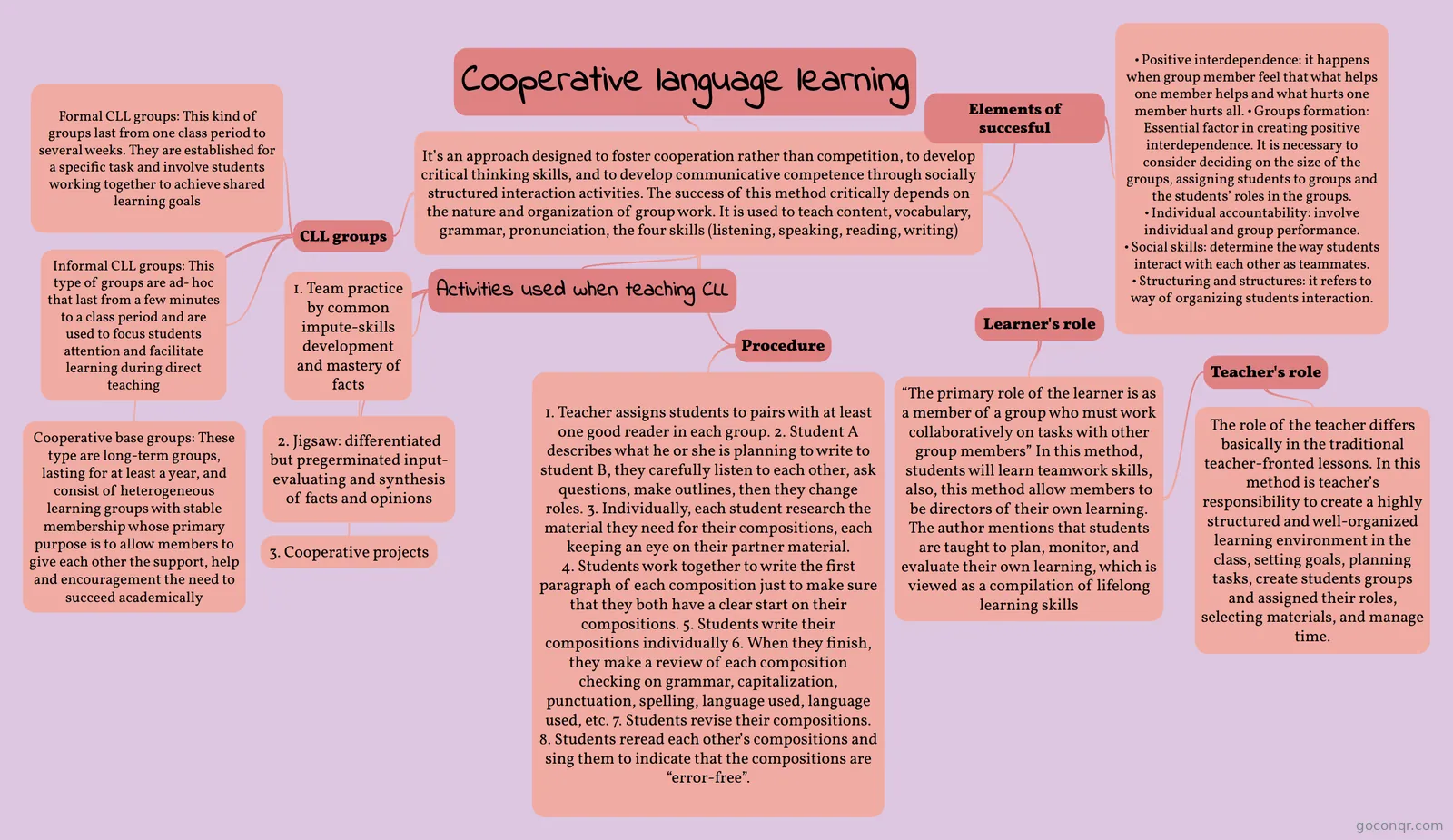
Mind map: Cooperative language learning
Map content
Cooperative language learning
It’s an approach designed to foster cooperation rather than competition, to develop critical thinking skills, and to develop communicative competence through socially structured interaction activities. The success of this method critically depends on the nature and organization of group work. It is used to teach content, vocabulary, grammar, pronunciation, the four skills (listening, speaking, reading, writing)
- CLL groups
- Formal CLL groups: This kind of groups last from one class period to several weeks. They are established for a specific task and involve students working together to achieve shared learning goals
- Informal CLL groups: This type of groups are ad- hoc that last from a few minutes to a class period and are used to focus students attention and facilitate learning during direct teaching
- Cooperative base groups: These type are long-term groups, lasting for at least a year, and consist of heterogeneous learning groups with stable membership whose primary purpose is to allow members to give each other the support, help and encouragement the need to succeed academically
- Elements of succesful
- • Positive interdependence: it happens when group member feel that what helps one member helps and what hurts one member hurts all. • Groups formation: Essential factor in creating positive interdependence. It is necessary to consider deciding on the size of the groups, assigning students to groups and the students’ roles in the groups. • Individual accountability: involve individual and group performance. • Social skills: determine the way students interact with each other as teammates. • Structuring and structures: it refers to way of organizing students interaction.
- Activities used when teaching CLL
- 1. Team practice by common impute-skills development and mastery of facts
- 2. Jigsaw: differentiated but pregerminated input- evaluating and synthesis of facts and opinions
- 3. Cooperative projects
- Learner's role
- “The primary role of the learner is as a member of a group who must work collaboratively on tasks with other group members” In this method, students will learn teamwork skills, also, this method allow members to be directors of their own learning. The author mentions that students are taught to plan, monitor, and evaluate their own learning, which is viewed as a compilation of lifelong learning skills
- Teacher's role
- The role of the teacher differs basically in the traditional teacher-fronted lessons. In this method is teacher’s responsibility to create a highly structured and well-organized learning environment in the class, setting goals, planning tasks, create students groups and assigned their roles, selecting materials, and manage time.
- Teacher's role
- “The primary role of the learner is as a member of a group who must work collaboratively on tasks with other group members” In this method, students will learn teamwork skills, also, this method allow members to be directors of their own learning. The author mentions that students are taught to plan, monitor, and evaluate their own learning, which is viewed as a compilation of lifelong learning skills
- Procedure
- 1. Teacher assigns students to pairs with at least one good reader in each group. 2. Student A describes what he or she is planning to write to student B, they carefully listen to each other, ask questions, make outlines, then they change roles. 3. Individually, each student research the material they need for their compositions, each keeping an eye on their partner material. 4. Students work together to write the first paragraph of each composition just to make sure that they both have a clear start on their compositions. 5. Students write their compositions individually 6. When they finish, they make a review of each composition checking on grammar, capitalization, punctuation, spelling, language used, language used, etc. 7. Students revise their compositions. 8. Students reread each other’s compositions and sing them to indicate that the compositions are “error-free”.
- CLL groups
Information
- Description
- Magisterio (Educación) Mind Map on Cooperative language learning, created by Marianela Fallas on 25/04/2021.
- Created by
- Marianela Fallas
- Views
- 5
- Rating
More on Cooperative and Learner-Centred Language Teaching