
Mind map
Methods in Language Teaching and Cooperative Language Learning
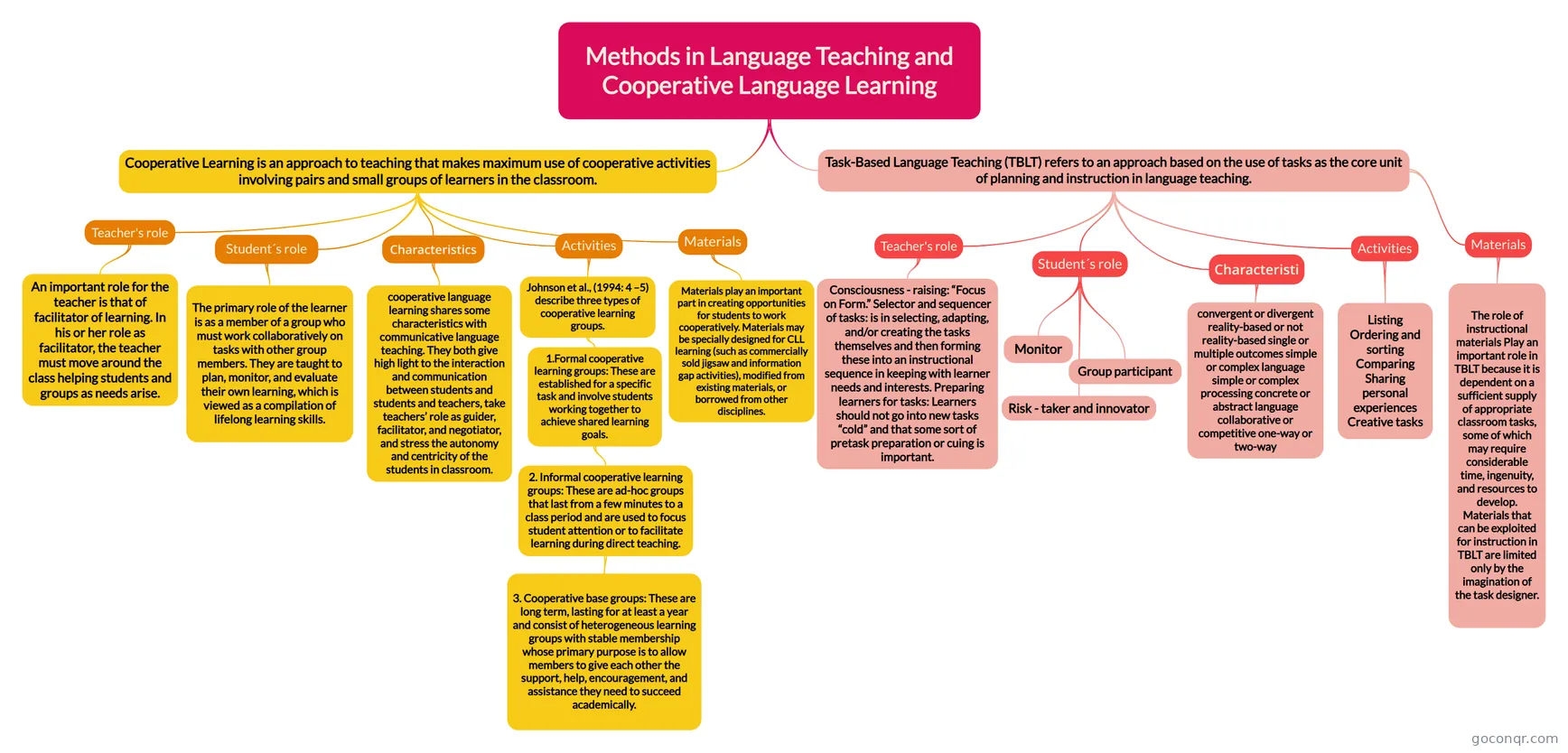
Mind map: Language teaching methods and cooperative learning
Map content
Methods in Language Teaching and Cooperative Language Learning
Cooperative Learning is an approach to teaching that makes maximum use of cooperative activities involving pairs and small groups of learners in the classroom.
- Teacher's role
- An important role for the teacher is that of facilitator of learning. In his or her role as facilitator, the teacher must move around the class helping students and groups as needs arise.
- Student´s role
- The primary role of the learner is as a member of a group who must work collaboratively on tasks with other group members. They are taught to plan, monitor, and evaluate their own learning, which is viewed as a compilation of lifelong learning skills.
- Characteristics
- cooperative language learning shares some characteristics with communicative language teaching. They both give high light to the interaction and communication between students and students and teachers, take teachers’ role as guider, facilitator, and negotiator, and stress the autonomy and centricity of the students in classroom.
- Activities
- Johnson et al., (1994: 4 –5) describe three types of cooperative learning groups.
- 1.Formal cooperative learning groups: These are established for a specific task and involve students working together to achieve shared learning goals.
- 2. Informal cooperative learning groups: These are ad-hoc groups that last from a few minutes to a class period and are used to focus student attention or to facilitate learning during direct teaching.
- 3. Cooperative base groups: These are long term, lasting for at least a year and consist of heterogeneous learning groups with stable membership whose primary purpose is to allow members to give each other the support, help, encouragement, and assistance they need to succeed academically.
- 2. Informal cooperative learning groups: These are ad-hoc groups that last from a few minutes to a class period and are used to focus student attention or to facilitate learning during direct teaching.
- 1.Formal cooperative learning groups: These are established for a specific task and involve students working together to achieve shared learning goals.
- Johnson et al., (1994: 4 –5) describe three types of cooperative learning groups.
- Materials
- Materials play an important part in creating opportunities for students to work cooperatively. Materials may be specially designed for CLL learning (such as commercially sold jigsaw and information gap activities), modified from existing materials, or borrowed from other disciplines.
- Teacher's role
Task-Based Language Teaching (TBLT) refers to an approach based on the use of tasks as the core unit of planning and instruction in language teaching.
- Student´s role
- Monitor
- Risk - taker and innovator
- Group participant
- Teacher's role
- Consciousness - raising: “Focus on Form.” Selector and sequencer of tasks: is in selecting, adapting, and/or creating the tasks themselves and then forming these into an instructional sequence in keeping with learner needs and interests. Preparing learners for tasks: Learners should not go into new tasks “cold” and that some sort of pretask preparation or cuing is important.
- Characteristi
- convergent or divergent reality-based or not reality-based single or multiple outcomes simple or complex language simple or complex processing concrete or abstract language collaborative or competitive one-way or two-way
- Activities
- Listing Ordering and sorting Comparing Sharing personal experiences Creative tasks
- Materials
- The role of instructional materials Play an important role in TBLT because it is dependent on a sufficient supply of appropriate classroom tasks, some of which may require considerable time, ingenuity, and resources to develop. Materials that can be exploited for instruction in TBLT are limited only by the imagination of the task designer.
- Student´s role
Information
- Description
- Mind Map on Methods in Language Teaching and Cooperative Language Learning, created by Gabriela Quinayas Rodriguez on 07/05/2021.
- Created by
- Gabriela Quinayas Rodriguez
- Views
- 3
- Rating
More on Cooperative and Learner-Centred Language Teaching