
Mind map
Language Minority Students in the Mainstream Classroom
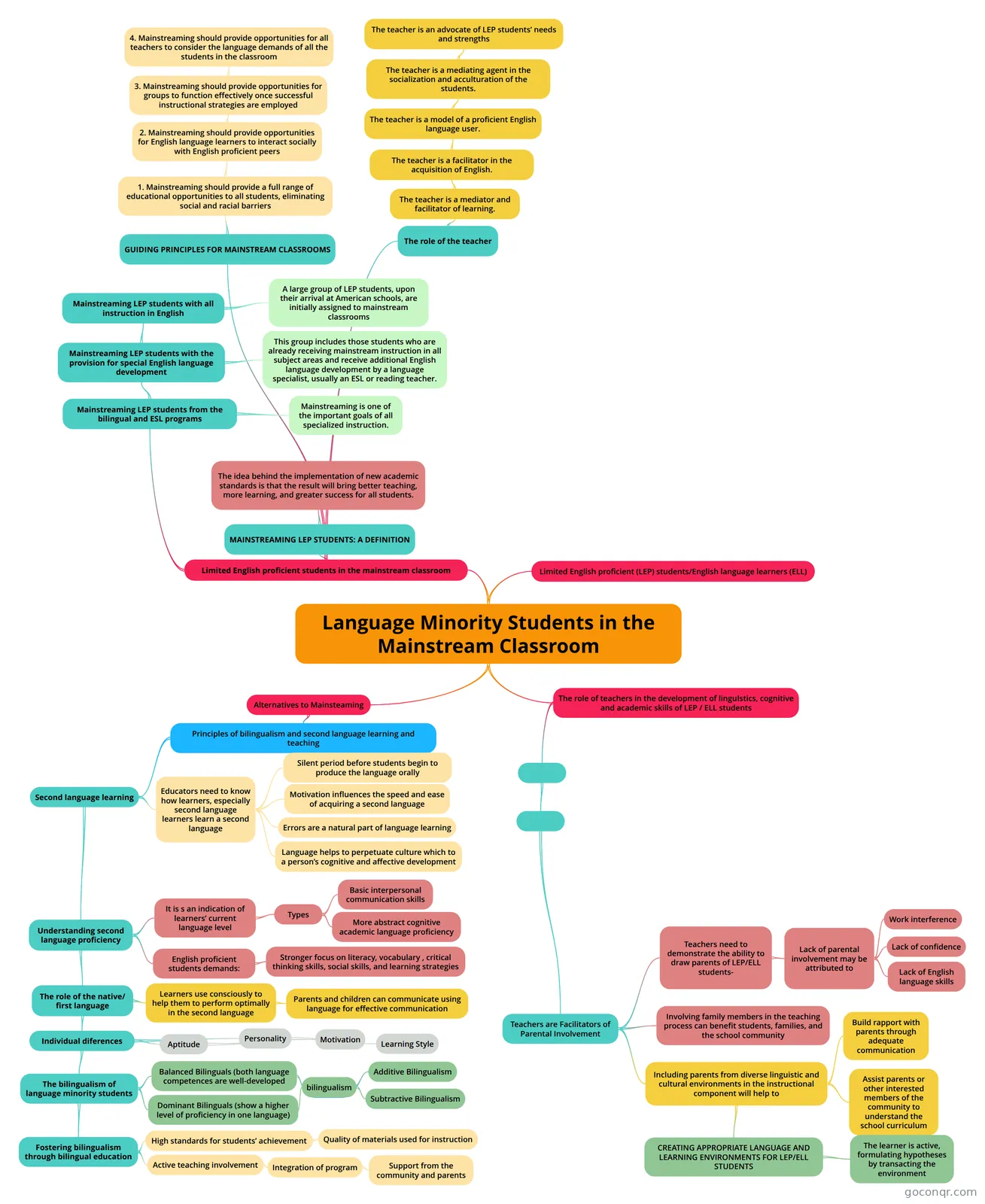
Mind map: Language minority students in the mainstream classroom
Map content
Language Minority Students in the Mainstream Classroom
Limited English proficient (LEP) students/English language learners (ELL)
Limited English proficient students in the mainstream classroom
- MAINSTREAMING LEP STUDENTS: A DEFINITION
- The idea behind the implementation of new academic standards is that the result will bring better teaching, more learning, and greater success for all students.
- Mainstreaming LEP students from the bilingual and ESL programs
- Mainstreaming is one of the important goals of all specialized instruction.
- Mainstreaming LEP students with the provision for special English language development
- This group includes those students who are already receiving mainstream instruction in all subject areas and receive additional English language development by a language specialist, usually an ESL or reading teacher.
- Mainstreaming LEP students with all instruction in English
- A large group of LEP students, upon their arrival at American schools, are initially assigned to mainstream classrooms
- GUIDING PRINCIPLES FOR MAINSTREAM CLASSROOMS
- 1. Mainstreaming should provide a full range of educational opportunities to all students, eliminating social and racial barriers
- 2. Mainstreaming should provide opportunities for English language learners to interact socially with English proficient peers
- 3. Mainstreaming should provide opportunities for groups to function effectively once successful instructional strategies are employed
- 4. Mainstreaming should provide opportunities for all teachers to consider the language demands of all the students in the classroom
- 3. Mainstreaming should provide opportunities for groups to function effectively once successful instructional strategies are employed
- 2. Mainstreaming should provide opportunities for English language learners to interact socially with English proficient peers
- 1. Mainstreaming should provide a full range of educational opportunities to all students, eliminating social and racial barriers
- The role of the teacher
- The teacher is a mediator and facilitator of learning.
- The teacher is a facilitator in the acquisition of English.
- The teacher is a model of a proficient English language user.
- The teacher is a mediating agent in the socialization and acculturation of the students.
- The teacher is an advocate of LEP students’ needs and strengths
- The teacher is a mediating agent in the socialization and acculturation of the students.
- The teacher is a model of a proficient English language user.
- The teacher is a facilitator in the acquisition of English.
- The teacher is a mediator and facilitator of learning.
- MAINSTREAMING LEP STUDENTS: A DEFINITION
Alternatives to Mainsteaming
- Principles of bilingualism and second language learning and teaching
- Second language learning
- Educators need to know how learners, especially second language learners learn a second language
- Silent period before students begin to produce the language orally
- Motivation influences the speed and ease of acquiring a second language
- Errors are a natural part of language learning
- Language helps to perpetuate culture which to a person’s cognitive and affective development
- Understanding second language proficiency
- It is s an indication of learners’ current language level
- Types
- Basic interpersonal communication skills
- More abstract cognitive academic language proficiency
- Types
- English proficient students demands:
- Stronger focus on literacy, vocabulary , critical thinking skills, social skills, and learning strategies
- The role of the native/ first language
- Learners use consciously to help them to perform optimally in the second language
- Parents and children can communicate using language for effective communication
- Individual diferences
- The bilingualism of language minority students
- Fostering bilingualism through bilingual education
- High standards for students’ achievement
- Quality of materials used for instruction
- Active teaching involvement
- Integration of program
- Support from the community and parents
- Integration of program
- High standards for students’ achievement
- Balanced Bilinguals (both language competences are well-developed
- Additive Bilingualism
- Dominant Bilinguals (show a higher level of proficiency in one language)
- bilingualism
- Subtractive Bilingualism
- bilingualism
- Fostering bilingualism through bilingual education
- Aptitude
- Motivation
- Personality
- Learning Style
- The bilingualism of language minority students
- Learners use consciously to help them to perform optimally in the second language
- It is s an indication of learners’ current language level
- Educators need to know how learners, especially second language learners learn a second language
- Second language learning
- Principles of bilingualism and second language learning and teaching
The role of teachers in the development of linguIstics, cognitive and academic skills of LEP / ELL students
- Teachers are Facilitators of Parental Involvement
- Teachers need to demonstrate the ability to draw parents of LEP/ELL students-
- Lack of parental involvement may be attributed to
- Work interference
- Lack of confidence
- Lack of English language skills
- Lack of parental involvement may be attributed to
- Involving family members in the teaching process can benefit students, families, and the school community
- Including parents from diverse linguistic and cultural environments in the instructional component will help to
- Build rapport with parents through adequate communication
- Assist parents or other interested members of the community to understand the school curriculum
- CREATING APPROPRIATE LANGUAGE AND LEARNING ENVIRONMENTS FOR LEP/ELL STUDENTS
- The learner is active, formulating hypotheses by transacting the environment
- Teachers need to demonstrate the ability to draw parents of LEP/ELL students-
- Teachers are Facilitators of Parental Involvement
Information
- Description
- Mind Map on Language Minority Students in the Mainstream Classroom, created by Daniel Uta on 13/06/2021.
- Created by
- Daniel Uta
- Views
- 0
- Rating