
Mind map
Social Aspects of Interlanguage
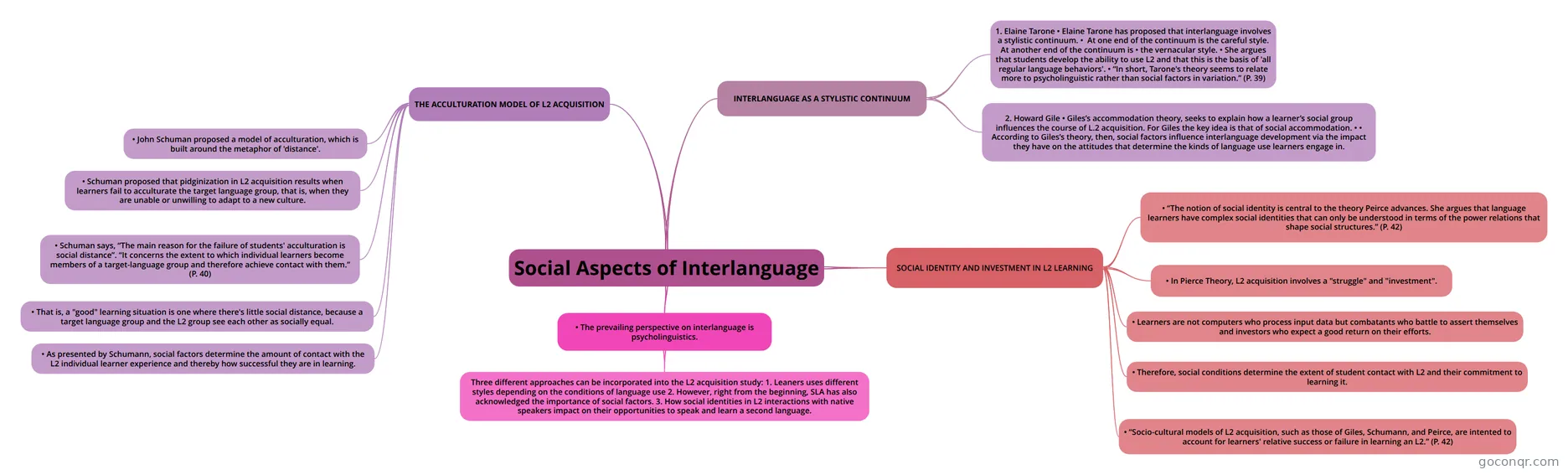
Mind map: Social Aspects of Interlanguage
Map content
Social Aspects of Interlanguage
• The prevailing perspective on interlanguage is psycholinguistics.
- Three different approaches can be incorporated into the L2 acquisition study: 1. Leaners uses different styles depending on the conditions of language use 2. However, right from the beginning, SLA has also acknowledged the importance of social factors. 3. How social identities in L2 interactions with native speakers impact on their opportunities to speak and learn a second language.
INTERLANGUAGE AS A STYLISTIC CONTINUUM
- 1. Elaine Tarone • Elaine Tarone has proposed that interlanguage involves a stylistic continuum. • At one end of the continuum is the careful style. At another end of the continuum is • the vernacular style. • She argues that students develop the ability to use L2 and that this is the basis of 'all regular language behaviors'. • “In short, Tarone's theory seems to relate more to psycholinguistic rather than social factors in variation.” (P. 39)
- 2. Howard Gile • Giles’s accommodation theory, seeks to explain how a learner’s social group influences the course of L.2 acquisition. For Giles the key idea is that of social accommodation. • • According to Giles’s theory, then, social factors influence interlanguage development via the impact they have on the attitudes that determine the kinds of language use learners engage in.
THE ACCULTURATION MODEL OF L2 ACQUISITION
- • John Schuman proposed a model of acculturation, which is built around the metaphor of 'distance'.
- • Schuman proposed that pidginization in L2 acquisition results when learners fail to acculturate the target language group, that is, when they are unable or unwilling to adapt to a new culture.
- • Schuman says, “The main reason for the failure of students' acculturation is social distance”. “It concerns the extent to which individual learners become members of a target-language group and therefore achieve contact with them.” (P. 40)
- • That is, a "good" learning situation is one where there's little social distance, because a target language group and the L2 group see each other as socially equal.
- • As presented by Schumann, social factors determine the amount of contact with the L2 individual learner experience and thereby how successful they are in learning.
SOCIAL IDENTITY AND INVESTMENT IN L2 LEARNING
- • “The notion of social identity is central to the theory Peirce advances. She argues that language learners have complex social identities that can only be understood in terms of the power relations that shape social structures.” (P. 42)
- • In Pierce Theory, L2 acquisition involves a "struggle" and "investment".
- • Learners are not computers who process input data but combatants who battle to assert themselves and investors who expect a good return on their efforts.
- • Therefore, social conditions determine the extent of student contact with L2 and their commitment to learning it.
- • “Socio-cultural models of L2 acquisition, such as those of Giles, Schumann, and Peirce, are intented to account for learners' relative success or failure in learning an L2.” (P. 42)
Information
- Description
- Mind Map on Social Aspects of Interlanguage, created by LETICIA APARECIDA MENDONCA SOUTO on 11/08/2021.
- Created by
- LETICIA APARECIDA MENDONCA SOUTO
- Views
- 0
- Rating
More on Social and Cultural Factors in Language Learning