
Mind map
PUNTUATION MARKS.
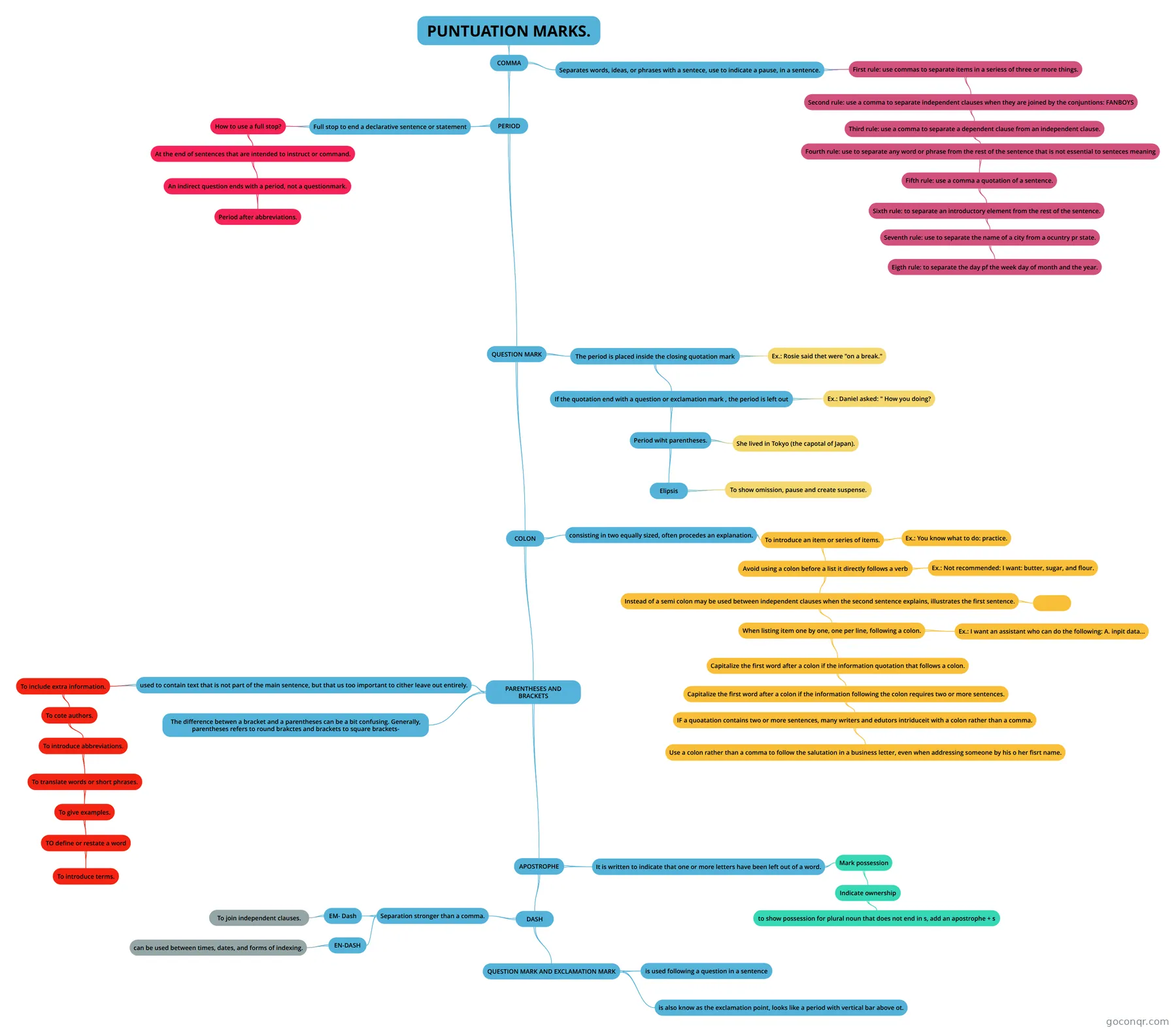
Mind map: Punctuation marks
Map content
PUNTUATION MARKS.
COMMA
- Separates words, ideas, or phrases with a sentece, use to indicate a pause, in a sentence.
- First rule: use commas to separate items in a seriess of three or more things.
- Second rule: use a comma to separate independent clauses when they are joined by the conjuntions: FANBOYS
- Third rule: use a comma to separate a dependent clause from an independent clause.
- Fourth rule: use to separate any word or phrase from the rest of the sentence that is not essential to senteces meaning
- Fifth rule: use a comma a quotation of a sentence.
- Sixth rule: to separate an introductory element from the rest of the sentence.
- Seventh rule: use to separate the name of a city from a ocuntry pr state.
- Eigth rule: to separate the day pf the week day of month and the year.
- Seventh rule: use to separate the name of a city from a ocuntry pr state.
- Sixth rule: to separate an introductory element from the rest of the sentence.
- Fifth rule: use a comma a quotation of a sentence.
- Fourth rule: use to separate any word or phrase from the rest of the sentence that is not essential to senteces meaning
- Third rule: use a comma to separate a dependent clause from an independent clause.
- Second rule: use a comma to separate independent clauses when they are joined by the conjuntions: FANBOYS
- First rule: use commas to separate items in a seriess of three or more things.
- PERIOD
- Full stop to end a declarative sentence or statement
- How to use a full stop?
- At the end of sentences that are intended to instruct or command.
- An indirect question ends with a period, not a questionmark.
- Period after abbreviations.
- An indirect question ends with a period, not a questionmark.
- At the end of sentences that are intended to instruct or command.
- How to use a full stop?
- QUESTION MARK
- The period is placed inside the closing quotation mark
- If the quotation end with a question or exclamation mark , the period is left out
- Period wiht parentheses.
- Elipsis
- To show omission, pause and create suspense.
- She lived in Tokyo (the capotal of Japan).
- Elipsis
- Ex.: Daniel asked: " How you doing?
- Period wiht parentheses.
- Ex.: Rosie said thet were "on a break."
- If the quotation end with a question or exclamation mark , the period is left out
- COLON
- consisting in two equally sized, often procedes an explanation.
- To introduce an item or series of items.
- Avoid using a colon before a list it directly follows a verb
- Instead of a semi colon may be used between independent clauses when the second sentence explains, illustrates the first sentence.
- When listing item one by one, one per line, following a colon.
- Capitalize the first word after a colon if the information quotation that follows a colon.
- Capitalize the first word after a colon if the information following the colon requires two or more sentences.
- IF a quoatation contains two or more sentences, many writers and edutors intriduceit with a colon rather than a comma.
- Use a colon rather than a comma to follow the salutation in a business letter, even when addressing someone by his o her fisrt name.
- IF a quoatation contains two or more sentences, many writers and edutors intriduceit with a colon rather than a comma.
- Capitalize the first word after a colon if the information following the colon requires two or more sentences.
- Ex.: I want an assistant who can do the following: A. inpit data...
- Capitalize the first word after a colon if the information quotation that follows a colon.
- When listing item one by one, one per line, following a colon.
- Ex.: Not recommended: I want: butter, sugar, and flour.
- Instead of a semi colon may be used between independent clauses when the second sentence explains, illustrates the first sentence.
- Ex.: You know what to do: practice.
- Avoid using a colon before a list it directly follows a verb
- To introduce an item or series of items.
- PARENTHESES AND BRACKETS
- used to contain text that is not part of the main sentence, but that us too important to cither leave out entirely.
- To include extra information.
- To cote authors.
- To introduce abbreviations.
- To translate words or short phrases.
- To give examples.
- TO define or restate a word
- To introduce terms.
- TO define or restate a word
- To give examples.
- To translate words or short phrases.
- To introduce abbreviations.
- To cote authors.
- To include extra information.
- The difference betwen a bracket and a parentheses can be a bit confusing. Generally, parentheses refers to round brakctes and brackets to square brackets-
- APOSTROPHE
- It is written to indicate that one or more letters have been left out of a word.
- Mark possession
- Indicate ownership
- to show possession for plural noun that does not end in s, add an apostrophe + s
- Indicate ownership
- Mark possession
- DASH
- Separation stronger than a comma.
- EM- Dash
- To join independent clauses.
- EN-DASH
- can be used between times, dates, and forms of indexing.
- EM- Dash
- QUESTION MARK AND EXCLAMATION MARK
- is used following a question in a sentence
- is also know as the exclamation point, looks like a period with vertical bar above ot.
- Separation stronger than a comma.
- It is written to indicate that one or more letters have been left out of a word.
- used to contain text that is not part of the main sentence, but that us too important to cither leave out entirely.
- consisting in two equally sized, often procedes an explanation.
- The period is placed inside the closing quotation mark
- Full stop to end a declarative sentence or statement
- Separates words, ideas, or phrases with a sentece, use to indicate a pause, in a sentence.
Information
- Description
- a main map about Puntuation Marks.
- Created by
- MARIA CRISTINA MENDOZA RIVERA
- Views
- 8
- Rating