
Mind map
Consonant Sounds Characteristics
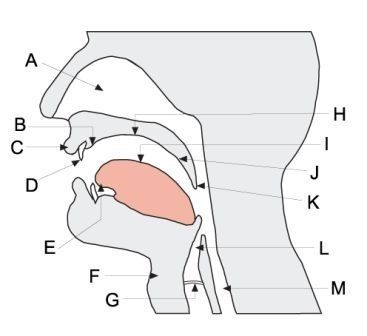
Map content
Consonant Sounds Characteristics
Place of Articulation
- There are two central components playing together to form consonant sounds, the place of articulation and articulators.
- Articulation
- There are seven places of articulation used to distinguish consonant sounds.
- Bilabial
- Labiodental
- Interdental
- Alveolar
- Alveo-Palatal
- Velar
- Glottal
- Produced by air passing from the windpipe through the vocal cords: /h/
- Ex: hi.
- Produced by air passing from the windpipe through the vocal cords: /h/
- Produced with the tongue body on or near the soft palate: /g, k, ŋ/
- Ex: go, kite.
- Glottal
- Produced by the body of the tongue touching the roof of the mouth in the area between the alveolar and the palate: /ʃ, ʒ, ʧ, ʤ/
- Ex: shin, genre, chef.
- Velar
- Produced with the tongue tip on or near the tooth ridge: /t, d, s, z, n, l/
- Ex: to, do, zoo, new.
- Alveo-Palatal
- Produced with the tongue tip on or near the inner surface of the upper teeth: / θ/, ð/
- Ex: thick and then.
- Alveolar
- Produced with the upper teeth and inner lower lip: /f, v/
- Ex: feel and veal.
- Interdental
- Produced with the two lips: /b, p, m, w/
- Ex: buy, pie, my.
- Labiodental
- Bilabial
- Articulators
- The ‘articulators’ are the instruments used to make a sound once placed on specific locations of the mouth. For example, the two lips.
- Eric M. Gálvez B.
- The ‘articulators’ are the instruments used to make a sound once placed on specific locations of the mouth. For example, the two lips.
- There are seven places of articulation used to distinguish consonant sounds.
- Articulation
- There are two central components playing together to form consonant sounds, the place of articulation and articulators.
Manner of Articulation
- The mode of articulation refers to how the sound is produced by blocking the airstream. Some consonant sounds involve the total obstruction of the airstream.
- for example, the plosive /b/ and /p/ sounds.
- Modes or manner of Articulation
- Stops or Plosives: The airstream is stopped or blocked completely prior to release: /p, b, t, d, k, g/
- Fricative: Air is forced through a narrow passageway in the mouth or throat creating continuous friction: /f, v, θ, ð, s, z, ʃ, ʒ, h/
- Affricative: The sound begins as a plosive or a stop and is then released as a fricative: /tʃ/, /dʒ/
- Nasal: Continuous air is released through the nasal cavity while the speech organs assume a stop-like position: /m, n, ŋ/.
- Liquids: Basically this is a consonant sound that is made when the tongue is obstructing the middle of your mouth so that air can only come out from the sides as in the sounds /l, r/
- Semi-vowels (or glides): These sounds are known as semi-vowels because they barely obstruct the airflow in a type of gliding motion /w, y/.
- Liquids: Basically this is a consonant sound that is made when the tongue is obstructing the middle of your mouth so that air can only come out from the sides as in the sounds /l, r/
- Nasal: Continuous air is released through the nasal cavity while the speech organs assume a stop-like position: /m, n, ŋ/.
- Affricative: The sound begins as a plosive or a stop and is then released as a fricative: /tʃ/, /dʒ/
- Fricative: Air is forced through a narrow passageway in the mouth or throat creating continuous friction: /f, v, θ, ð, s, z, ʃ, ʒ, h/
- Stops or Plosives: The airstream is stopped or blocked completely prior to release: /p, b, t, d, k, g/
- The mode of articulation refers to how the sound is produced by blocking the airstream. Some consonant sounds involve the total obstruction of the airstream.
Voicing
- Some sounds are made using our voices, and some are not. Vowels are always voiced, but not all consonants are.
- • These consonants are voiced: b, d, g, z, m, n, ng, l, r, w, y, th.
- • These are voiceless, or unvoiced: p, t, s, k, h, th, sh.
- • These consonants are voiced: b, d, g, z, m, n, ng, l, r, w, y, th.
- Some sounds are made using our voices, and some are not. Vowels are always voiced, but not all consonants are.
Aspiration
- Some plosive consonants (e.g. “p”) are aspirated. That means that there is a little puff of air after the sound.
- In English the aspiration is not significant. There are no minimal pairs where it makes a difference in meaning, and we tend to aspirate at the beginning of words but not in the middle or end.
- Some plosive consonants (e.g. “p”) are aspirated. That means that there is a little puff of air after the sound.