
Mind map
Types of Market Structures
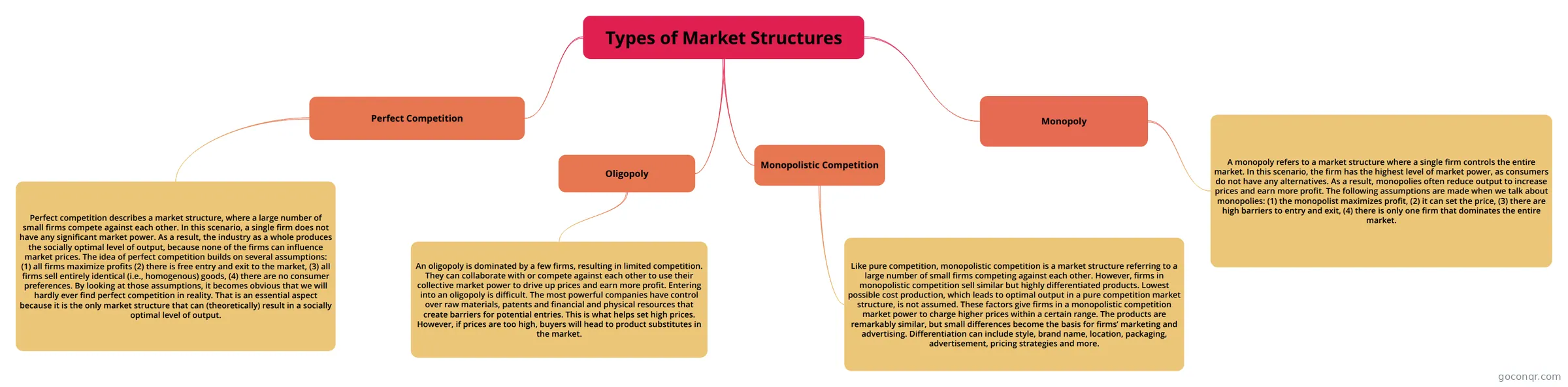
Mind map: Types of market structures
Map content
Types of Market Structures
Perfect Competition
- Perfect competition describes a market structure, where a large number of small firms compete against each other. In this scenario, a single firm does not have any significant market power. As a result, the industry as a whole produces the socially optimal level of output, because none of the firms can influence market prices. The idea of perfect competition builds on several assumptions: (1) all firms maximize profits (2) there is free entry and exit to the market, (3) all firms sell entirely identical (i.e., homogenous) goods, (4) there are no consumer preferences. By looking at those assumptions, it becomes obvious that we will hardly ever find perfect competition in reality. That is an essential aspect because it is the only market structure that can (theoretically) result in a socially optimal level of output.
Monopolistic Competition
- Like pure competition, monopolistic competition is a market structure referring to a large number of small firms competing against each other. However, firms in monopolistic competition sell similar but highly differentiated products. Lowest possible cost production, which leads to optimal output in a pure competition market structure, is not assumed. These factors give firms in a monopolistic competition market power to charge higher prices within a certain range. The products are remarkably similar, but small differences become the basis for firms’ marketing and advertising. Differentiation can include style, brand name, location, packaging, advertisement, pricing strategies and more.
Oligopoly
- An oligopoly is dominated by a few firms, resulting in limited competition. They can collaborate with or compete against each other to use their collective market power to drive up prices and earn more profit. Entering into an oligopoly is difficult. The most powerful companies have control over raw materials, patents and financial and physical resources that create barriers for potential entries. This is what helps set high prices. However, if prices are too high, buyers will head to product substitutes in the market.
Monopoly
- A monopoly refers to a market structure where a single firm controls the entire market. In this scenario, the firm has the highest level of market power, as consumers do not have any alternatives. As a result, monopolies often reduce output to increase prices and earn more profit. The following assumptions are made when we talk about monopolies: (1) the monopolist maximizes profit, (2) it can set the price, (3) there are high barriers to entry and exit, (4) there is only one firm that dominates the entire market.
Information
- Description
- Mind Map on Types of Market Structures, created by Yasser Carmona on 13/09/2021.
- Created by
- Yasser Carmona
- Views
- 1
- Rating