
Mind map
Foundations of Second Language Acquisition
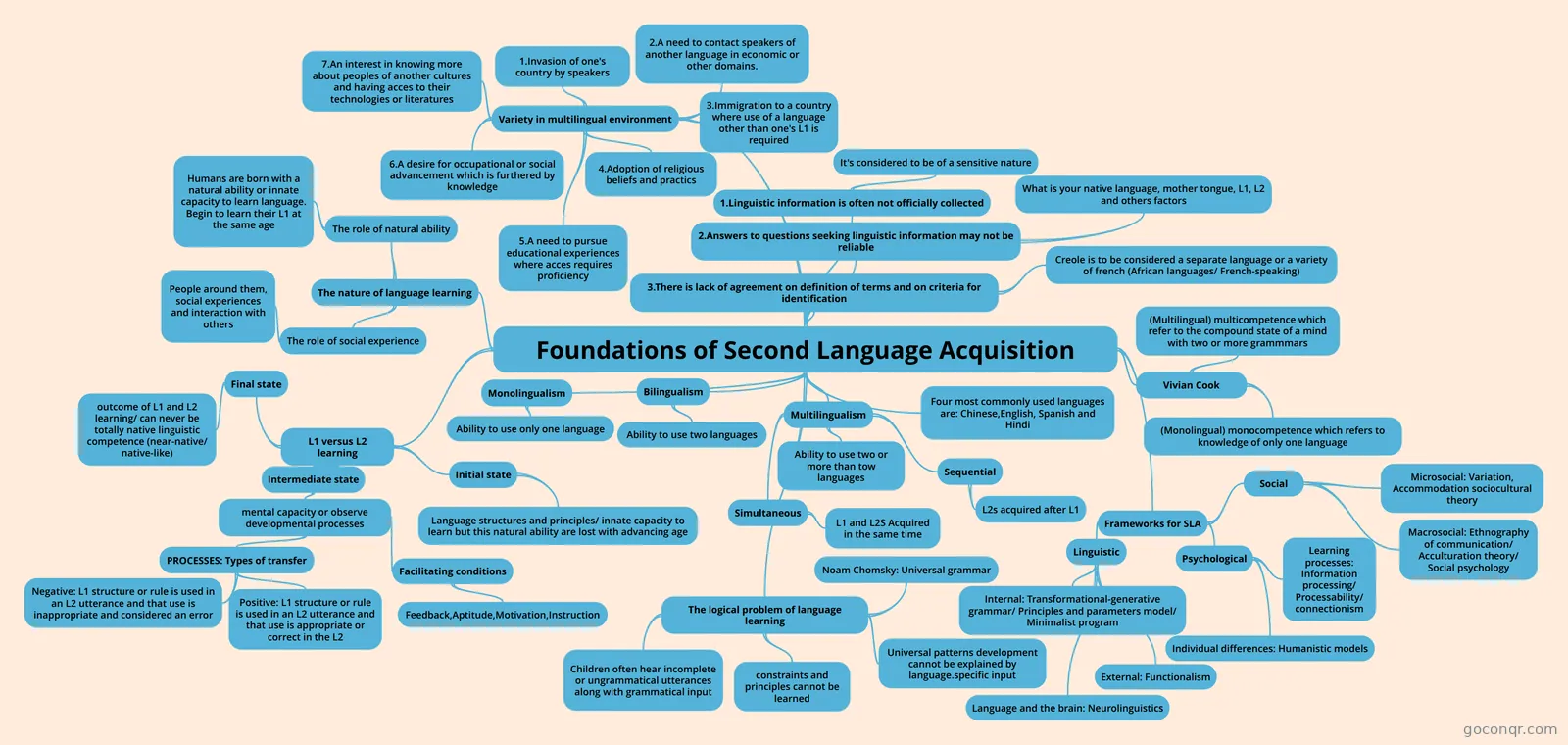
Mind map: Foundations of Second Language Acquisition
Map content
Foundations of Second Language Acquisition
Multilingualism
- Ability to use two or more than tow languages
- Simultaneous
- L1 and L2S Acquired in the same time
- Sequential
- L2s acquired after L1
Bilingualism
- Ability to use two languages
Monolingualism
- Ability to use only one language
Four most commonly used languages are: Chinese,English, Spanish and Hindi
Vivian Cook
- (Multilingual) multicompetence which refer to the compound state of a mind with two or more grammmars
- (Monolingual) monocompetence which refers to knowledge of only one language
Variety in multilingual environment
- 1.Invasion of one's country by speakers
- 2.A need to contact speakers of another language in economic or other domains.
- 3.Immigration to a country where use of a language other than one's L1 is required
- 4.Adoption of religious beliefs and practics
- 5.A need to pursue educational experiences where acces requires proficiency
- 6.A desire for occupational or social advancement which is furthered by knowledge
- 7.An interest in knowing more about peoples of another cultures and having acces to their technologies or literatures
2.Answers to questions seeking linguistic information may not be reliable
- What is your native language, mother tongue, L1, L2 and others factors
1.Linguistic information is often not officially collected
- It's considered to be of a sensitive nature
3.There is lack of agreement on definition of terms and on criteria for identification
- Creole is to be considered a separate language or a variety of french (African languages/ French-speaking)
The nature of language learning
- The role of natural ability
- Humans are born with a natural ability or innate capacity to learn language. Begin to learn their L1 at the same age
- The role of social experience
- People around them, social experiences and interaction with others
- The role of natural ability
L1 versus L2 learning
- Initial state
- Language structures and principles/ innate capacity to learn but this natural ability are lost with advancing age
- Final state
- outcome of L1 and L2 learning/ can never be totally native linguistic competence (near-native/ native-like)
- Intermediate state
- mental capacity or observe developmental processes
- PROCESSES: Types of transfer
- Positive: L1 structure or rule is used in an L2 utterance and that use is appropriate or correct in the L2
- Negative: L1 structure or rule is used in an L2 utterance and that use is inappropriate and considered an error
- Facilitating conditions
- Feedback,Aptitude,Motivation,Instruction
- PROCESSES: Types of transfer
- mental capacity or observe developmental processes
- Initial state
The logical problem of language learning
- Children often hear incomplete or ungrammatical utterances along with grammatical input
- Noam Chomsky: Universal grammar
- Universal patterns development cannot be explained by language.specific input
- constraints and principles cannot be learned
Frameworks for SLA
- Psychological
- Learning processes: Information processing/ Processability/ connectionism
- Individual differences: Humanistic models
- Linguistic
- Internal: Transformational-generative grammar/ Principles and parameters model/ Minimalist program
- External: Functionalism
- Language and the brain: Neurolinguistics
- Social
- Microsocial: Variation, Accommodation sociocultural theory
- Macrosocial: Ethnography of communication/ Acculturation theory/ Social psychology
- Psychological
Information
- Description
- Mind Map on Foundations of Second Language Acquisition, created by Ingrid Lizeth Campos on 06/09/2015.
- Created by
- Ingrid Lizeth Campos
- Views
- 3
- Rating