
Mind map
Types of Market Structures
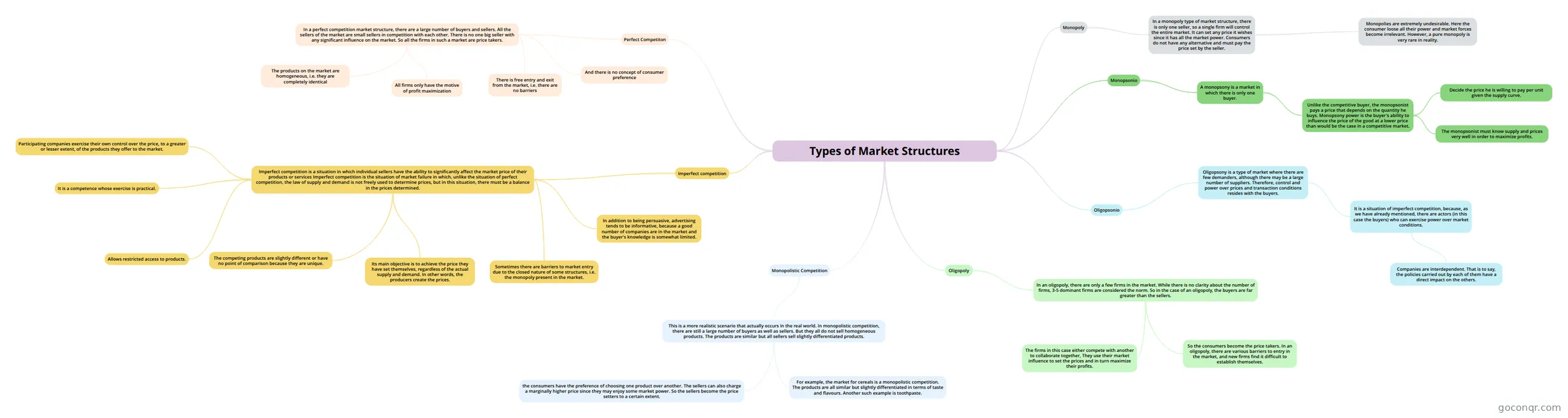
Mind map: types of market structures
Map content
Types of Market Structures
Monopolistic Competition
- This is a more realistic scenario that actually occurs in the real world. In monopolistic competition, there are still a large number of buyers as well as sellers. But they all do not sell homogeneous products. The products are similar but all sellers sell slightly differentiated products.
- the consumers have the preference of choosing one product over another. The sellers can also charge a marginally higher price since they may enjoy some market power. So the sellers become the price setters to a certain extent.
- For example, the market for cereals is a monopolistic competition. The products are all similar but slightly differentiated in terms of taste and flavours. Another such example is toothpaste.
- This is a more realistic scenario that actually occurs in the real world. In monopolistic competition, there are still a large number of buyers as well as sellers. But they all do not sell homogeneous products. The products are similar but all sellers sell slightly differentiated products.
Perfect Competiton
- In a perfect competition market structure, there are a large number of buyers and sellers. All the sellers of the market are small sellers in competition with each other. There is no one big seller with any significant influence on the market. So all the firms in such a market are price takers.
- The products on the market are homogeneous, i.e. they are completely identical
- All firms only have the motive of profit maximization
- There is free entry and exit from the market, i.e. there are no barriers
- And there is no concept of consumer preference
- In a perfect competition market structure, there are a large number of buyers and sellers. All the sellers of the market are small sellers in competition with each other. There is no one big seller with any significant influence on the market. So all the firms in such a market are price takers.
Oligopoly
- In an oligopoly, there are only a few firms in the market. While there is no clarity about the number of firms, 3-5 dominant firms are considered the norm. So in the case of an oligopoly, the buyers are far greater than the sellers.
- The firms in this case either compete with another to collaborate together, They use their market influence to set the prices and in turn maximize their profits.
- So the consumers become the price takers. In an oligopoly, there are various barriers to entry in the market, and new firms find it difficult to establish themselves.
- In an oligopoly, there are only a few firms in the market. While there is no clarity about the number of firms, 3-5 dominant firms are considered the norm. So in the case of an oligopoly, the buyers are far greater than the sellers.
Monopoly
- In a monopoly type of market structure, there is only one seller, so a single firm will control the entire market. It can set any price it wishes since it has all the market power. Consumers do not have any alternative and must pay the price set by the seller.
- Monopolies are extremely undesirable. Here the consumer loose all their power and market forces become irrelevant. However, a pure monopoly is very rare in reality.
- In a monopoly type of market structure, there is only one seller, so a single firm will control the entire market. It can set any price it wishes since it has all the market power. Consumers do not have any alternative and must pay the price set by the seller.
Monopsonio
- A monopsony is a market in which there is only one buyer.
- Unlike the competitive buyer, the monopsonist pays a price that depends on the quantity he buys. Monopsony power is the buyer's ability to influence the price of the good at a lower price than would be the case in a competitive market.
- Decide the price he is willing to pay per unit given the supply curve.
- The monopsonist must know supply and prices very well in order to maximize profits.
- Unlike the competitive buyer, the monopsonist pays a price that depends on the quantity he buys. Monopsony power is the buyer's ability to influence the price of the good at a lower price than would be the case in a competitive market.
- A monopsony is a market in which there is only one buyer.
Oligopsonio
- Oligopsony is a type of market where there are few demanders, although there may be a large number of suppliers. Therefore, control and power over prices and transaction conditions resides with the buyers.
- It is a situation of imperfect competition, because, as we have already mentioned, there are actors (in this case the buyers) who can exercise power over market conditions.
- Companies are interdependent. That is to say, the policies carried out by each of them have a direct impact on the others.
- It is a situation of imperfect competition, because, as we have already mentioned, there are actors (in this case the buyers) who can exercise power over market conditions.
- Oligopsony is a type of market where there are few demanders, although there may be a large number of suppliers. Therefore, control and power over prices and transaction conditions resides with the buyers.
Imperfect competition
- Imperfect competition is a situation in which individual sellers have the ability to significantly affect the market price of their products or services Imperfect competition is the situation of market failure in which, unlike the situation of perfect competition, the law of supply and demand is not freely used to determine prices, but in this situation, there must be a balance in the prices determined.
- Participating companies exercise their own control over the price, to a greater or lesser extent, of the products they offer to the market.
- It is a competence whose exercise is practical.
- The competing products are slightly different or have no point of comparison because they are unique.
- Its main objective is to achieve the price they have set themselves, regardless of the actual supply and demand. In other words, the producers create the prices.
- In addition to being persuasive, advertising tends to be informative, because a good number of companies are in the market and the buyer's knowledge is somewhat limited.
- Sometimes there are barriers to market entry due to the closed nature of some structures, i.e. the monopoly present in the market.
- Allows restricted access to products.
- Imperfect competition is a situation in which individual sellers have the ability to significantly affect the market price of their products or services Imperfect competition is the situation of market failure in which, unlike the situation of perfect competition, the law of supply and demand is not freely used to determine prices, but in this situation, there must be a balance in the prices determined.