
Mind map
MODAL VERBS GIVING ADVICE
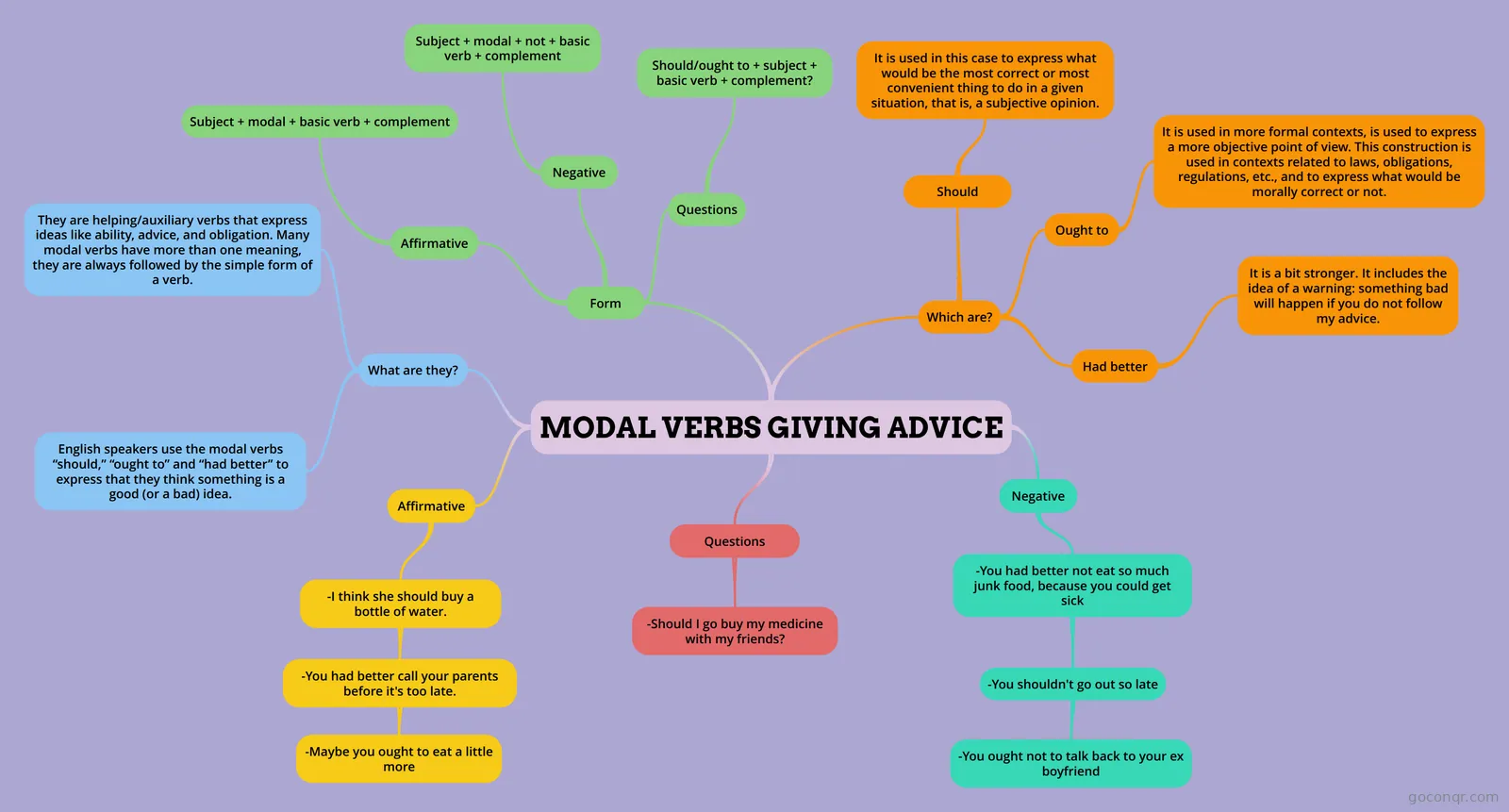
Mind map: Modal verbs giving advice
Map content
MODAL VERBS GIVING ADVICE
What are they?
- They are helping/auxiliary verbs that express ideas like ability, advice, and obligation. Many modal verbs have more than one meaning, they are always followed by the simple form of a verb.
- English speakers use the modal verbs “should,” “ought to” and “had better” to express that they think something is a good (or a bad) idea.
Form
- Affirmative
- Subject + modal + basic verb + complement
- Negative
- Subject + modal + not + basic verb + complement
- Questions
- Should/ought to + subject + basic verb + complement?
- Affirmative
Which are?
- Should
- It is used in this case to express what would be the most correct or most convenient thing to do in a given situation, that is, a subjective opinion.
- Ought to
- It is used in more formal contexts, is used to express a more objective point of view. This construction is used in contexts related to laws, obligations, regulations, etc., and to express what would be morally correct or not.
- Had better
- It is a bit stronger. It includes the idea of a warning: something bad will happen if you do not follow my advice.
- Should
Negative
- -You had better not eat so much junk food, because you could get sick
- -You shouldn't go out so late
- -You ought not to talk back to your ex boyfriend
- -You shouldn't go out so late
- -You had better not eat so much junk food, because you could get sick
Questions
- -Should I go buy my medicine with my friends?
Affirmative
- -I think she should buy a bottle of water.
- -You had better call your parents before it's too late.
- -Maybe you ought to eat a little more
- -You had better call your parents before it's too late.
- -I think she should buy a bottle of water.
Information
- Description
- Mind Map on MODAL VERBS GIVING ADVICE, created by Jhelen Secundino Venegas on 07/05/2022.
- Created by
- Jhelen Secundino Venegas
- Views
- 0
- Rating
More on Modals of Advice and Suggestions