
Mind map
quality
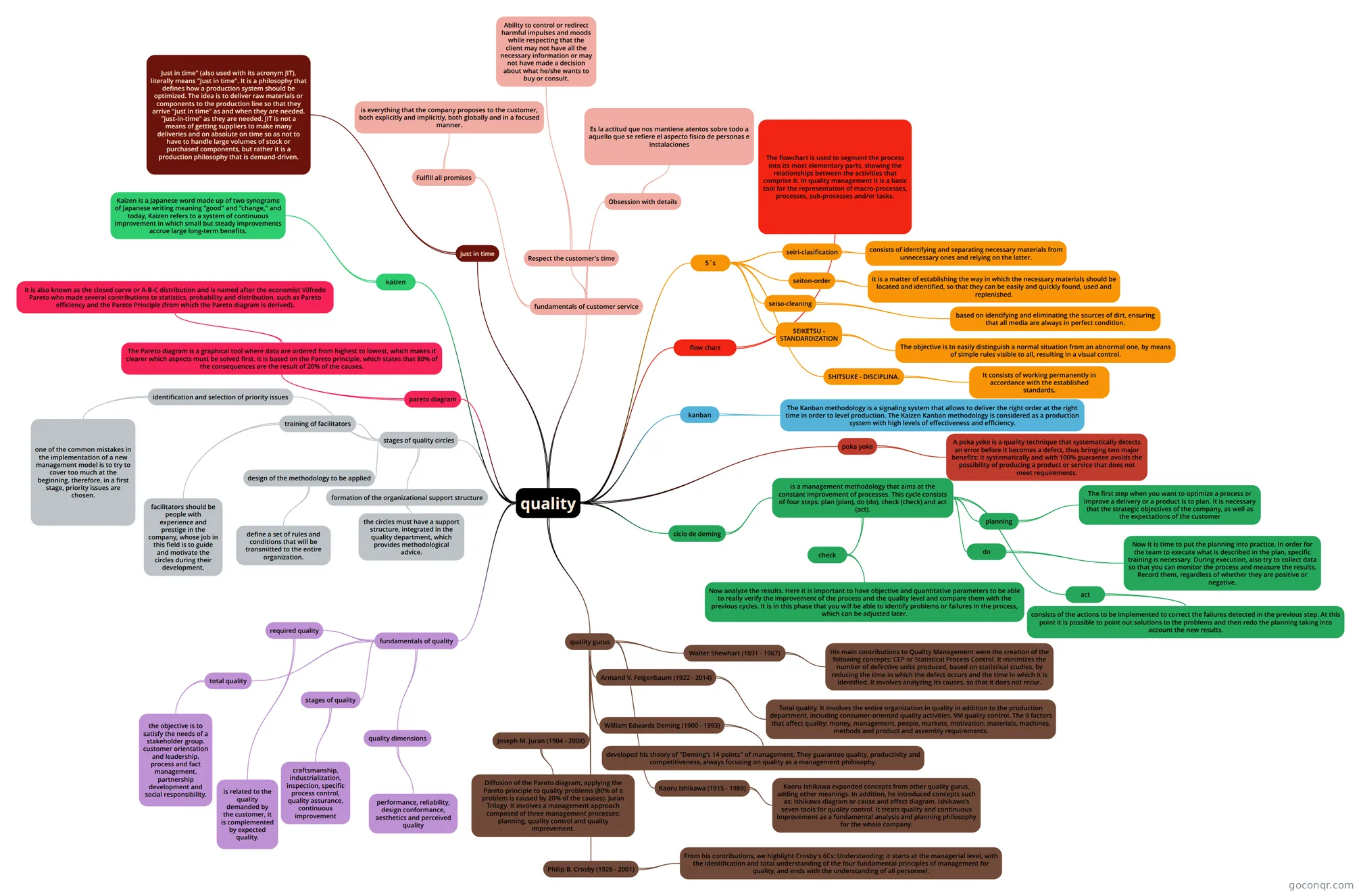
Mind map: quality
Map content
quality
5´s
- seiri-clasification
- consists of identifying and separating necessary materials from unnecessary ones and relying on the latter.
- seiton-order
- it is a matter of establishing the way in which the necessary materials should be located and identified, so that they can be easily and quickly found, used and replenished.
- seiso-cleaning
- based on identifying and eliminating the sources of dirt, ensuring that all media are always in perfect condition.
- SEIKETSU - STANDARDIZATION
- The objective is to easily distinguish a normal situation from an abnormal one, by means of simple rules visible to all, resulting in a visual control.
- SHITSUKE - DISCIPLINA.
- It consists of working permanently in accordance with the established standards.
- seiri-clasification
kanban
- The Kanban methodology is a signaling system that allows to deliver the right order at the right time in order to level production. The Kaizen Kanban methodology is considered as a production system with high levels of effectiveness and efficiency.
poka yoke
- A poka yoke is a quality technique that systematically detects an error before it becomes a defect, thus bringing two major benefits: It systematically and with 100% guarantee avoids the possibility of producing a product or service that does not meet requirements.
ciclo de deming
- is a management methodology that aims at the constant improvement of processes. This cycle consists of four steps: plan (plan), do (do), check (check) and act (act).
- planning
- The first step when you want to optimize a process or improve a delivery or a product is to plan. It is necessary that the strategic objectives of the company, as well as the expectations of the customer
- do
- Now it is time to put the planning into practice. In order for the team to execute what is described in the plan, specific training is necessary. During execution, also try to collect data so that you can monitor the process and measure the results. Record them, regardless of whether they are positive or negative.
- check
- Now analyze the results. Here it is important to have objective and quantitative parameters to be able to really verify the improvement of the process and the quality level and compare them with the previous cycles. It is in this phase that you will be able to identify problems or failures in the process, which can be adjusted later.
- act
- consists of the actions to be implemented to correct the failures detected in the previous step. At this point it is possible to point out solutions to the problems and then redo the planning taking into account the new results.
- planning
- is a management methodology that aims at the constant improvement of processes. This cycle consists of four steps: plan (plan), do (do), check (check) and act (act).
quality gurus
- Walter Shewhart (1891 - 1967)
- His main contributions to Quality Management were the creation of the following concepts: CEP or Statistical Process Control. It minimizes the number of defective units produced, based on statistical studies, by reducing the time in which the defect occurs and the time in which it is identified. It involves analyzing its causes, so that it does not recur.
- Armand V. Feigenbaum (1922 - 2014)
- Total quality. It involves the entire organization in quality in addition to the production department, including consumer-oriented quality activities. 9M quality control. The 9 factors that affect quality: money, management, people, markets, motivation, materials, machines, methods and product and assembly requirements.
- William Edwards Deming (1900 - 1993)
- developed his theory of "Deming's 14 points" of management. They guarantee quality, productivity and competitiveness, always focusing on quality as a management philosophy.
- Joseph M. Juran (1904 - 2008)
- Diffusion of the Pareto diagram, applying the Pareto principle to quality problems (80% of a problem is caused by 20% of the causes). Juran Trilogy. It involves a management approach composed of three management processes: planning, quality control and quality improvement.
- Kaoru Ishikawa (1915 - 1989)
- Kaoru Ishikawa expanded concepts from other quality gurus, adding other meanings. In addition, he introduced concepts such as: Ishikawa diagram or cause and effect diagram. Ishikawa's seven tools for quality control. It treats quality and continuous improvement as a fundamental analysis and planning philosophy for the whole company.
- Philip B. Crosby (1926 - 2001)
- From his contributions, we highlight Crosby's 6Cs: Understanding: it starts at the managerial level, with the identification and total understanding of the four fundamental principles of management for quality, and ends with the understanding of all personnel.
- Walter Shewhart (1891 - 1967)
fundamentals of quality
- quality dimensions
- performance, reliability, design conformance, aesthetics and perceived quality
- stages of quality
- craftsmanship, industrialization, inspection, specific process control, quality assurance, continuous improvement
- required quality
- is related to the quality demanded by the customer, it is complemented by expected quality.
- total quality
- the objective is to satisfy the needs of a stakeholder group. customer orientation and leadership. process and fact management. partnership development and social responsibility.
- quality dimensions
stages of quality circles
- formation of the organizational support structure
- the circles must have a support structure, integrated in the quality department, which provides methodological advice.
- design of the methodology to be applied
- define a set of rules and conditions that will be transmitted to the entire organization.
- training of facilitators
- facilitators should be people with experience and prestige in the company, whose job in this field is to guide and motivate the circles during their development.
- identification and selection of priority issues
- one of the common mistakes in the implementation of a new management model is to try to cover too much at the beginning. therefore, in a first stage, priority issues are chosen.
- formation of the organizational support structure
flow chart
- The flowchart is used to segment the process into its most elementary parts, showing the relationships between the activities that comprise it. In quality management it is a basic tool for the representation of macro-processes, processes, sub-processes and/or tasks.
pareto diagram
- The Pareto diagram is a graphical tool where data are ordered from highest to lowest, which makes it clearer which aspects must be solved first. It is based on the Pareto principle, which states that 80% of the consequences are the result of 20% of the causes.
- It is also known as the closed curve or A-B-C distribution and is named after the economist Vilfredo Pareto who made several contributions to statistics, probability and distribution, such as Pareto efficiency and the Pareto Principle (from which the Pareto diagram is derived).
- The Pareto diagram is a graphical tool where data are ordered from highest to lowest, which makes it clearer which aspects must be solved first. It is based on the Pareto principle, which states that 80% of the consequences are the result of 20% of the causes.
kaizen
- Kaizen is a Japanese word made up of two synograms of Japanese writing meaning "good" and "change," and today, Kaizen refers to a system of continuous improvement in which small but steady improvements accrue large long-term benefits.
just in time
- Just in time" (also used with its acronym JIT), literally means "Just in time". It is a philosophy that defines how a production system should be optimized. The idea is to deliver raw materials or components to the production line so that they arrive "just in time" as and when they are needed. "just-in-time" as they are needed. JIT is not a means of getting suppliers to make many deliveries and on absolute on time so as not to have to handle large volumes of stock or purchased components, but rather it is a production philosophy that is demand-driven.
fundamentals of customer service
- Fulfill all promises
- is everything that the company proposes to the customer, both explicitly and implicitly, both globally and in a focused manner.
- Respect the customer's time
- Ability to control or redirect harmful impulses and moods while respecting that the client may not have all the necessary information or may not have made a decision about what he/she wants to buy or consult.
- Obsession with details
- Es la actitud que nos mantiene atentos sobre todo a aquello que se refiere el aspecto físico de personas e instalaciones
- Fulfill all promises
Information
- Description
- Mind Map on quality, created by XAVIER RODRIGUEZ VAZQUEZ on 18/11/2022.
- Created by
- XAVIER RODRIGUEZ VAZQUEZ
- Views
- 2
- Rating
More on Continuous Improvement and Lean