
Mind map
Probiotics in periodontics
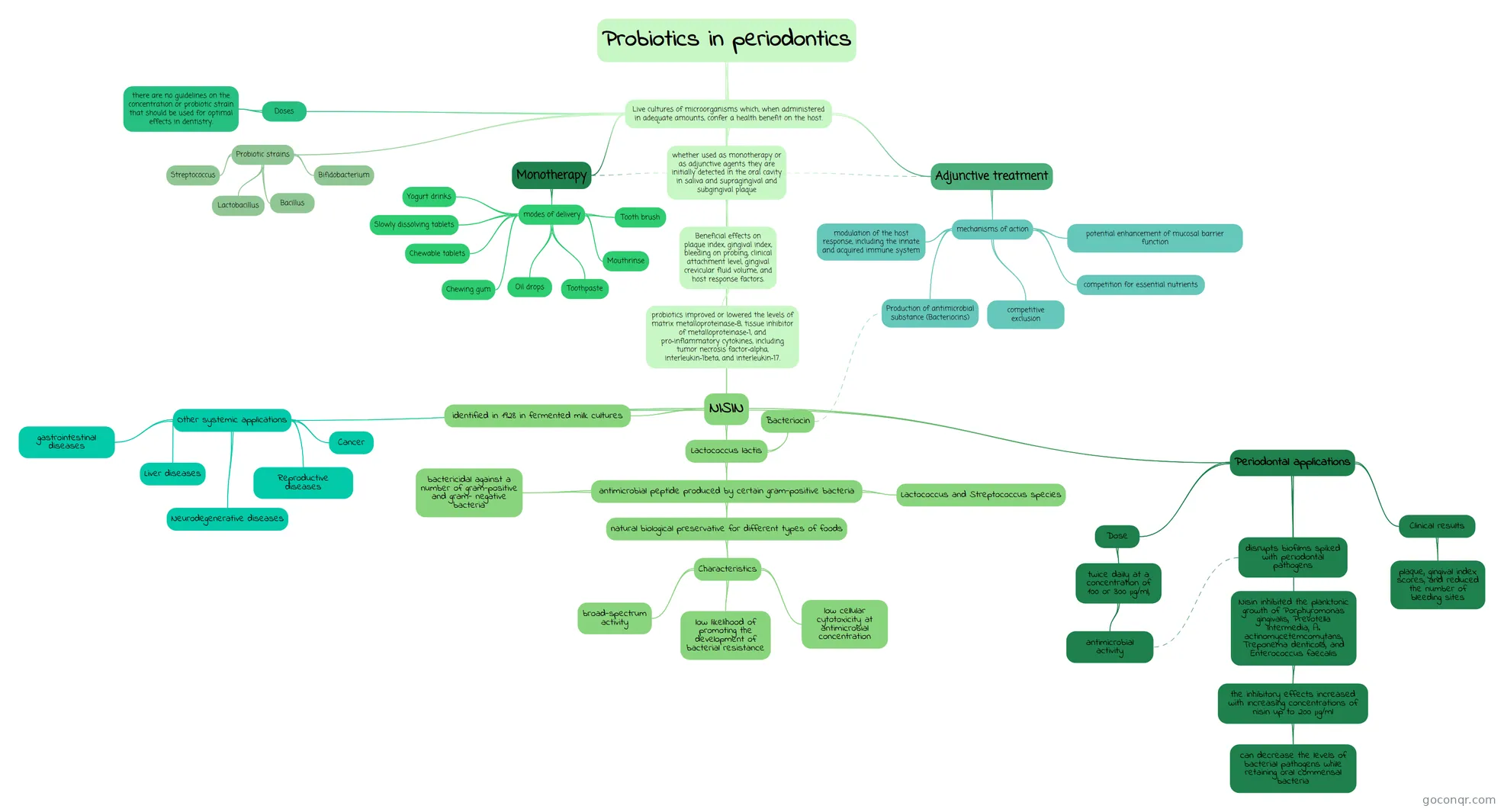
Mind map: Probiotics in periodontics
Map content
Probiotics in periodontics
Live cultures of microorganisms which, when administered in adequate amounts, confer a health benefit on the host.
- Monotherapy
- modes of delivery
- Chewable tablets
- Chewing gum
- Toothpaste
- Mouthrinse
- Tooth brush
- Slowly dissolving tablets
- Oil drops
- Yogurt drinks
- modes of delivery
- Adjunctive treatment
- mechanisms of action
- modulation of the host response, including the innate and acquired immune system
- Production of antimicrobial substance (Bacteriocins)
- competitive exclusion
- competition for essential nutrients
- potential enhancement of mucosal barrier function
- mechanisms of action
- Probiotic strains
- Streptococcus
- Lactobacillus
- Bacillus
- Bifidobacterium
- Doses
- there are no guidelines on the concentration or probiotic strain that should be used for optimal effects in dentistry.
- whether used as monotherapy or as adjunctive agents they are initially detected in the oral cavity in saliva and supragingival and subgingival plaque
- Beneficial effects on plaque index, gingival index, bleeding on probing, clinical attachment level, gingival crevicular fluid volume, and host response factors.
- probiotics improved or lowered the levels of matrix metalloproteinase‐8, tissue inhibitor of metalloproteinase‐1, and pro‐inflammatory cytokines, including tumor necrosis factor‐alpha, interleukin‐1beta, and interleukin‐17.
- Beneficial effects on plaque index, gingival index, bleeding on probing, clinical attachment level, gingival crevicular fluid volume, and host response factors.
- Monotherapy
NISIN
- Lactococcus lactis
- Bacteriocin
- antimicrobial peptide produced by certain gram‐positive bacteria
- Lactococcus and Streptococcus species
- natural biological preservative for different types of foods
- Characteristics
- broad‐spectrum activity
- low likelihood of promoting the development of bacterial resistance
- low cellular cytotoxicity at antimicrobial concentration
- Characteristics
- bactericidal against a number of gram‐positive and gram‐ negative bacteria
- identified in 1928 in fermented milk cultures
- Periodontal applications
- Clinical results
- plaque, gingival index scores, and reduced the number of bleeding sites
- Nisin inhibited the planktonic growth of Porphyromonas gingivalis, Prevotella intermedia, A. actinomycetemcomytans, Treponema denticola, and Enterococcus faecalis
- the inhibitory effects increased with increasing concentrations of nisin up to 200 μg/ml
- can decrease the levels of bacterial pathogens while retaining oral commensal bacteria
- the inhibitory effects increased with increasing concentrations of nisin up to 200 μg/ml
- disrupts biofilms spiked with periodontal pathogens
- Dose
- twice daily at a concentration of 100 or 300 μg/ml,
- antimicrobial activity
- twice daily at a concentration of 100 or 300 μg/ml,
- Clinical results
- Other systemic applications
- gastrointestinal diseases
- Liver diseases
- Neurodegenerative diseases
- Reproductive diseases
- Cancer
- Lactococcus lactis
Information
- Description
- Mind Map on Probiotics in periodontics, created by CAMILLA PELAEZ GARCIA on 04/09/2024.
- Created by
- CAMILLA PELAEZ GARCIA
- Views
- 0
- Rating
More on Periodontal therapy and plaque control