
Mind map
THE ADJECTIVE PHRASE
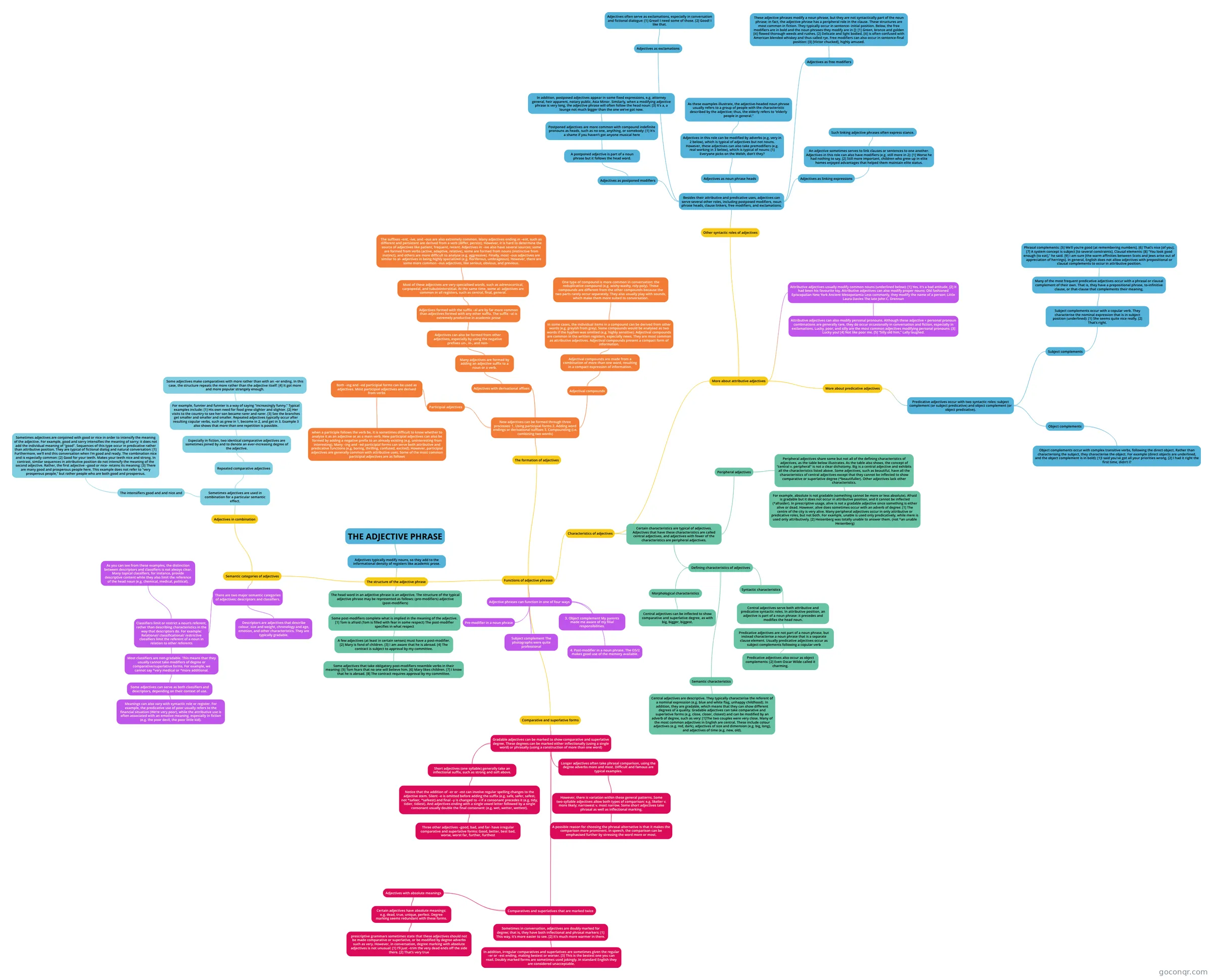
Mind map: The adjective phrase
Map content
THE ADJECTIVE PHRASE
Adjectives typically modify nouns, so they add to the informational density of registers like academic prose.
- The structure of the adjective phrase
- The head word in an adjective phrase is an adjective. The structure of the typical adjective phrase may be represented as follows: (pre-modifiers) adjective (post-modifiers)
- Some post-modifiers complete what is implied in the meaning of the adjective. [1] Tom is afraid (Tom is filled with fear in some respect) The post-modifier specifies in what respect
- A few adjectives (at least in certain senses) must have a post-modifier. [2] Mary is fond of children. [3] I am aware that he is abroad. [4] The contract is subject to approval by my committee.
- Some adjectives that take obligatory post-modifiers resemble verbs in their meaning: [5] Tom fears that no one will believe him. [6] Mary likes children. [7] I know that he is abroad. [8] The contract requires approval by my committee.
- A few adjectives (at least in certain senses) must have a post-modifier. [2] Mary is fond of children. [3] I am aware that he is abroad. [4] The contract is subject to approval by my committee.
- Some post-modifiers complete what is implied in the meaning of the adjective. [1] Tom is afraid (Tom is filled with fear in some respect) The post-modifier specifies in what respect
- Functions of adjective phrases
- Adjective phrases can function in one of four ways
- Pre-modifier in a noun phrase
- Subject complement The photographs were quite professional
- 3. Object complement My parents made me aware of my filial responsibilities.
- 4. Post-modifier in a noun phrase. The OS/2 makes good use of the memory available.
- Characteristics of adjectives
- Certain characteristics are typical of adjectives. Adjectives that have these characteristics are called central adjectives, and adjectives with fewer of the characteristics are peripheral adjectives.
- Defining characteristics of adjectives
- Morphological characteristics
- Central adjectives can be inflected to show comparative and superlative degree, as with big, bigger, biggest.
- Syntactic characteristics
- Central adjectives serve both attributive and predicative syntactic roles. In attributive position, an adjective is part of a noun phrase: it precedes and modifies the head noun.
- Predicative adjectives are not part of a noun phrase, but instead characterise a noun phrase that is a separate clause element. Usually predicative adjectives occur as subject complements following a copular verb
- Predicative adjectives also occur as object complements: [2] Even Oscar Wilde called it charming.
- Predicative adjectives are not part of a noun phrase, but instead characterise a noun phrase that is a separate clause element. Usually predicative adjectives occur as subject complements following a copular verb
- Central adjectives serve both attributive and predicative syntactic roles. In attributive position, an adjective is part of a noun phrase: it precedes and modifies the head noun.
- Semantic characteristics
- Central adjectives are descriptive. They typically characterise the referent of a nominal expression (e.g. blue and white flag, unhappy childhood). In addition, they are gradable, which means that they can show different degrees of a quality. Gradable adjectives can take comparative and superlative forms (e.g. close, closer, closest) and can be modified by an adverb of degree, such as very: [1]The two couples were very close. Many of the most common adjectives in English are central. These include colour adjectives (e.g. red, dark), adjectives of size and dimension (e.g. big, long), and adjectives of time (e.g. new, old).
- Morphological characteristics
- Peripheral adjectives
- Peripheral adjectives share some but not all of the defining characteristics of adjectives, as the table below illustrates. As the table also shows, the concept of “central v. peripheral” is not a clear dichotomy. Big is a central adjective and exhibits all the characteristics listed above. Some adjectives, such as beautiful, have all the characteristics of central adjectives except that they cannot be inflected to show comparative or superlative degree (*beautifuller). Other adjectives lack other characteristics.
- For example, absolute is not gradable (something cannot be more or less absolute). Afraid is gradable but it does not occur in attributive position, and it cannot be inflected (*afraider). In prescriptive usage, alive is not a gradable adjective since something is either alive or dead. However, alive does sometimes occur with an adverb of degree: [1] The centre of the city is very alive. Many peripheral adjectives occur in only attributive or predicative roles, but not both. For example, unable is used only predicatively, while mere is used only attributively. [2] Heisenberg was totally unable to answer them. (not *an unable Heisenberg)
- Peripheral adjectives share some but not all of the defining characteristics of adjectives, as the table below illustrates. As the table also shows, the concept of “central v. peripheral” is not a clear dichotomy. Big is a central adjective and exhibits all the characteristics listed above. Some adjectives, such as beautiful, have all the characteristics of central adjectives except that they cannot be inflected to show comparative or superlative degree (*beautifuller). Other adjectives lack other characteristics.
- Defining characteristics of adjectives
- More about attributive adjectives
- Attributive adjectives usually modify common nouns (underlined below): [1] Yes, it’s a bad attitude. [2] It had been his favourite toy. Attributive adjectives can also modify proper nouns: Old fashioned Episcopalian New York Ancient Mesopotamia Less commonly, they modify the name of a person: Little Laura Davies The late John C. Drennan
- Attributive adjectives can also modify personal pronouns. Although these adjective + personal pronoun combinations are generally rare, they do occur occasionally in conversation and fiction, especially in exclamations. Lucky, poor, and silly are the most common adjectives modifying personal pronouns: [3] Lucky you! [4] Not like poor me. [5] “Silly old him,” Lally laughed.
- More about predicative adjectives
- Predicative adjectives occur with two syntactic roles: subject complement (or subject predicative) and object complement (or object predicative).
- Subject complements
- Subject complements occur with a copular verb. They characterise the nominal expression that is in subject position (underlined): [1] She seems quite nice really. [2] That’s right.
- Many of the most frequent predicative adjectives occur with a phrasal or clausal complement of their own. That is, they have a prepositional phrase, to-infinitive clause, or that-clause that complements their meaning.
- Phrasal complements: [5] We’ll you’re good [at remembering numbers]. [6] That’s nice [of you]. [7] A system concept is subject [to several constraints]. Clausal elements: [8] “You look good enough [to eat],” he said. [9] I am sure [the warm affinities between Scots and Jews arise out of appreciation of herrings]. In general, English does not allow adjectives with prepositional or clausal complements to occur in attributive position.
- Many of the most frequent predicative adjectives occur with a phrasal or clausal complement of their own. That is, they have a prepositional phrase, to-infinitive clause, or that-clause that complements their meaning.
- Subject complements occur with a copular verb. They characterise the nominal expression that is in subject position (underlined): [1] She seems quite nice really. [2] That’s right.
- Object complements
- Object complements occur with complex transitive verbs, following the direct object. Rather than characterising the subject, they characterise the object. For example (direct objects are underlined, and the object complement is in bold): [1]I said you’ve got all your priorities wrong. [2] I had it right the first time, didn’t I?
- Subject complements
- Predicative adjectives occur with two syntactic roles: subject complement (or subject predicative) and object complement (or object predicative).
- Other syntactic roles of adjectives
- Besides their attributive and predicative uses, adjectives can serve several other roles, including postposed modifiers, noun phrase heads, clause linkers, free modifiers, and exclamations.
- Adjectives as postponed modifiers
- A postponed adjective is part of a noun phrase but it follows the head word.
- Postponed adjectives are more common with compound indefinite pronouns as heads, such as no one, anything, or somebody: [1] It’s a shame if you haven’t got anyone musical here
- In addition, postposed adjectives appear in some fixed expressions, e.g. attorney general, heir apparent, notary public, Asia Minor. Similarly, when a modifying adjective phrase is very long, the adjective phrase will often follow the head noun: [3] It’s a, a lounge not much bigger than the one we’ve got now.
- Postponed adjectives are more common with compound indefinite pronouns as heads, such as no one, anything, or somebody: [1] It’s a shame if you haven’t got anyone musical here
- A postponed adjective is part of a noun phrase but it follows the head word.
- Adjectives as noun phrase heads
- Adjectives in this role can be modified by adverbs (e.g. very in 2 below), which is typical of adjectives but not nouns. However, these adjectives can also take premodifiers (e.g. real working in 3 below), which is typical of nouns: [1] Everyone picks on the Welsh, don’t they?
- As these examples illustrate, the adjective-headed noun phrase usually refers to a group of people with the characteristic described by the adjective; thus, the elderly refers to “elderly people in general.”
- Adjectives in this role can be modified by adverbs (e.g. very in 2 below), which is typical of adjectives but not nouns. However, these adjectives can also take premodifiers (e.g. real working in 3 below), which is typical of nouns: [1] Everyone picks on the Welsh, don’t they?
- Adjectives as linking expressions
- An adjective sometimes serves to link clauses or sentences to one another. Adjectives in this role can also have modifiers (e.g. still more in 2): [1] Worse he had nothing to say. [2] Still more important, children who grew up in elite homes enjoyed advantages that helped them maintain elite status.
- Such linking adjective phrases often express stance.
- An adjective sometimes serves to link clauses or sentences to one another. Adjectives in this role can also have modifiers (e.g. still more in 2): [1] Worse he had nothing to say. [2] Still more important, children who grew up in elite homes enjoyed advantages that helped them maintain elite status.
- Adjectives as free modifiers
- These adjective phrases modify a noun phrase, but they are not syntactically part of the noun phrase; in fact, the adjective phrase has a peripheral role in the clause. These structures are most common in fiction. They typically occur in sentence- initial position. Below, the free modifiers are in bold and the noun phrases they modify are in []: [1] Green, bronze and golden [it] flowed thorough weeds and rushes. [2] Delicate and light bodied, [it] is often confused with American blended whiskey and thus called rye. Free modifiers can also occur in sentence-final position: [3] [Victor chucked], highly amused.
- Adjectives as exclamations
- Adjectives often serve as exclamations, especially in conversation and fictional dialogue: [1] Great! I need some of those. [2] Good! I like that.
- Adjectives as postponed modifiers
- Besides their attributive and predicative uses, adjectives can serve several other roles, including postposed modifiers, noun phrase heads, clause linkers, free modifiers, and exclamations.
- Attributive adjectives usually modify common nouns (underlined below): [1] Yes, it’s a bad attitude. [2] It had been his favourite toy. Attributive adjectives can also modify proper nouns: Old fashioned Episcopalian New York Ancient Mesopotamia Less commonly, they modify the name of a person: Little Laura Davies The late John C. Drennan
- Certain characteristics are typical of adjectives. Adjectives that have these characteristics are called central adjectives, and adjectives with fewer of the characteristics are peripheral adjectives.
- The formation of adjectives
- New adjectives can be formed through three processes: 1. Using participial forms 2. Adding word endings or derivational suffixes 3. Compounding (i.e. combining two words)
- Participial adjectives
- Both –ing and –ed participial forms can be used as adjectives. Most participial adjectives are derived from verbs
- when a participle follows the verb be, it is sometimes difficult to know whether to analyse it as an adjective or as a main verb. New participial adjectives can also be formed by adding a negative prefix to an already existing (e.g. uninteresting from interesting). Many –ing and –ed participial forms can serve both attributive and predicative functions (e.g. boring, thrilling, confused, excited). However, participial adjectives are generally common with attributive uses. Some of the most common participial adjectives are as follows
- Both –ing and –ed participial forms can be used as adjectives. Most participial adjectives are derived from verbs (e.g. promising, surprised, determined). In fact, when a participle follows the verb be, it is sometimes difficult to know whether to analyse it as an adjective or as a main verb. New participial adjectives can also be formed by adding a negative prefix to an already existing (e.g. uninteresting from interesting). Many –ing and –ed participial forms can serve both attributive and predicative functions (e.g. boring, thrilling, confused, excited). However, participial adjectives are generally common with attributive uses. Some of the most common participial adjectives are as follows: Common –ing participial adjectives: amazing, boring, corresponding, encouraging, exciting, existing, following, increasing, interesting, leading, missing, outstanding, promising, remaining, threatening, underlying, willing, working Common –ed participial adjectives: advanced, alleged, armed, ashamed, bored, complicated, confused, depressed, determined, disabled, disappointed, educated, excited, exhausted, frightened, interested, pleased, surprised, tired, unemployed, unexpected, worried
- when a participle follows the verb be, it is sometimes difficult to know whether to analyse it as an adjective or as a main verb. New participial adjectives can also be formed by adding a negative prefix to an already existing (e.g. uninteresting from interesting). Many –ing and –ed participial forms can serve both attributive and predicative functions (e.g. boring, thrilling, confused, excited). However, participial adjectives are generally common with attributive uses. Some of the most common participial adjectives are as follows
- Both –ing and –ed participial forms can be used as adjectives. Most participial adjectives are derived from verbs
- Adjectives with derivational affixes
- Many adjectives are formed by adding an adjective suffix to a noun or a verb.
- Adjectives can also be formed from other adjectives, especially by using the negative prefixes un-, in-, and non-
- Adjectives formed with the suffix –al are by far more common than adjectives formed with any other suffix. The suffix –al is extremely productive in academic prose
- Most of these adjectives are very specialised words, such as adrenocortical, carpopedal, and tubulointerstitial. At the same time, some al- adjectives are common in all registers, such as central, final, general.
- The suffixes –ent, -ive, and –ous are also extremely common. Many adjectives ending in –ent, such as different and persistent are derived from a verb (differ, persist). However, it is hard to determine the source of adjectives like patient, frequent, recent. Adjectives in –ive also have several sources: some are formed from verbs (active, adaptive, relative), some are formed from nouns (instinctive from instinct), and others are more difficult to analyse (e.g. aggressive). Finally, most –ous adjectives are similar to al- adjectives in being highly specialized (e.g. floriferous, umbrageous). However, there are some more common –ous adjectives, like serious, obvious, and previous.
- Most of these adjectives are very specialised words, such as adrenocortical, carpopedal, and tubulointerstitial. At the same time, some al- adjectives are common in all registers, such as central, final, general.
- Adjectives formed with the suffix –al are by far more common than adjectives formed with any other suffix. The suffix –al is extremely productive in academic prose
- Adjectives can also be formed from other adjectives, especially by using the negative prefixes un-, in-, and non-
- Many adjectives are formed by adding an adjective suffix to a noun or a verb.
- Adjectival compounds
- Adjectival compounds are made from a combination of more than one word, resulting in a compact expression of information.
- In some cases, the individual items in a compound can be derived from other words (e.g. greyish from grey). Some compounds would be analysed as two words if the hyphen was omitted (e.g. highly sensitive). Adjectival compounds are common in the written registers, especially news. They are most common as attributive adjectives. Adjectival compounds present a compact form of information.
- One type of compound is more common in conversation: the reduplicative compound (e.g. wishy-washy, roly-poly). These compounds are different from the other compounds because the two parts rarely occur separately. They also usually play with sounds, which make them more suited to conversation.
- In some cases, the individual items in a compound can be derived from other words (e.g. greyish from grey). Some compounds would be analysed as two words if the hyphen was omitted (e.g. highly sensitive). Adjectival compounds are common in the written registers, especially news. They are most common as attributive adjectives. Adjectival compounds present a compact form of information.
- Adjectival compounds are made from a combination of more than one word, resulting in a compact expression of information.
- Participial adjectives
- New adjectives can be formed through three processes: 1. Using participial forms 2. Adding word endings or derivational suffixes 3. Compounding (i.e. combining two words)
- Comparative and superlative forms
- Gradable adjectives can be marked to show comparative and superlative degree. These degrees can be marked either inflectionally (using a single word) or phrasally (using a construction of more than one word)
- Short adjectives (one syllable) generally take an inflectional suffix, such as strong and soft above.
- Notice that the addition of –er or –est can involve regular spelling changes to the adjective stem. Silent –e is omitted before adding the suffix (e.g. safe, safer, safest, not *safeer, *safeest) and final –y is changed to –i if a consonant precedes it (e.g. tidy, tidier, tidiest). And adjectives ending with a single vowel letter followed by a single consonant usually double the final consonant: (e.g. wet, wetter, wettest).
- Three other adjectives –good, bad, and far- have irregular comparative and superlative forms: Good, better, best bad, worse, worst far, further, furthest
- Notice that the addition of –er or –est can involve regular spelling changes to the adjective stem. Silent –e is omitted before adding the suffix (e.g. safe, safer, safest, not *safeer, *safeest) and final –y is changed to –i if a consonant precedes it (e.g. tidy, tidier, tidiest). And adjectives ending with a single vowel letter followed by a single consonant usually double the final consonant: (e.g. wet, wetter, wettest).
- Longer adjectives often take phrasal comparison, using the degree adverbs more and most. Difficult and famous are typical examples.
- However, there is variation within these general patterns. Some two-syllable adjectives allow both types of comparison: e.g. likelier v. more likely; narrowest v. most narrow. Some short adjectives take phrasal as well as inflectional marking.
- A possible reason for choosing the phrasal alternative is that it makes the comparison more prominent. In speech, the comparison can be emphasised further by stressing the word more or most.
- However, there is variation within these general patterns. Some two-syllable adjectives allow both types of comparison: e.g. likelier v. more likely; narrowest v. most narrow. Some short adjectives take phrasal as well as inflectional marking.
- Comparatives and superlatives that are marked twice
- Sometimes in conversation, adjectives are doubly marked for degree; that is, they have both inflectional and phrasal markers: [1] This way, it’s more easier to see. [2] It’s much more warmer in there.
- In addition, irregular comparatives and superlatives are sometimes given the regular –er or –est ending, making bestest or worser. [3] This is the bestest one you can read. Doubly marked forms are sometimes used jokingly. In standard English they are considered unacceptable.
- Adjectives with absolute meanings
- Certain adjectives have absolute meanings: e.g. dead, true, unique, perfect. Degree marking seems redundant with these forms.
- prescriptive grammars sometimes state that these adjectives should not be made comparative or superlative, or be modified by degree adverbs such as very. However, in conversation, degree marking with absolute adjectives is not unusual: [1] I’ll just –trim the very dead ends off the side there. [2] That’s very true
- Certain adjectives have absolute meanings: e.g. dead, true, unique, perfect. Degree marking seems redundant with these forms.
- Sometimes in conversation, adjectives are doubly marked for degree; that is, they have both inflectional and phrasal markers: [1] This way, it’s more easier to see. [2] It’s much more warmer in there.
- Short adjectives (one syllable) generally take an inflectional suffix, such as strong and soft above.
- Gradable adjectives can be marked to show comparative and superlative degree. These degrees can be marked either inflectionally (using a single word) or phrasally (using a construction of more than one word)
- Adjective phrases can function in one of four ways
- Semantic categories of adjectives
- There are two major semantic categories of adjectives: descriptors and classifiers.
- Descriptors are adjectives that describe colour, size and weight, chronology and age, emotion, and other characteristics. They are typically gradable.
- For example: Colour descriptors: black, dark, bright, blue, brown, green, grey, red Size/ quantity/ extent descriptors: big, deep, heavy, huge, long, large, little, short, small, thin, wide Time descriptors describe chronology, age, and frequency: annual, daily, early, late, new, old, recent, young Evaluative/emotive descriptors denote judgements, emotions, and emphasis: bad, beautiful, best, fine, good, great, lovely, nice, poor Miscellaneous descriptors cover many other kinds of characteristics: appropriate, cold, complex, dead, empty, free, hard, hot, open, positive, practical, private, serious, strange, strong, sudden.
- Classifiers limit or restrict a noun’s referent, rather than describing characteristics in the way that descriptors do. For example: Relational/ classificational/ restrictive classifiers limit the referent of a noun in relation to other referents
- Classifiers limit or restrict a noun’s referent, rather than describing characteristics in the way that descriptors do. For example: Relational/ classificational/ restrictive classifiers limit the referent of a noun in relation to other referents: additional, average, chief, complete, different, direct, entire, external, final, following, general, initial, internal, left, main, maximum, necessary, original, particular, previous, primary, public, similar, single, standard, top, various Affiliative classifiers identify the national or social group of a referent: American, Chinese, Christian, English, French, German, Irish, United Topical/other classifiers give the subject area or specific type of a noun: chemical, commercial, environmental, human, industrial, legal, medical, mental, official, oral, phonetic, political, sexual, social, visual.
- As you can see from these examples, the distinction between descriptors and classifiers is not always clear. Many topical classifiers, for instance, provide descriptive content while they also limit the reference of the head noun (e.g. chemical, medical, political).
- Most classifiers are non-gradable. This means that they usually cannot take modifiers of degree or comparative/superlative forms. For example, we cannot say *very medical or *more additional.
- Some adjectives can serve as both classifiers and descriptors, depending on their context of use.
- Meanings can also vary with syntactic role or register. For example, the predicative use of poor usually refers to the financial situation (We’re very poor), while the attributive use is often associated with an emotive meaning, especially in fiction (e.g. the poor devil, the poor little kid).
- Some adjectives can serve as both classifiers and descriptors, depending on their context of use.
- Descriptors are adjectives that describe colour, size and weight, chronology and age, emotion, and other characteristics. They are typically gradable.
- Adjectives in combination
- Sometimes adjectives are used in combination for a particular semantic effect.
- Repeated comparative adjectives
- Especially in fiction, two identical comparative adjectives are sometimes joined by and to denote an ever-increasing degree of the adjective.
- For example, funnier and funnier is a way of saying “increasingly funny.” Typical examples include: [1] His own need for food grew slighter and slighter. [2] Her visits to the country to see her son became rarer and rarer. [3] See the branches get smaller and smaller and smaller. Repeated adjectives typically occur after resulting copular verbs, such as grew in 1, become in 2, and get in 3. Example 3 also shows that more than one repetition is possible.
- Some adjectives make comparatives with more rather than with an –er ending. In this case, the structure repeats the more rather than the adjective itself: [4] It got more and more popular strangely enough.
- For example, funnier and funnier is a way of saying “increasingly funny.” Typical examples include: [1] His own need for food grew slighter and slighter. [2] Her visits to the country to see her son became rarer and rarer. [3] See the branches get smaller and smaller and smaller. Repeated adjectives typically occur after resulting copular verbs, such as grew in 1, become in 2, and get in 3. Example 3 also shows that more than one repetition is possible.
- Especially in fiction, two identical comparative adjectives are sometimes joined by and to denote an ever-increasing degree of the adjective.
- The intensifiers good and and nice and
- Sometimes adjectives are conjoined with good or nice in order to intensify the meaning of the adjective. For example, good and sorry intensifies the meaning of sorry; it does not add the individual meaning of “good”. Sequences of this type occur in predicative rather than attributive position. They are typical of fictional dialog and natural conversation: [1] Furthermore, we’ll end this conversation when I’m good and ready. The combination nice and is especially common: [2] Good for your teeth. Makes your teeth nice and strong. In contrast, similar sequences in attributive position do not intensify the meaning of the second adjective. Rather, the first adjective –good or nice- retains its meaning: [3] There are many good and prosperous people here. This example does not refer to “very prosperous people,” but rather people who are both good and prosperous.
- Repeated comparative adjectives
- Sometimes adjectives are used in combination for a particular semantic effect.
- There are two major semantic categories of adjectives: descriptors and classifiers.
- The head word in an adjective phrase is an adjective. The structure of the typical adjective phrase may be represented as follows: (pre-modifiers) adjective (post-modifiers)
- The structure of the adjective phrase
Information
- Description
- Universitario Gramatica 2 Mind Map on THE ADJECTIVE PHRASE, created by Leon Gutierrez on 11/02/2026.
- Created by
- Leon Gutierrez
- Views
- 0
- History
-
- Created by Leon Gutierrez · Feb 6, 2026
- Copied by Leon Gutierrez · Feb 11, 2026
- Rating