
Mind map
Chapter 2: Understanding Strategies
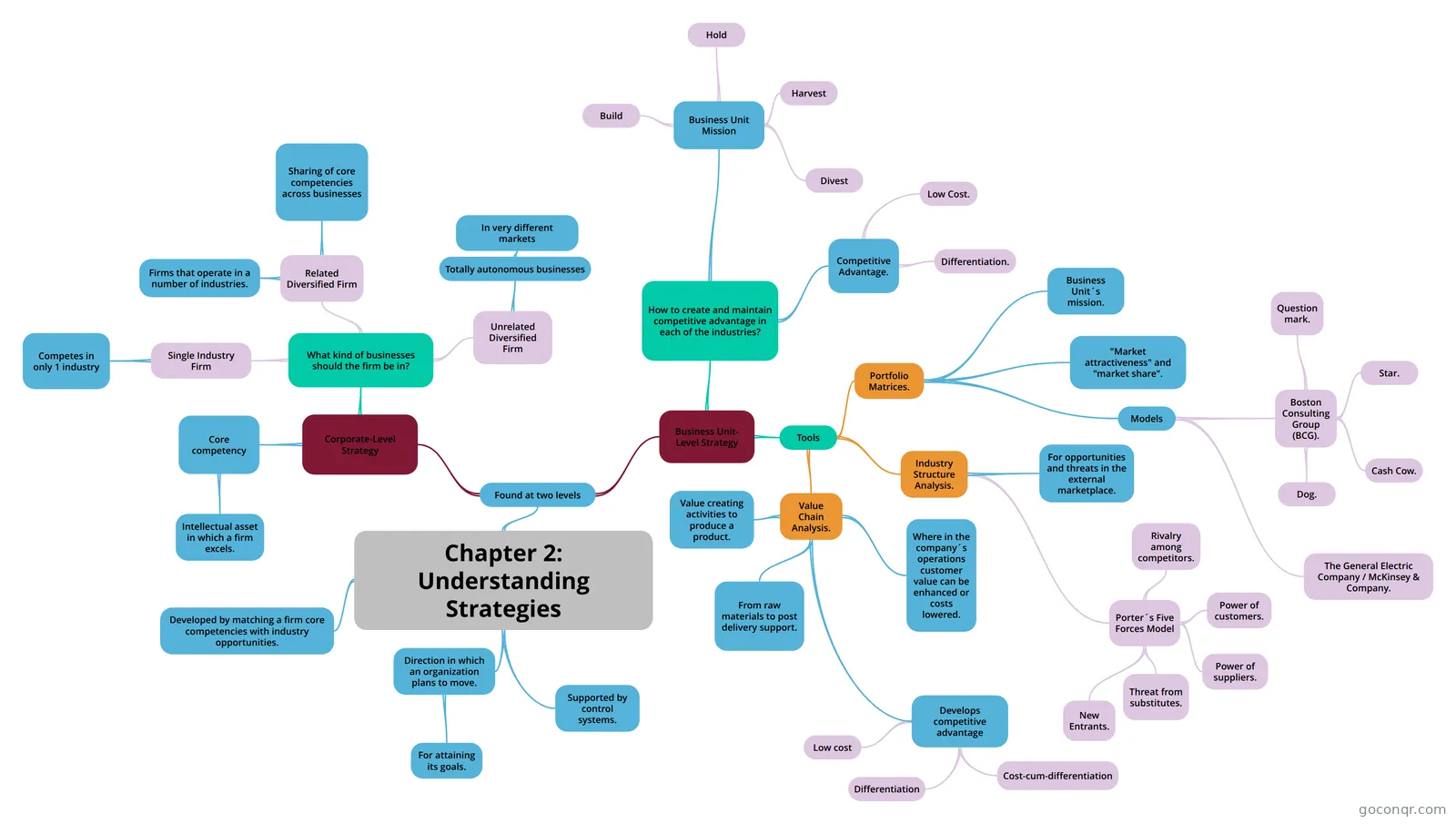
Mind map: Understanding strategies
Map content
Chapter 2: Understanding Strategies
Direction in which an organization plans to move.
- For attaining its goals.
Developed by matching a firm core competencies with industry opportunities.
Found at two levels
- Corporate-Level Strategy
- What kind of businesses should the firm be in?
- Single Industry Firm
- Competes in only 1 industry
- Related Diversified Firm
- Sharing of core competencies across businesses
- Firms that operate in a number of industries.
- Unrelated Diversified Firm
- Totally autonomous businesses
- In very different markets
- Totally autonomous businesses
- Single Industry Firm
- Core competency
- Intellectual asset in which a firm excels.
- What kind of businesses should the firm be in?
- Business Unit- Level Strategy
- How to create and maintain competitive advantage in each of the industries?
- Business Unit Mission
- Build
- Hold
- Harvest
- Divest
- Competitive Advantage.
- Low Cost.
- Differentiation.
- Business Unit Mission
- Tools
- Portfolio Matrices.
- Business Unit´s mission.
- "Market attractiveness" and "market share".
- Models
- Boston Consulting Group (BCG).
- Question mark.
- Star.
- Cash Cow.
- Dog.
- The General Electric Company / McKinsey & Company.
- Boston Consulting Group (BCG).
- Industry Structure Analysis.
- For opportunities and threats in the external marketplace.
- Porter´s Five Forces Model
- Rivalry among competitors.
- Power of customers.
- Power of suppliers.
- Threat from substitutes.
- New Entrants.
- Value Chain Analysis.
- Value creating activities to produce a product.
- From raw materials to post delivery support.
- Where in the company´s operations customer value can be enhanced or costs lowered.
- Develops competitive advantage
- Low cost
- Differentiation
- Cost-cum-differentiation
- Portfolio Matrices.
- How to create and maintain competitive advantage in each of the industries?
- Corporate-Level Strategy
Supported by control systems.