
Mind map
Types of phrases
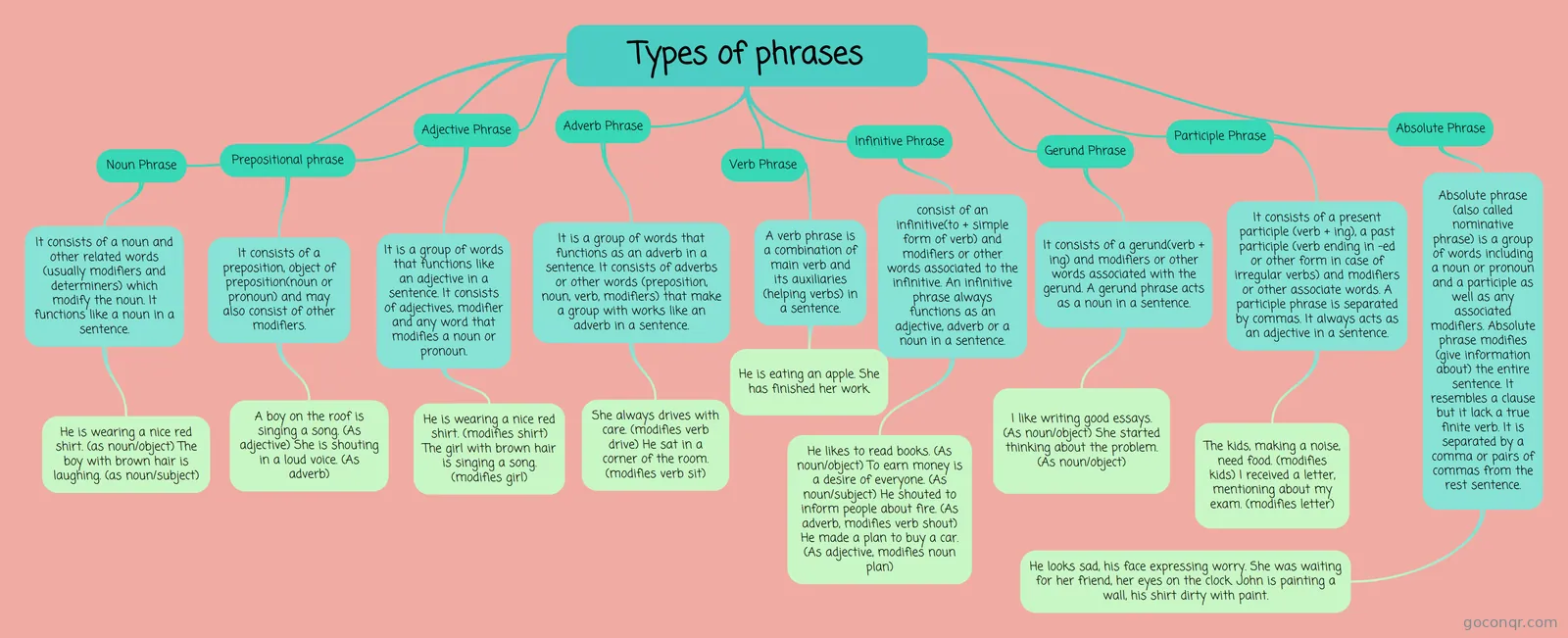
Mind map: Types of phrases
Map content
Types of phrases
Noun Phrase
- It consists of a noun and other related words (usually modifiers and determiners) which modify the noun. It functions like a noun in a sentence.
- He is wearing a nice red shirt. (as noun/object) The boy with brown hair is laughing. (as noun/subject)
- It consists of a noun and other related words (usually modifiers and determiners) which modify the noun. It functions like a noun in a sentence.
Prepositional phrase
- It consists of a preposition, object of preposition(noun or pronoun) and may also consist of other modifiers.
- A boy on the roof is singing a song. (As adjective) She is shouting in a loud voice. (As adverb)
- It consists of a preposition, object of preposition(noun or pronoun) and may also consist of other modifiers.
Adjective Phrase
- It is a group of words that functions like an adjective in a sentence. It consists of adjectives, modifier and any word that modifies a noun or pronoun.
- He is wearing a nice red shirt. (modifies shirt) The girl with brown hair is singing a song. (modifies girl)
- It is a group of words that functions like an adjective in a sentence. It consists of adjectives, modifier and any word that modifies a noun or pronoun.
Adverb Phrase
- It is a group of words that functions as an adverb in a sentence. It consists of adverbs or other words (preposition, noun, verb, modifiers) that make a group with works like an adverb in a sentence.
- She always drives with care. (modifies verb drive) He sat in a corner of the room. (modifies verb sit)
- It is a group of words that functions as an adverb in a sentence. It consists of adverbs or other words (preposition, noun, verb, modifiers) that make a group with works like an adverb in a sentence.
Verb Phrase
- A verb phrase is a combination of main verb and its auxiliaries (helping verbs) in a sentence.
- He is eating an apple. She has finished her work.
- A verb phrase is a combination of main verb and its auxiliaries (helping verbs) in a sentence.
Infinitive Phrase
- consist of an infinitive(to + simple form of verb) and modifiers or other words associated to the infinitive. An infinitive phrase always functions as an adjective, adverb or a noun in a sentence.
- He likes to read books. (As noun/object) To earn money is a desire of everyone. (As noun/subject) He shouted to inform people about fire. (As adverb, modifies verb shout) He made a plan to buy a car. (As adjective, modifies noun plan)
- consist of an infinitive(to + simple form of verb) and modifiers or other words associated to the infinitive. An infinitive phrase always functions as an adjective, adverb or a noun in a sentence.
Gerund Phrase
- It consists of a gerund(verb + ing) and modifiers or other words associated with the gerund. A gerund phrase acts as a noun in a sentence.
- I like writing good essays. (As noun/object) She started thinking about the problem. (As noun/object)
- It consists of a gerund(verb + ing) and modifiers or other words associated with the gerund. A gerund phrase acts as a noun in a sentence.
Participle Phrase
- It consists of a present participle (verb + ing), a past participle (verb ending in -ed or other form in case of irregular verbs) and modifiers or other associate words. A participle phrase is separated by commas. It always acts as an adjective in a sentence.
- The kids, making a noise, need food. (modifies kids) I received a letter, mentioning about my exam. (modifies letter)
- It consists of a present participle (verb + ing), a past participle (verb ending in -ed or other form in case of irregular verbs) and modifiers or other associate words. A participle phrase is separated by commas. It always acts as an adjective in a sentence.
Absolute Phrase
- Absolute phrase (also called nominative phrase) is a group of words including a noun or pronoun and a participle as well as any associated modifiers. Absolute phrase modifies (give information about) the entire sentence. It resembles a clause but it lack a true finite verb. It is separated by a comma or pairs of commas from the rest sentence.
- He looks sad, his face expressing worry. She was waiting for her friend, her eyes on the clock. John is painting a wall, his shirt dirty with paint.
- Absolute phrase (also called nominative phrase) is a group of words including a noun or pronoun and a participle as well as any associated modifiers. Absolute phrase modifies (give information about) the entire sentence. It resembles a clause but it lack a true finite verb. It is separated by a comma or pairs of commas from the rest sentence.
Information
- Description
- Mind Map on Types of phrases, created by María Canto on 23/02/2017.
- Created by
- María Canto
- Views
- 2
- Rating