
Mind map
viral hepatitis
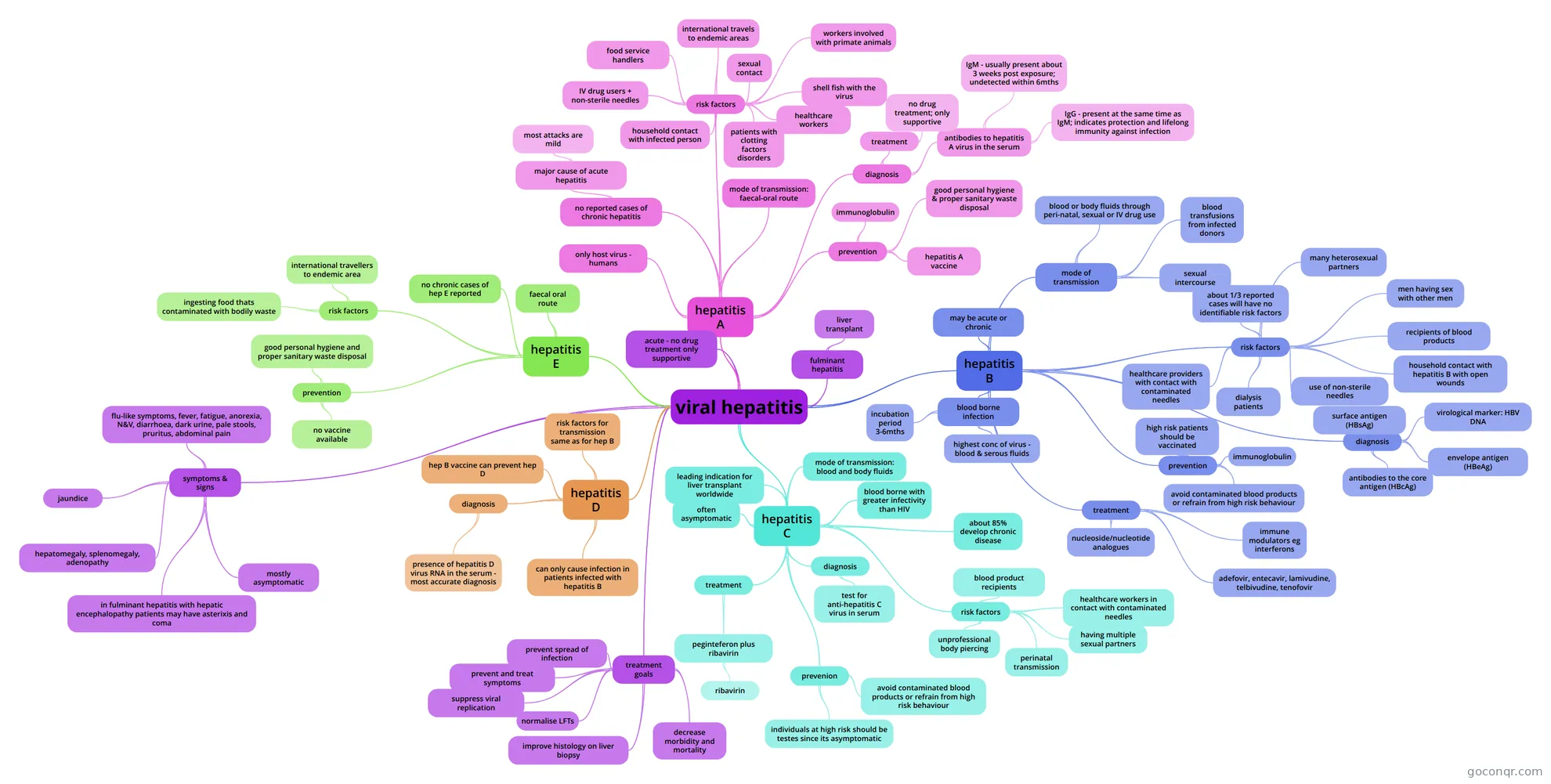
Mind map: viral hepatitis
Map content
viral hepatitis
- differ by: -mode of transmission -liver damage they cause -how they affect health Most common cause of liver disease worldwide. Mild attacks are asymptomatic. May be acute or chronic. Can occur at any age.
- acute viral hepatitis: - <6mths -observed with all types chronic viral hepatitis: -viremia and hepatic inflammation >6mths following infection -hep B,C and D -may lead to cirrhosis and end stage liver disease
hepatitis A
- only host virus - humans
- no reported cases of chronic hepatitis
- major cause of acute hepatitis
- most attacks are mild
- major cause of acute hepatitis
- mode of transmission: faecal-oral route
- risk factors
- international travels to endemic areas
- sexual contact
- shell fish with the virus
- IV drug users + non-sterile needles
- workers involved with primate animals
- food service handlers
- patients with clotting factors disorders
- healthcare workers
- household contact with infected person
- diagnosis
- antibodies to hepatitis A virus in the serum
- IgM - usually present about 3 weeks post exposure; undetected within 6mths
- IgG - present at the same time as IgM; indicates protection and lifelong immunity against infection
- treatment
- no drug treatment; only supportive
- significant nausea, vomiting, diarrhoea and encephalopathy - hospitalisation required
- no drug treatment; only supportive
- antibodies to hepatitis A virus in the serum
- prevention
- good personal hygiene & proper sanitary waste disposal
- immunoglobulin
- IM preparation Provides passive immunity but not life long effective for pre and post exposure prophylaxis against hepatitis A
- hepatitis A vaccine
- -may be given alone or combined with typhoid vaccine -provides effective active immunity -adverse effects: *injection site reactions *headache *fatigue
hepatitis B
- blood borne infection
- highest conc of virus - blood & serous fluids
- incubation period 3-6mths
- may be acute or chronic
- mode of transmission
- blood or body fluids through peri-natal, sexual or IV drug use
- blood transfusions from infected donors
- sexual intercourse
- risk factors
- about 1/3 reported cases will have no identifiable risk factors
- men having sex with other men
- many heterosexual partners
- use of non-sterile needles
- recipients of blood products
- household contact with hepatitis B with open wounds
- healthcare providers with contact with contaminated needles
- dialysis patients
- diagnosis
- surface antigen (HBsAg)
- -first to be detected in blood -presence of recent infection -chronic infection if present for >6mths
- envelope antigen (HBeAg)
- -virus replication -active acute infection if HBV DNA is also present
- antibodies to the core antigen (HBcAg)
- -IgM indicates acute infection -IgG indicates chronic infection
- virological marker: HBV DNA
- Hepatitis B virus DNA -present in blood regardless of phase of infection -viral infectivity and quantify viral replication
- surface antigen (HBsAg)
- prevention
- avoid contaminated blood products or refrain from high risk behaviour
- high risk patients should be vaccinated
- IM for optimal effects 3 doses given injection should not be give in the gluteal region
- immunoglobulin
- give IM for passive immunity for post exposure prophylaxis
- treatment
- immune modulators eg interferons
- help immune system to mount a defense against the virus
- nucleoside/nucleotide analogues
- suppress or destroy the hep B virus
- adefovir, entecavir, lamivudine, telbivudine, tenofovir
- immune modulators eg interferons
- blood borne infection
hepatitis C
- blood borne with greater infectivity than HIV
- mode of transmission: blood and body fluids
- often asymptomatic
- about 85% develop chronic disease
- leading indication for liver transplant worldwide
- risk factors
- blood product recipients
- healthcare workers in contact with contaminated needles
- having multiple sexual partners
- perinatal transmission
- unprofessional body piercing
- diagnosis
- test for anti-hepatitis C virus in serum
- prevenion
- avoid contaminated blood products or refrain from high risk behaviour
- individuals at high risk should be testes since its asymptomatic
- treatment
- peginteferon plus ribavirin
- peginteferon can be used as monotherapy if ribavirin is intolerated of CI
- ribavirin
- -excreted in semen -condom use if partners of infected men are pregnant -can cause gout -avoid if creatinine clearance is <50ml/min
- peginteferon plus ribavirin
hepatitis D
- risk factors for transmission same as for hep B
- can only cause infection in patients infected with hepatitis B
- diagnosis
- presence of hepatitis D virus RNA in the serum - most accurate diagnosis
- hep B vaccine can prevent hep D
hepatitis E
- faecal oral route
- no chronic cases of hep E reported
- risk factors
- international travellers to endemic area
- ingesting food thats contaminated with bodily waste
- prevention
- good personal hygiene and proper sanitary waste disposal
- no vaccine available
fulminant hepatitis
- liver transplant
acute - no drug treatment only supportive
symptoms & signs
- mostly asymptomatic
- flu-like symptoms, fever, fatigue, anorexia, N&V, diarrhoea, dark urine, pale stools, pruritus, abdominal pain
- jaundice
- hepatomegaly, splenomegaly, adenopathy
- in fulminant hepatitis with hepatic encephalopathy patients may have asterixis and coma
treatment goals
- prevent spread of infection
- prevent and treat symptoms
- suppress viral replication
- normalise LFTs
- improve histology on liver biopsy
- decrease morbidity and mortality
Information
- Description
- pham1008 Mind Map on viral hepatitis, created by Karo on 01/05/2013.
- Created by
- Karo
- Views
- 332
- Tags
- Rating