
Mind map
P5g - Refraction of Waves
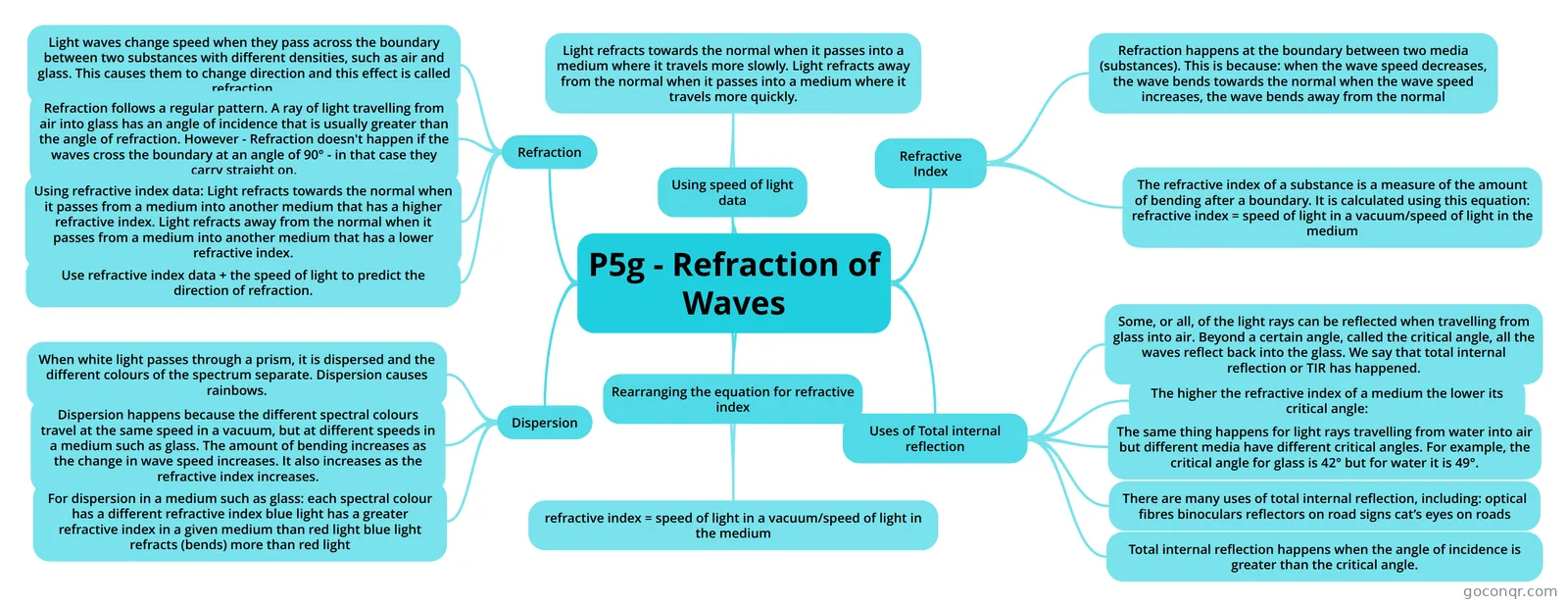
Mind map: Refraction of waves
Map content
P5g - Refraction of Waves
Refraction
- Light waves change speed when they pass across the boundary between two substances with different densities, such as air and glass. This causes them to change direction and this effect is called refraction.
- Refraction follows a regular pattern. A ray of light travelling from air into glass has an angle of incidence that is usually greater than the angle of refraction. However - Refraction doesn't happen if the waves cross the boundary at an angle of 90° - in that case they carry straight on.
- Using refractive index data: Light refracts towards the normal when it passes from a medium into another medium that has a higher refractive index. Light refracts away from the normal when it passes from a medium into another medium that has a lower refractive index.
- Use refractive index data + the speed of light to predict the direction of refraction.
Refractive Index
- Refraction happens at the boundary between two media (substances). This is because: when the wave speed decreases, the wave bends towards the normal when the wave speed increases, the wave bends away from the normal
- The refractive index of a substance is a measure of the amount of bending after a boundary. It is calculated using this equation: refractive index = speed of light in a vacuum/speed of light in the medium
Dispersion
- When white light passes through a prism, it is dispersed and the different colours of the spectrum separate. Dispersion causes rainbows.
- Dispersion happens because the different spectral colours travel at the same speed in a vacuum, but at different speeds in a medium such as glass. The amount of bending increases as the change in wave speed increases. It also increases as the refractive index increases.
- For dispersion in a medium such as glass: each spectral colour has a different refractive index blue light has a greater refractive index in a given medium than red light blue light refracts (bends) more than red light
Uses of Total internal reflection
- Some, or all, of the light rays can be reflected when travelling from glass into air. Beyond a certain angle, called the critical angle, all the waves reflect back into the glass. We say that total internal reflection or TIR has happened.
- The same thing happens for light rays travelling from water into air but different media have different critical angles. For example, the critical angle for glass is 42° but for water it is 49°.
- There are many uses of total internal reflection, including: optical fibres binoculars reflectors on road signs cat’s eyes on roads
- The higher the refractive index of a medium the lower its critical angle:
- Total internal reflection happens when the angle of incidence is greater than the critical angle.
Using speed of light data
- Light refracts towards the normal when it passes into a medium where it travels more slowly. Light refracts away from the normal when it passes into a medium where it travels more quickly.
Rearranging the equation for refractive index
- refractive index = speed of light in a vacuum/speed of light in the medium
Information
- Description
- GCSE PHYSICS Mind Map on P5g - Refraction of Waves, created by Chloe.Sharland on 14/06/2014.
- Created by
- Chloe.Sharland
- Views
- 20
- Rating
More on Reflection and refraction