
Mind map
Changing Party Fortunes 1918-31
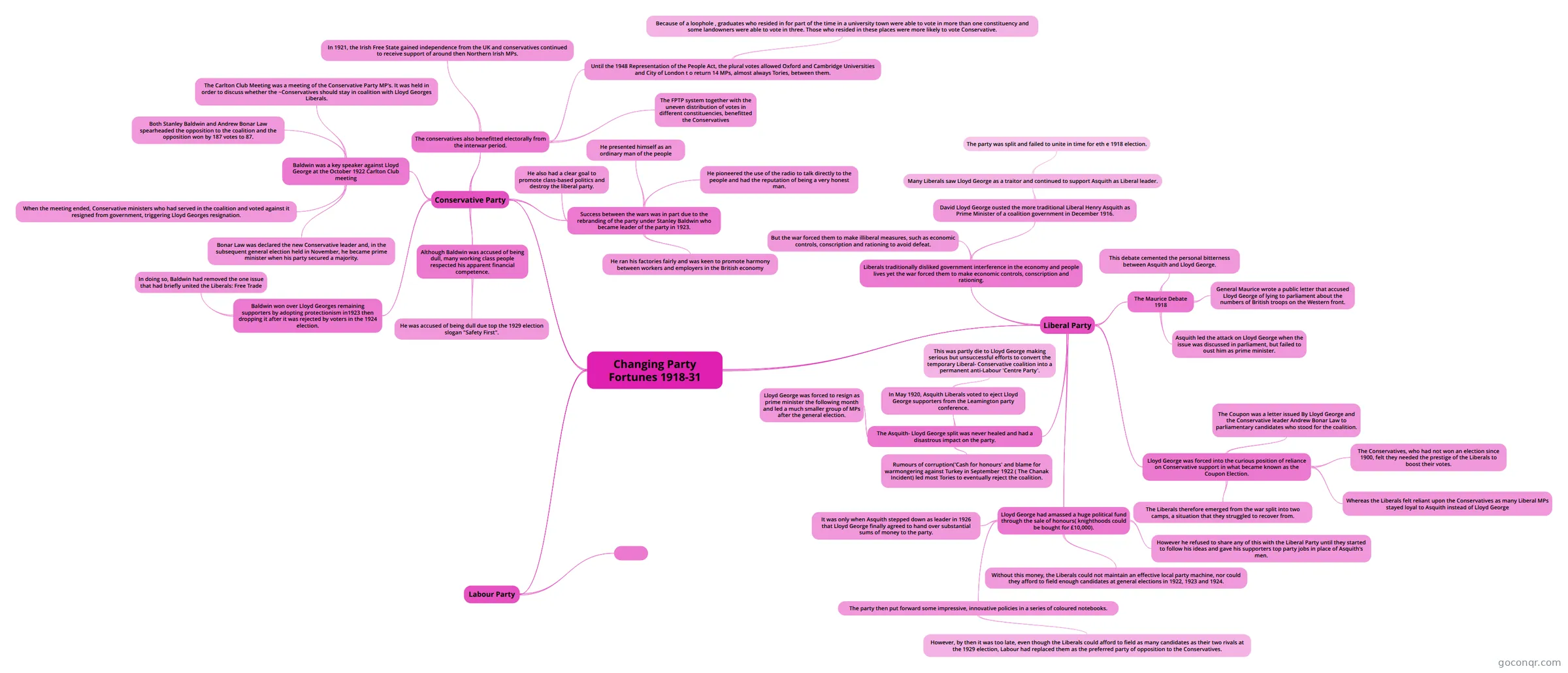
Mind map: Changing Party Fortunes 1918-31
Map content
Changing Party Fortunes 1918-31
Labour Party
Conservative Party
- Success between the wars was in part due to the rebranding of the party under Stanley Baldwin who became leader of the party in 1923.
- He presented himself as an ordinary man of the people
- He pioneered the use of the radio to talk directly to the people and had the reputation of being a very honest man.
- He ran his factories fairly and was keen to promote harmony between workers and employers in the British economy
- He also had a clear goal to promote class-based politics and destroy the liberal party.
- Baldwin was a key speaker against Lloyd George at the October 1922 Carlton Club meeting
- The Carlton Club Meeting was a meeting of the Conservative Party MP's. It was held in order to discuss whether the ~Conservatives should stay in coalition with Lloyd Georges Liberals.
- Both Stanley Baldwin and Andrew Bonar Law spearheaded the opposition to the coalition and the opposition won by 187 votes to 87.
- When the meeting ended, Conservative ministers who had served in the coalition and voted against it resigned from government, triggering Lloyd Georges resignation.
- Bonar Law was declared the new Conservative leader and, in the subsequent general election held in November, he became prime minister when his party secured a majority.
- Baldwin won over Lloyd Georges remaining supporters by adopting protectionism in1923 then dropping it after it was rejected by voters in the 1924 election.
- In doing so, Baldwin had removed the one issue that had briefly united the Liberals: Free Trade
- Although Baldwin was accused of being dull, many working class people respected his apparent financial competence.
- He was accused of being dull due top the 1929 election slogan "Safety First".
- The conservatives also benefitted electorally from the interwar period.
- In 1921, the Irish Free State gained independence from the UK and conservatives continued to receive support of around then Northern Irish MPs.
- The FPTP system together with the uneven distribution of votes in different constituencies, benefitted the Conservatives
- Until the 1948 Representation of the People Act, the plural votes allowed Oxford and Cambridge Universities and City of London t o return 14 MPs, almost always Tories, between them.
- Because of a loophole , graduates who resided in for part of the time in a university town were able to vote in more than one constituency and some landowners were able to vote in three. Those who resided in these places were more likely to vote Conservative.
- Success between the wars was in part due to the rebranding of the party under Stanley Baldwin who became leader of the party in 1923.
Liberal Party
- Liberals traditionally disliked government interference in the economy and people lives yet the war forced them to make economic controls, conscription and rationing.
- But the war forced them to make illiberal measures, such as economic controls, conscription and rationing to avoid defeat.
- David Lloyd George ousted the more traditional Liberal Henry Asquith as Prime Minister of a coalition government in December 1916.
- Many Liberals saw Lloyd George as a traitor and continued to support Asquith as Liberal leader.
- The party was split and failed to unite in time for eth e 1918 election.
- Many Liberals saw Lloyd George as a traitor and continued to support Asquith as Liberal leader.
- The Maurice Debate 1918
- This debate cemented the personal bitterness between Asquith and Lloyd George.
- General Maurice wrote a public letter that accused Lloyd George of lying to parliament about the numbers of British troops on the Western front.
- Asquith led the attack on Lloyd George when the issue was discussed in parliament, but failed to oust him as prime minister.
- Lloyd George was forced into the curious position of reliance on Conservative support in what became known as the Coupon Election.
- The Coupon was a letter issued By Lloyd George and the Conservative leader Andrew Bonar Law to parliamentary candidates who stood for the coalition.
- The Conservatives, who had not won an election since 1900, felt they needed the prestige of the Liberals to boost their votes.
- Whereas the Liberals felt reliant upon the Conservatives as many Liberal MPs stayed loyal to Asquith instead of Lloyd George
- The Liberals therefore emerged from the war split into two camps, a situation that they struggled to recover from.
- The Asquith- Lloyd George split was never healed and had a disastrous impact on the party.
- In May 1920, Asquith Liberals voted to eject Lloyd George supporters from the Leamington party conference.
- This was partly die to Lloyd George making serious but unsuccessful efforts to convert the temporary Liberal- Conservative coalition into a permanent anti-Labour 'Centre Party'.
- Rumours of corruption('Cash for honours' and blame for warmongering against Turkey in September 1922 ( The Chanak Incident) led most Tories to eventually reject the coalition.
- Lloyd George was forced to resign as prime minister the following month and led a much smaller group of MPs after the general election.
- In May 1920, Asquith Liberals voted to eject Lloyd George supporters from the Leamington party conference.
- Lloyd George had amassed a huge political fund through the sale of honours( knighthoods could be bought for £10,000).
- However he refused to share any of this with the Liberal Party until they started to follow his ideas and gave his supporters top party jobs in place of Asquith's men.
- Without this money, the Liberals could not maintain an effective local party machine, nor could they afford to field enough candidates at general elections in 1922, 1923 and 1924.
- It was only when Asquith stepped down as leader in 1926 that Lloyd George finally agreed to hand over substantial sums of money to the party.
- The party then put forward some impressive, innovative policies in a series of coloured notebooks.
- However, by then it was too late, even though the Liberals could afford to field as many candidates as their two rivals at the 1929 election, Labour had replaced them as the preferred party of opposition to the Conservatives.
- Liberals traditionally disliked government interference in the economy and people lives yet the war forced them to make economic controls, conscription and rationing.
Information
- Description
- Mind Map on Changing Party Fortunes 1918-31, created by Ali Disandolo on 13/09/2017.
- Created by
- Ali Disandolo
- Views
- 3
- Rating
More on Political Change and the Decline of the Liberal Party