
Mind map
Plato understanding reality
Map content
Plato understanding reality
Forms
- When we try to make something we begin with an idea of what we shall make and we have in mind a picture of the finished product. Plato would point out the impermanence of the idea in our mind
- This thought leads Plato to argue that there must exist and ideal version of something and that anything else is simply an imperfect copy. The perfect version does not exist in this world, so it must exist elsewhere. So Plato suggest the existence of the Realm of the Forms
- For Plato there are two realms: the Realm of the Forms, inhabited by spiritual souls and the true beings in themselves and the Realm of Appearances, this world in which things look more or less like their originals in the Realm of the Forms
- For Plato, our souls belong naturally in the Realm of the forms, the realm of reality, not this world. When we are born into this world we forgot the Realm of the Forms, which is true, good and permanent. For Plato, all learning is actually recollection of the Forms experienced in a previous life or lives. Education does not put anything into a child's mind- it draws our what is already there, hidden by forgetfulness
- When we try to make something we begin with an idea of what we shall make and we have in mind a picture of the finished product. Plato would point out the impermanence of the idea in our mind
Hierarchy
- The Realm of the Forms is superior in every way to the Realm of Appearances- the latter is a rater pale reflection of the former. As we shall see, even among the Forms there is also a hierarchy, with the Form of the Good above all. If there are two realms, Plato assumes that they are in ration to each other
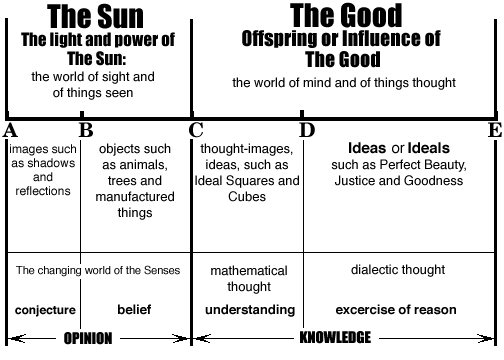
- Plato assumes that if something is true in this world of Appearances, it is even more fully true in the Realm of the Forms. In the world of objects, we need the light from the sun to illuminate them. We also need something in the Realm of the Forms to illuminate our understanding. This 'sun equivalent' is the Form of the Good. Below it come from other 'higher Forms' such as Beauty
- These Forms, then are the perfect versions of inferior things of this world. As such, Plato believes, they must be eternal, just as our souls are. For him, eternity is part of perfection, because something perfect cannot be destroyed
- Humans distract themselves with things that appear beautiful but, as these are material, sensual things, they are imperfect and impermanent. Those who think of the meaning of things in themselves are the philosophers. They ask what is true beauty, or true justice. They are capable of knowledge, not opinion
- Plato explained wrongdoing as the result of ignorance or incomplete knowledge. If I know the Form of the Good, I will be Good. Plato firmly believed that the best form of government was a society led by the truly wise, the philosophers
Divided line
- Plato notes how the process of observation in the world works in two ways. Sometimes we look at things themselves but sometimes we look at imagines and shadows. For Plato, looking at images is like looking at shadows, as far away from true reality as could be
- If we have shadows and images in this world, then there must be an equivalent in the relationship to the Realm of the Forms
- Plato makes the assumption that truth and knowledge only apply to what truly exists. He argues that things in our world do not exist as truly as beings in the Realm of the Forms. So we do not have knowledge of them, as they are not real in the full sense. We only have an opinion about the things in our world. So Plato calls 'ignorance' the awareness of what does not exist
Objections
- Aristotle's objections
- We may question whether there can be a single Form of the Good. We use terms such as 'good' in so many different ways that there can simply be no single 'good'. For example a good harpist is one who plays the harp well. We may call het a good harpist but think she is a bad person. A good rifle is not morally good- it is good because it is good for shooting with, not because it has moral qualities
- If the Forms were so essential to true understanding, why does no one study them? It seems odd that others feel no need to study the forms if they are as necessary to clear thought as Plato think
- The Forms have no practical value
- The idea that theoretical knowledge of something leads necessarily to being able to do it is wrong
- Some things have no form, according to the Platonists. An example of this is that there is no Form of Number, but only oneness, twoness and so on. This raises the issue that if there are forms of each number, and there is an infinity of possible numbers, then there is an infinity of possible Forms
- Plato assumes that for something to be pure it needs to be eternal. If we consider a quality such as whiteness, we recognise that being white and being eternal are two different things. Something does not become whiter by being eternal. Something might only last a few moments, but be perfect while it lasted
- Other objections
- Empiricists would object to various assumptions that we may know anything about the world a priori, other than by sense experience
- There is no empirical evidence for the Forms
- Plato assumes both that there are things in the Realm of Appearances and that their perfect counterparts are in the Realm of the Forms. He only says there are. He provides no justification for this assumption
- Aristotle's objections
Images and files in the map
Information
- Description
- AS level Philosophy ethics and theology (Philosophy) Mind Map on Plato understanding reality, created by Lily Duffy on 21/09/2017.
- Created by
- Lily Duffy
- Views
- 4
- Rating