
Mind map
6.2 Demonstrative Pronouns
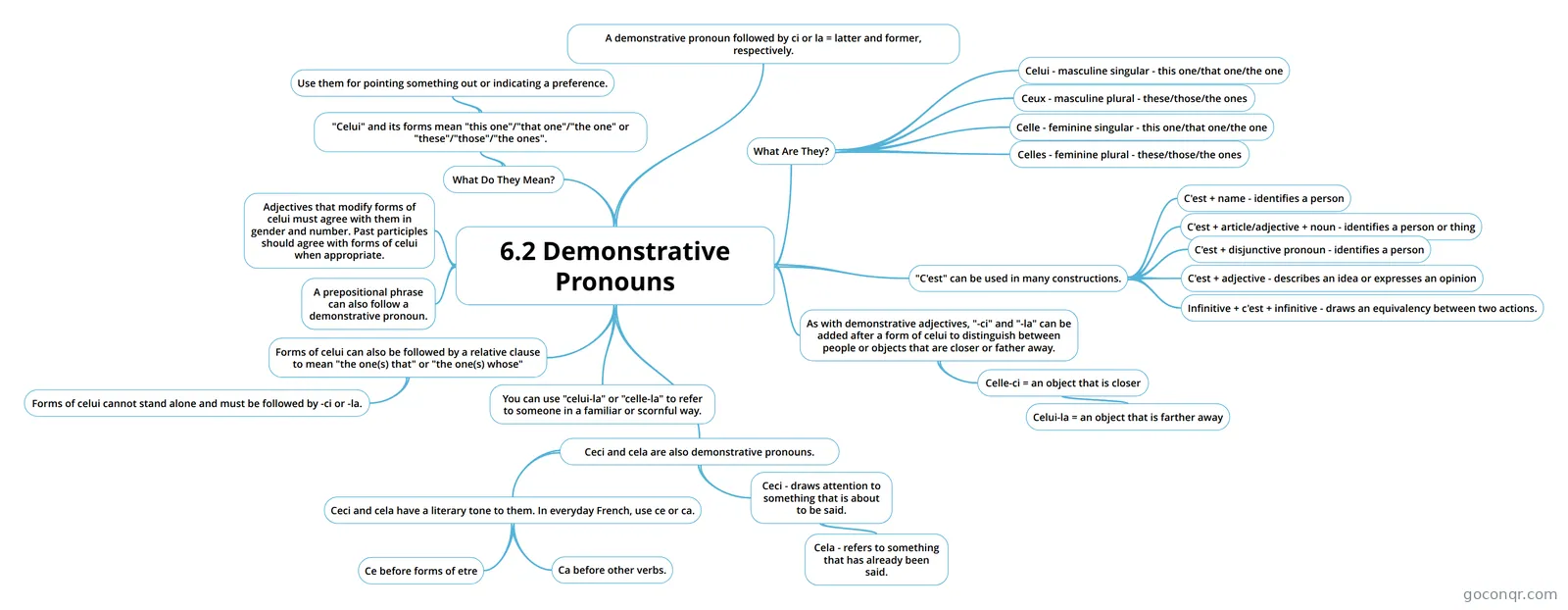
Mind map: Demonstrative pronouns in French
Map content
6.2 Demonstrative Pronouns
What Do They Mean?
- "Celui" and its forms mean "this one"/"that one"/"the one" or "these"/"those"/"the ones".
- Use them for pointing something out or indicating a preference.
- "Celui" and its forms mean "this one"/"that one"/"the one" or "these"/"those"/"the ones".
What Are They?
- Celui - masculine singular - this one/that one/the one
- Celle - feminine singular - this one/that one/the one
- Ceux - masculine plural - these/those/the ones
- Celles - feminine plural - these/those/the ones
As with demonstrative adjectives, "-ci" and "-la" can be added after a form of celui to distinguish between people or objects that are closer or father away.
- Celle-ci = an object that is closer
- Celui-la = an object that is farther away
- Celle-ci = an object that is closer
Forms of celui can also be followed by a relative clause to mean "the one(s) that" or "the one(s) whose"
- Forms of celui cannot stand alone and must be followed by -ci or -la.
A prepositional phrase can also follow a demonstrative pronoun.
Adjectives that modify forms of celui must agree with them in gender and number. Past participles should agree with forms of celui when appropriate.
You can use "celui-la" or "celle-la" to refer to someone in a familiar or scornful way.
Ceci and cela are also demonstrative pronouns.
- Ceci - draws attention to something that is about to be said.
- Cela - refers to something that has already been said.
- Ceci and cela have a literary tone to them. In everyday French, use ce or ca.
- Ce before forms of etre
- Ca before other verbs.
- Ceci - draws attention to something that is about to be said.
"C'est" can be used in many constructions.
- C'est + name - identifies a person
- C'est + article/adjective + noun - identifies a person or thing
- C'est + disjunctive pronoun - identifies a person
- C'est + adjective - describes an idea or expresses an opinion
- Infinitive + c'est + infinitive - draws an equivalency between two actions.
A demonstrative pronoun followed by ci or la = latter and former, respectively.
Information
- Description
- A mindmap on 6.2 - Demonstrative Pronouns using the D'accord French Textbook.
- Created by
- Meghan Miraglia
- Views
- 113
- Tags
- Rating