
Mind map
Burrhus Frederic Skinner (1904-1990) Behaviourism
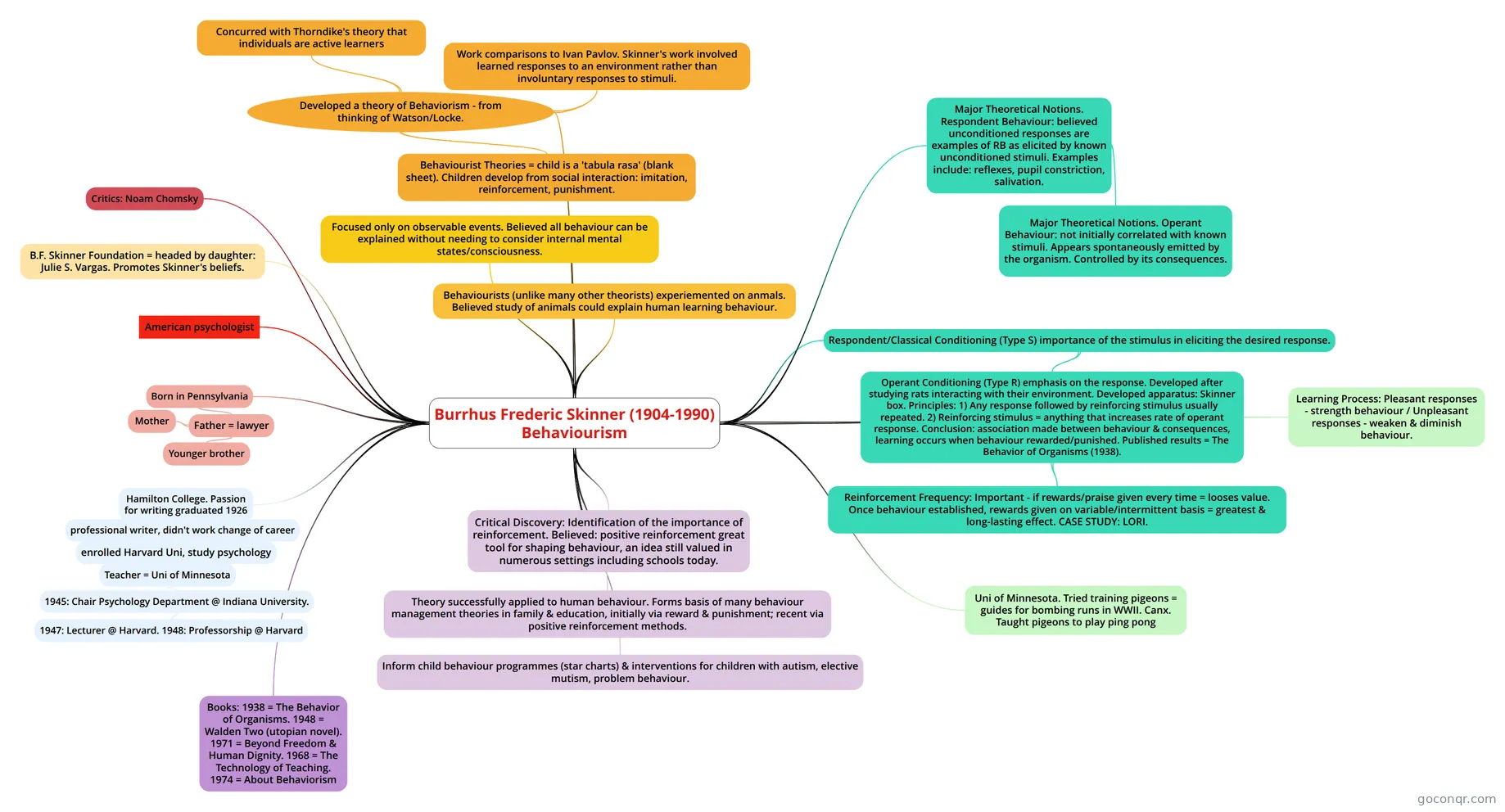
Mind map: Burrhus Frederic Skinner behaviourism
Map content
Burrhus Frederic Skinner (1904-1990) Behaviourism
American psychologist
Developed a theory of Behaviorism - from thinking of Watson/Locke.
- Work comparisons to Ivan Pavlov. Skinner's work involved learned responses to an environment rather than involuntary responses to stimuli.
- Concurred with Thorndike's theory that individuals are active learners
- Behaviourist Theories = child is a 'tabula rasa' (blank sheet). Children develop from social interaction: imitation, reinforcement, punishment.
Books: 1938 = The Behavior of Organisms. 1948 = Walden Two (utopian novel). 1971 = Beyond Freedom & Human Dignity. 1968 = The Technology of Teaching. 1974 = About Behaviorism
Born in Pennsylvania
- Father = lawyer
- Younger brother
- Mother
- Father = lawyer
Hamilton College. Passion for writing graduated 1926
- professional writer, didn't work change of career
- enrolled Harvard Uni, study psychology
- Teacher = Uni of Minnesota
- 1945: Chair Psychology Department @ Indiana University.
- 1947: Lecturer @ Harvard. 1948: Professorship @ Harvard
- 1945: Chair Psychology Department @ Indiana University.
- Teacher = Uni of Minnesota
- enrolled Harvard Uni, study psychology
- professional writer, didn't work change of career
Learning Process: Pleasant responses - strength behaviour / Unpleasant responses - weaken & diminish behaviour.
Uni of Minnesota. Tried training pigeons = guides for bombing runs in WWII. Canx. Taught pigeons to play ping pong
Critics: Noam Chomsky
Critical Discovery: Identification of the importance of reinforcement. Believed: positive reinforcement great tool for shaping behaviour, an idea still valued in numerous settings including schools today.
B.F. Skinner Foundation = headed by daughter: Julie S. Vargas. Promotes Skinner's beliefs.
Theory successfully applied to human behaviour. Forms basis of many behaviour management theories in family & education, initially via reward & punishment; recent via positive reinforcement methods.
Major Theoretical Notions. Respondent Behaviour: believed unconditioned responses are examples of RB as elicited by known unconditioned stimuli. Examples include: reflexes, pupil constriction, salivation.
- Major Theoretical Notions. Operant Behaviour: not initially correlated with known stimuli. Appears spontaneously emitted by the organism. Controlled by its consequences.
Respondent/Classical Conditioning (Type S) importance of the stimulus in eliciting the desired response.
- Operant Conditioning (Type R) emphasis on the response. Developed after studying rats interacting with their environment. Developed apparatus: Skinner box. Principles: 1) Any response followed by reinforcing stimulus usually repeated. 2) Reinforcing stimulus = anything that increases rate of operant response. Conclusion: association made between behaviour & consequences, learning occurs when behaviour rewarded/punished. Published results = The Behavior of Organisms (1938).
- Reinforcement Frequency: Important - if rewards/praise given every time = looses value. Once behaviour established, rewards given on variable/intermittent basis = greatest & long-lasting effect. CASE STUDY: LORI.
- Operant Conditioning (Type R) emphasis on the response. Developed after studying rats interacting with their environment. Developed apparatus: Skinner box. Principles: 1) Any response followed by reinforcing stimulus usually repeated. 2) Reinforcing stimulus = anything that increases rate of operant response. Conclusion: association made between behaviour & consequences, learning occurs when behaviour rewarded/punished. Published results = The Behavior of Organisms (1938).
Inform child behaviour programmes (star charts) & interventions for children with autism, elective mutism, problem behaviour.
Focused only on observable events. Believed all behaviour can be explained without needing to consider internal mental states/consciousness.
Behaviourists (unlike many other theorists) experiemented on anmals. Believed study of animals could explain human learning behaviour.
Information
- Description
- Education Mind Map on Burrhus Frederic Skinner (1904-1990) Behaviourism, created by karina wink on 10/10/2017.
- Created by
- karina wink
- Views
- 0
- Rating