
Mind map
Axon guidance 1

Map content
Axon guidance 1
How does connectivity arise?
- 2 hypotheses
- Chemoaffinity hypothesis
- Sperry
- 1939
- Directed and specific outgrowth occurs through axons following 'individual identification tags' created by the cells and fibres of the embryo
- Sperry
- Resonance theory
- Stochastic and diffuse neuronal outgrowth occurs to all targets followed by elimination of non-functional connections
- Weiss
- 1928
- Who was right?
- Sperrys frog experiment
- Cut optic nerve
- Remove temporal retina
- Allows just nasal axons to grow back
- Remove temporal retina
- Grew back directly to the right place
- Importantly, the regrowing 'red' axons grew through- yet ignored the territory normally innervated by the 'blue' axons
- Cut optic nerve
- Axon pathways in embryos are highly stereotyped
- If weiss were right
- Would expect to see random patterns of outgrowth in embryos
- Actually
- Patterns of axon outgrowth are highly organised, reproducible and stereotyped
- If weiss were right
- Motor axons
- Guided specifically to targets in the chick embryo
- Sperrys frog experiment
- Chemoaffinity hypothesis
- 2 hypotheses
Guidance cues
- Where are they?
- Early experiments
- Done in insects
- Relatively simple nervous systems
- Embryos easy to observe and manipulate
- In the larger insects (e.g. grasshopper) individual cells could be ablated with lasers
- Found that pathways taken by axons are stereotyped
- From embryo-embryo
- From segment-segment
- In grasshopper - map of axon projections made
- Reproducibility of axon behaviours suggested that growth cones were responding to cues or labels
- Pathways seem to change when specific axons are encountered
- Tested by ablating cells that might carry potential cues
- Done in insects
- Early experiments
- Labelled pathway hypothesis
- Axons can selectively fasiculate with other axons
- Axon surfaces carry labels or cues
- Different axon growth cones express different sets of receptors for such cues
- Axon scaffolds
- Early axons form a scaffold on which later axons can extend
- Establishes axon surfaces as potential source of guidance cues
- Axon scaffolds are also Important in vertebrates
- Stereotyped pathways in grasshopper embryo
- Reproducibility of axon behaviour suggested that growth cones were responding to cues or labels in the environment.
- Pathways seem to change when specific axons were encountered
- Tested by ablating cells that might carry potential cues:
- G axon “stalls” in absence of P axon
- Not due to lack of axons on which to extend (e.g. A axon still present, C axon still extends)
- Not due to reduction in numbers of axons (e.g. not affected when A axons ablated)
- Must be because the G axon growth cone is ‘looking’ for specific cues on the P axon.
- G axon “stalls” in absence of P axon
- Where are they?
Pioneer axons
- Axons follow stereotyped paths
- Patterning information from early embryo predicts where axon tracts will form
- Forebrain
- Axons follow boundries of domains of patterning gene expression
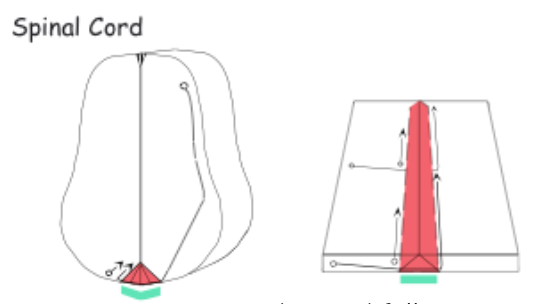
- Spinal cord
- Axons follow boundries of floor plate
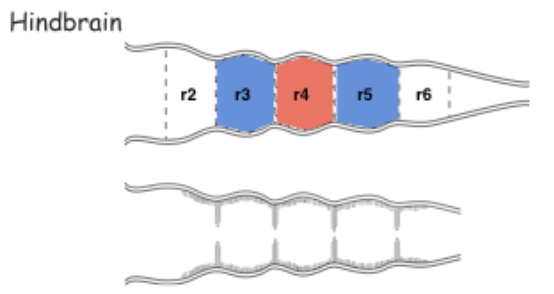
- Hindbrain
- Axons follow boundries of rhombomeres
- Take home message is that axon guidance cues are located, not just in other axons, but in many cell types in the early embryo
- Forebrain
- E.g. In grasshopper embryo limb
- pioneer Ti1 (tibial1) growth cone makes a specific turn at the limb boundary, and then again as it approaches a specific cell, Cx1.
- Ablation of Cx1 causes the Ti1 growth cone to stall at the other side of the limb boundary.
- Neither Cx1 nor the limb boundary cells are distinguished by any obvious morphological features.
- Cx1 and the other cells are sometimes referred to as ‘stepping stones’ or ‘guidepost cells’
- Implies that there must be molecular differences in the environment
- Ablation of Cx1 causes the Ti1 growth cone to stall at the other side of the limb boundary.
- pioneer Ti1 (tibial1) growth cone makes a specific turn at the limb boundary, and then again as it approaches a specific cell, Cx1.
- Despite this apparently featureless environment, the pathways of pioneer axons are also stereotyped and growth cones appear to react at specific points in the pathway.
- Patterning information from early embryo predicts where axon tracts will form
- Axons follow stereotyped paths
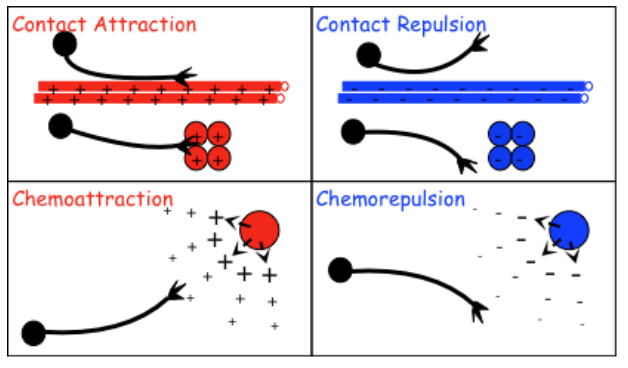
Four forces of axon guidance
- Chemoattraction
- Chemorepulsion
- Contact attraction
- Contact repulsion
- The experiments we have seen suggest that axon guidance cues may be both positive and negative e.g.
- Cell ablations lead to growth cones stalls, as if an attractive force has been lost
- Ti1 growth cone seems to avoid the limb boundary as if it were inhibitory
Images and files in the map


Information
- Description
- Undergraduate BMS 381 Developmental neurobiology (AF lectures) Mind Map on Axon guidance 1, created by Kristi Brogden on 29/07/2014.
- Created by
- Kristi Brogden
- Views
- 39
- Rating