
Mind map
P4: Radiation for Life Pt 2
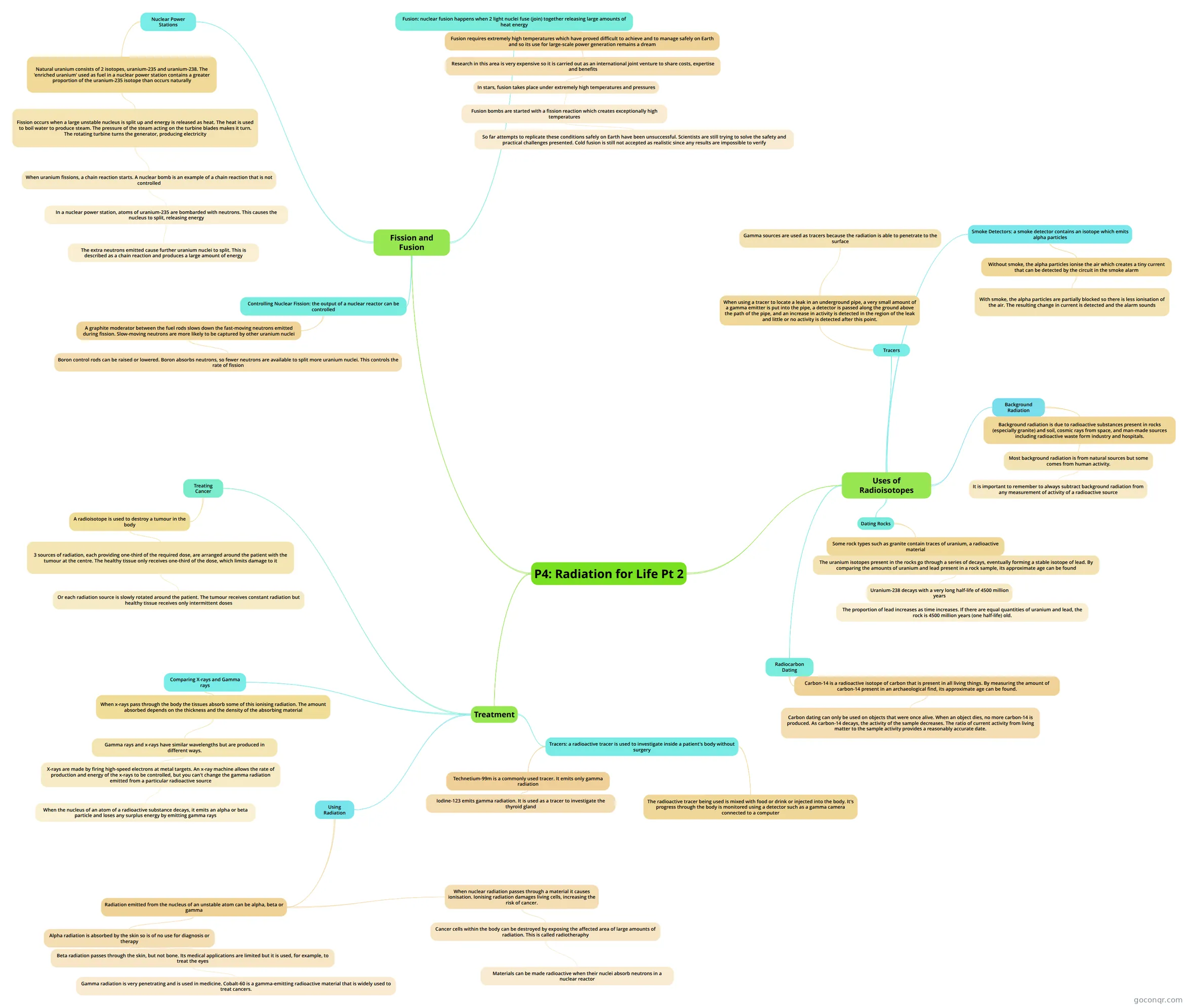
Mind map: Radiation for life
Map content
P4: Radiation for Life Pt 2
Uses of Radioisotopes
- Background Radiation
- Background radiation is due to radioactive substances present in rocks (especially granite) and soil, cosmic rays from space, and man-made sources including radioactive waste form industry and hospitals.
- Most background radiation is from natural sources but some comes from human activity.
- It is important to remember to always subtract background radiation from any measurement of activity of a radioactive source
- Most background radiation is from natural sources but some comes from human activity.
- Background radiation is due to radioactive substances present in rocks (especially granite) and soil, cosmic rays from space, and man-made sources including radioactive waste form industry and hospitals.
- Tracers
- When using a tracer to locate a leak in an underground pipe, a very small amount of a gamma emitter is put into the pipe, a detector is passed along the ground above the path of the pipe, and an increase in activity is detected in the region of the leak and little or no activity is detected after this point.
- Gamma sources are used as tracers because the radiation is able to penetrate to the surface
- When using a tracer to locate a leak in an underground pipe, a very small amount of a gamma emitter is put into the pipe, a detector is passed along the ground above the path of the pipe, and an increase in activity is detected in the region of the leak and little or no activity is detected after this point.
- Smoke Detectors: a smoke detector contains an isotope which emits alpha particles
- Without smoke, the alpha particles ionise the air which creates a tiny current that can be detected by the circuit in the smoke alarm
- With smoke, the alpha particles are partially blocked so there is less ionisation of the air. The resulting change in current is detected and the alarm sounds
- Without smoke, the alpha particles ionise the air which creates a tiny current that can be detected by the circuit in the smoke alarm
- Dating Rocks
- Some rock types such as granite contain traces of uranium, a radioactive material
- The uranium isotopes present in the rocks go through a series of decays, eventually forming a stable isotope of lead. By comparing the amounts of uranium and lead present in a rock sample, its approximate age can be found
- Uranium-238 decays with a very long half-life of 4500 million years
- The proportion of lead increases as time increases. If there are equal quantities of uranium and lead, the rock is 4500 million years (one half-life) old.
- Uranium-238 decays with a very long half-life of 4500 million years
- The uranium isotopes present in the rocks go through a series of decays, eventually forming a stable isotope of lead. By comparing the amounts of uranium and lead present in a rock sample, its approximate age can be found
- Some rock types such as granite contain traces of uranium, a radioactive material
- Radiocarbon Dating
- Carbon-14 is a radioactive isotope of carbon that is present in all living things. By measuring the amount of carbon-14 present in an archaeological find, its approximate age can be found.
- Carbon dating can only be used on objects that were once alive. When an object dies, no more carbon-14 is produced. As carbon-14 decays, the activity of the sample decreases. The ratio of current activity from living matter to the sample activity provides a reasonably accurate date.
- Carbon-14 is a radioactive isotope of carbon that is present in all living things. By measuring the amount of carbon-14 present in an archaeological find, its approximate age can be found.
- Background Radiation
Treatment
- Using Radiation
- Radiation emitted from the nucleus of an unstable atom can be alpha, beta or gamma
- Alpha radiation is absorbed by the skin so is of no use for diagnosis or therapy
- Beta radiation passes through the skin, but not bone. Its medical applications are limited but it is used, for example, to treat the eyes
- Gamma radiation is very penetrating and is used in medicine. Cobalt-60 is a gamma-emitting radioactive material that is widely used to treat cancers.
- Beta radiation passes through the skin, but not bone. Its medical applications are limited but it is used, for example, to treat the eyes
- When nuclear radiation passes through a material it causes ionisation. Ionising radiation damages living cells, increasing the risk of cancer.
- Cancer cells within the body can be destroyed by exposing the affected area of large amounts of radiation. This is called radiotheraphy
- Materials can be made radioactive when their nuclei absorb neutrons in a nuclear reactor
- Cancer cells within the body can be destroyed by exposing the affected area of large amounts of radiation. This is called radiotheraphy
- Alpha radiation is absorbed by the skin so is of no use for diagnosis or therapy
- Radiation emitted from the nucleus of an unstable atom can be alpha, beta or gamma
- Comparing X-rays and Gamma rays
- When x-rays pass through the body the tissues absorb some of this ionising radiation. The amount absorbed depends on the thickness and the density of the absorbing material
- Gamma rays and x-rays have similar wavelengths but are produced in different ways.
- X-rays are made by firing high-speed electrons at metal targets. An x-ray machine allows the rate of production and energy of the x-rays to be controlled, but you can't change the gamma radiation emitted from a particular radioactive source
- When the nucleus of an atom of a radioactive substance decays, it emits an alpha or beta particle and loses any surplus energy by emitting gamma rays
- X-rays are made by firing high-speed electrons at metal targets. An x-ray machine allows the rate of production and energy of the x-rays to be controlled, but you can't change the gamma radiation emitted from a particular radioactive source
- Gamma rays and x-rays have similar wavelengths but are produced in different ways.
- When x-rays pass through the body the tissues absorb some of this ionising radiation. The amount absorbed depends on the thickness and the density of the absorbing material
- Tracers: a radioactive tracer is used to investigate inside a patient's body without surgery
- The radioactive tracer being used is mixed with food or drink or injected into the body. It's progress through the body is monitored using a detector such as a gamma camera connected to a computer
- Technetium-99m is a commonly used tracer. It emits only gamma radiation
- Iodine-123 emits gamma radiation. It is used as a tracer to investigate the thyroid gland
- Treating Cancer
- A radioisotope is used to destroy a tumour in the body
- 3 sources of radiation, each providing one-third of the required dose, are arranged around the patient with the tumour at the centre. The healthy tissue only receives one-third of the dose, which limits damage to it
- Or each radiation source is slowly rotated around the patient. The tumour receives constant radiation but healthy tissue receives only intermittent doses
- 3 sources of radiation, each providing one-third of the required dose, are arranged around the patient with the tumour at the centre. The healthy tissue only receives one-third of the dose, which limits damage to it
- A radioisotope is used to destroy a tumour in the body
- Using Radiation
Fission and Fusion
- Nuclear Power Stations
- Natural uranium consists of 2 isotopes, uranium-235 and uranium-238. The 'enriched uranium' used as fuel in a nuclear power station contains a greater proportion of the uranium-235 isotope than occurs naturally
- Fission occurs when a large unstable nucleus is split up and energy is released as heat. The heat is used to boil water to produce steam. The pressure of the steam acting on the turbine blades makes it turn. The rotating turbine turns the generator, producing electricity
- When uranium fissions, a chain reaction starts. A nuclear bomb is an example of a chain reaction that is not controlled
- In a nuclear power station, atoms of uranium-235 are bombarded with neutrons. This causes the nucleus to split, releasing energy
- The extra neutrons emitted cause further uranium nuclei to split. This is described as a chain reaction and produces a large amount of energy
- In a nuclear power station, atoms of uranium-235 are bombarded with neutrons. This causes the nucleus to split, releasing energy
- When uranium fissions, a chain reaction starts. A nuclear bomb is an example of a chain reaction that is not controlled
- Fission occurs when a large unstable nucleus is split up and energy is released as heat. The heat is used to boil water to produce steam. The pressure of the steam acting on the turbine blades makes it turn. The rotating turbine turns the generator, producing electricity
- Natural uranium consists of 2 isotopes, uranium-235 and uranium-238. The 'enriched uranium' used as fuel in a nuclear power station contains a greater proportion of the uranium-235 isotope than occurs naturally
- Controlling Nuclear Fission: the output of a nuclear reactor can be controlled
- A graphite moderator between the fuel rods slows down the fast-moving neutrons emitted during fission. Slow-moving neutrons are more likely to be captured by other uranium nuclei
- Boron control rods can be raised or lowered. Boron absorbs neutrons, so fewer neutrons are available to split more uranium nuclei. This controls the rate of fission
- A graphite moderator between the fuel rods slows down the fast-moving neutrons emitted during fission. Slow-moving neutrons are more likely to be captured by other uranium nuclei
- Fusion: nuclear fusion happens when 2 light nuclei fuse (join) together releasing large amounts of heat energy
- Fusion requires extremely high temperatures which have proved difficult to achieve and to manage safely on Earth and so its use for large-scale power generation remains a dream
- Research in this area is very expensive so it is carried out as an international joint venture to share costs, expertise and benefits
- In stars, fusion takes place under extremely high temperatures and pressures
- Fusion bombs are started with a fission reaction which creates exceptionally high temperatures
- So far attempts to replicate these conditions safely on Earth have been unsuccessful. Scientists are still trying to solve the safety and practical challenges presented. Cold fusion is still not accepted as realistic since any results are impossible to verify
- Fusion bombs are started with a fission reaction which creates exceptionally high temperatures
- In stars, fusion takes place under extremely high temperatures and pressures
- Research in this area is very expensive so it is carried out as an international joint venture to share costs, expertise and benefits
- Fusion requires extremely high temperatures which have proved difficult to achieve and to manage safely on Earth and so its use for large-scale power generation remains a dream
- Nuclear Power Stations
Information
- Description
- Physics Mind Map on P4: Radiation for Life Pt 2, created by Matthew Coombes on 29/05/2013.
- Created by
- Matthew Coombes
- Views
- 55
- Tags
- Rating
More on Uses of Radiation and Radioisotopes