
Mind map
Lang & Cog: Child Language Development
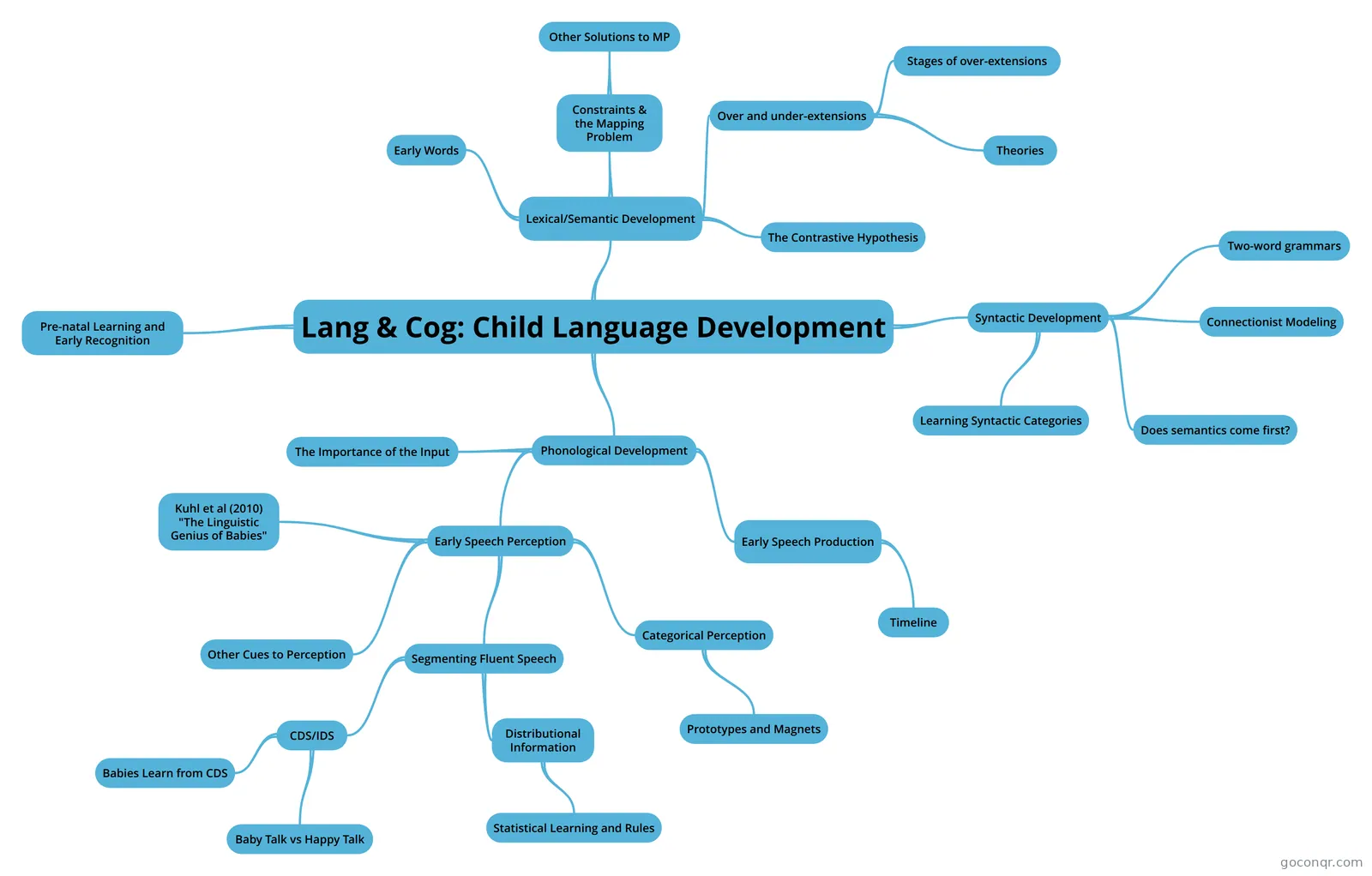
Mind map: Child language development
Map content
Lang & Cog: Child Language Development
Phonological Development
- Early Speech Perception
- Pre-linguistic infants between 1 and 4 months are sensitive to ALL acoustic differences later used to signal phonetic distinctions (Eimas, Miller & Jusczyk, 1987)
- Eimas et al (1971) showed that infants as young as 1m old can distinguish between two syllables that differed in only one distinctive phonological feature. Found that these different sounds eliciting changes altered the babies' sucking rate. Furthermore, they found that perception was categorical: as infants were only sensitive to changes in voice onset time that straddled adult boundaries -> categories used by infants were the same as those used by adults, suggesting that perceptual mechanisms may be inate
- Werker & Tees (1984) Found that infants discriminate sounds from each other regardless of whether or not these sounds are to be found in their surrounding adult language. They found that infants from English speaking families in Canada could make distinctions between phonetic differences in Hindi aged 6m, but this ability declined rapidly over the next 2m. 2m old Kikuyu infants in Africa can distinguish between [p] and [b]. If the sound is not used in their language in which they are growing up, this ability is lost by the age of one year or less.
- Nazzi, Mehler & Bertocini (1998) Infants can distinguish languages as long as they are rhythmically distinct enough; newborn French infants can distinguish English from Japanese, but not from Dutch.
- Segmenting Fluent Speech
- One of the biggest difficulties children face learning language is how to segment fluent speech in to words
- CDS/IDS
- Child Directed Speech or Infant Directed Speech: previously known as motherese, is speech directed at infants. Usually delivered characteristically with a cooing pattern, high in pitch, shortening/simplifying of words, greater intonation, hyperarticulation. Consistent across many cultures, genders and age spans. (Golinkoff et al, 2015)
- Thought to have both a linguistic and social benefit to infants: - maintains attention - fosters bond between infant and caregiver - social contingency - linguistic modifications, particularly prosody may help children segment speech in speech perception
- Fernald (1985) - using listening preference head turn technique, tested whether 4-5m olds preferred listening to CDS or ADS - they prefer CDS, even when German/Italian CDS is played to an English infant - suggests its the intonation that is being attended to, not the content - even neonates show this preference (Cooper and Aslin, 1990)
- Baby Talk vs Happy Talk
- Singh et al (2002) - noted confound between register (CD/AD) and affect (Happy/neutral) - what is driving listening preference? - systematically varied affect and register across five experiments - found listening preference for CDS disappears when affect is held constant - found a general preference for happy talk over neutral affect within each register - and a reversal of typical listening preference when realigned with register
- Babies Learn from CDS
- Singh et al (2009) - 7.5 month olds familiarised to two words, one in ADS and one in IDS - tested 24 hours later: listened to passages containing familiarised words, half IDS half ADS, and measured listening time to distinguish preferences (IDS vs ADS vs passages not containing familiarised words - found advantage for words familiarised in IDS, suggesting that IDS helps infants remember words before the onset of formal vocabulary knowledge
- Distributional Information
- Distributional information about phonetic segments is an important cue in learning to segment speech. It concerns the way in which sounds co-occur in a language. e.g. we don't segment speech so that a word begins with a sequence such as /mp/ in English - this is not a legal string of sounds at the start of English words. The sounds within the words 'laughing' and 'loudly' co-occur frequently by virtue, the sounds 'ingloud' occur less frequently.
- Theory of distributional info. proposed by Cairns et al (1997): once a child has successfully segmented a few words, it becomes progressively easier. Using little information to uncover more of the same is known as bootstrapping (Batchelder, 2002)
- Saffran, Aslin & Newport (1996) found that 8m old infants very quickly learn to discriminate words in a stream of syllables on the basis of which sounds tend to occur together regularly.
- Children also use more speech-specific cues to discriminate speech, including phonotactic e.g. coarticulation, the way sounds change in the presence of other sounds (Johnson & Juscyzk, 2001)
- Statistical Learning: in the broad sense, statistical learning is the discovery of patterns or structure in the input. It is implicit and can be implied to novel stimuli as it is formed on the basis of principles and not rules. Statistics may be simple (e.g. frequency) or complex (conditional probability). Infants show statistical learning for many aspects of the world: syntactic categories, faces, shapes, music etc
- Statistical Learning and Rules
- Saffran et al (1996) - 8m olds listened to two minutes of continuous speech consisting of 4 trisyllabic non-words strung together in random order - words vs nonwords - preferential listening for novel stimulus, suggesting they are sensitive to transitional probabilities (frequency kept constant) - keeping track of statistics allowed them to discriminate words and nonwords - a general learning mechanism: infants show the same effect for tone stimuli
- Issues for statistical learning: 1. how about rules - abstractions about patterns that could be generalised to stimuli that are novel? -> language as a symbolic system 2. is it relevant for language learning?
- Marcus et al (1991) suggested that in addition to statistical learning based on transitional probabilities, infants need also to have an abstract algebraic-like rule learning mechanism in order to acquire language -> rules are necessary to generalise to new exemplars -> and generalisation is critical to language learning.
- Marcus et al (1991) experiment: - 7m old infants, 2 minutes familiarisation phase and then test and looked for preferential listening - ABA group: ga li ga, etc - ABB group: ga li li etc - found that 15/16 infants showed a preference for the novel sentences - mean looking times were 6.3 secs for familiar sentences, and 9.0s for novel sentences - Marcus claimed that this was evidence for a rule-based learning system alongside statistical learning, but there is some controversy around this.
- Issues: 1. Not language-specific (Saffran et al, 2007) 2. Not species-specific (Murphy et al, 2008) - rule learning in rats
- Two separate mechanisms? 1. Statistical learning: learning about elements that are experiences during exposure 2. Rule learning: learning that can be applied to novel elements and novel combinations Induction Problem: a set of experiences potentially supports many different generalisations - what does the learner do if there are many different formal descriptions?
- Gerken (2006) - input items as used by Markus et al - considered different subsets: diagonal and coloumnal - 9m old infants trained with either diagonal or columnal condition - column 1: AAB rule, but all trisyllabic words end in 'di', diagonal: AAB rule Results: - diagonal: infants generalised to AAB rule - replicating Markus et al - column 1: generalised to 'di' rule, no reliable learning of AAB
- Gerken's study suggests that rule learning and statistical learning are not different separate mechanisms. Learning is an interaction between perceptual salience and consistency of contextual cues - together they determine learning and generalisation. Learning is accomplished through one mechanism without instruction, through mere exposure to structured input.
- Infants use statistics to segment the speech stream and discriminate words - what is the nature of the representation they acquire, and is it necessary for language learning? do infants treat high probably sequences as potential candidates for words? can they be mapped to meaning?
- Graf Estes et al (2007) - 17 month old infants - Phase 1: exposure to 2.5 mins of continuous speech stream with transitional probabilites as the ONLY clues for word boundaries - Phase 2: mapping meaning. Object-label association task. Presented with object-label pairs for words and nonwords until habituated. Test trial: switch object-label pair vs same. If treated as potential words that map to meanings, switch trials should be more surprising for words vs nonwords. Results: - switch trials lead to longer looking time for potential words, but not nonwords or part words -> Consistent with the idea that statistical word segmentations experiments have linguistic status
- Kuhl et al (2010) "The Linguistic Genius of Babies"
- Categorical Perception
- Eimas et al (1971) tested for categorical perception in infants native language using habituation/dishabituation sucking paradigm. - gradually habituated babies to a phoneme, e.g. /ba/ until sucking rate at baseline - changed the stimulus to either a different phoneme (as perceived a different category by adults), or an allophone of the same phoneme - always by a difference of 20msec VOT - dishabituation: babies suck harder again if new sound is perceived as different category from the habituated stimulus - found that babies aged 1 and 4 months showed find speech sound discrimination, same categories as adults - categorical perception does not require much experience of language - innate ability?
- Non-native contrasts (Werker and Tees, 1984) - adult category boundaries differ in different languages - when does this language specific categorical listening emerge? - difficult for English adults to perceive Hindi and Salish category contrasts - when do babies lose this ability? - use head turn paradigm: trained infants to turn head to speaker on the left when perceived a sound change - if correct, rewarded with animated drumming toy - Findings: infants 6-8 months can discriminate non-native contrasts without relevant experience (nature) - this ability seems to disappear between 10-12 months, whereas native infants retain this ability and improve on it
- Kuhl (2004)- Japanese 'r' an English 'l' and 'r' - aged 6m, both Japanese and American infants can discriminate l and r with similar ability - by 10m, English infants got better, Japanese infants got worse
- Prototypes and Magnets
- Kuhl et al, 1992 - as with other kinds of statistical learning, infant brains generalise across examples and represents 'prototypes' of phonemes - prototypical sounds function as perceptual magnets - sounds that are perceptually similar to it are attracted to it, and thereby grouped together - which sounds are experienced as similar and put together in a category depends on linguistic experience - i.e the exemplars you've heard
- Kuhl (2003) noted the importance of social interaction on the formation of prototypes and learning - examined learning in 9m old American infants who'd been exposed to native Chinese speakers - live interaction versus televised interaction - only infants exposed to live interaction were able to discriminate the mandarin phonemes, the ones exposed to televised interaction were no better than the monolingual infants not exposed at all - clearly social interaction is important for learning
- The social gating hypothesis: social communication at the heart of language. Attention/arousal/shared information discussed as potential mechanisms, Kuhl (2007)
- Other Cues to Perception
- 1. Infant's own name (Bortfield et al, 2005) - infants own name and other familiar words can be used as a cue for segmenting the speech stream
- 2. Stress Patterns - in English 90% of bisyllabic words have a trochaic stress pattern - word initial stress (Cutler and Carter, 1987) - 7.5-9 month olds can segment bisyllabic words with a strong-weak stress pattern from speech (e.g. DOCtor but not guiTAR) - 10.5 months can segment both strong-weak and weak-strong (Juscyzk, Houston and Newcombe, 1999)
- 3. Rhythm (the relationship between stressed and unstressed syllables - stress-timed languages (English) - syllable-timed languages (Mandarin) - mora-timed language (Japanese) Nazzi, Betrocini and Mehler (1998) - 4 day olds can distinguish between rhythmic types e.g. Dutch versus Japanese (when 400Hz filtered)
- 4. Phonotactic constraints - the permissible combinations of phonemes in a language Mattys and Juscyzk (2001) - 9m old American infants listened longer to legal English words than Dutch legal words which are illegal in English - 9m old Dutch infants showed opposite pattern - 6m olds, no preference - 9m olds can use phonotactic cues to segment words from speech
- 5. Syllable Transitional Probability Saffran, Aslin and Newport (1996) - 8m olds listened to 2 minutes of artificial language - created high transitional and low transitional probability words and part words - after only 2 minutes of exposure the infants were able to segment speech based on statistical learning
- 1, 2, 3 = linguistic cues 4, 5 = statistical cues
- Early Speech Production
- *Babbling* Infants start speaking around the age of 6-10 months There are two types of babbling: - reduplicated babbling, repetition of consonant-vowel syllables, often producing the same combination for a long time e.g. bababa - non-reduplicated babbling, strings of non-repeated syllables (Oller, 1980)
- Babbling appears universal, deaf infants also babble (Sykes, 1940), although produce different babbling patterns, suggesting that speech perception plays a role in what is produced when babbling.
- Continuity hypothesis (Mowrer, 1960) states that babbling is a direct precursor of language. Babbling children produce ALL the sounds found in the world's languages which is then narrowed down Discontinuity hypothesis (Jakobson, 1968): states that babbling has no relation to later development.
- Timeline
- 0-2m: phonation (pleasure/cries) 2-3m: gooing and cooing 4-6m: expansion (increased control of pitch and rhythm, varied consonant and vowel sounds) 7-10m: reduplicated babbling 10-12m: variegated (non-reduplicated) babbling/first words Early speech: muscular control problem, babies have not got the appropriate control of vocal organs to produce articulate speech.
- The Importance of the Input
- Evidently langauge input is important for languae learning. But there is a huge variation in the amount of input that children receive.
- Hart and Risley (1995) (US) Number of utterances per hour to infants: - High SES familes: 487 - Low SES families: 178 By 4 years of age, differences in input are huge: - High SES: 44 million - Low SES: 12 million
- Weisleider et al (2013) - measured in low SES sample: language exposure in the home at 19 months, langauge processing at 19months, expressive vocabulary at 24 months - recording 11 hours a day over a week - found huge variability: 2,000 - 29,000 words in total speech; 670 - 12,000 in CDS - infants fixate rapidly on the visual referent matching the word they hear - dramatic gains in speed and efficiency over their 2nd year - by 24 months, gaze shifts well before offset of the word - they do not need to hear the whole word before responding to it -> the input at 19 months DIRECTLY predicted the expressive vocabulary at 24 months -> and exposure at 19months indirectly predicted the language processing ability aged 29m (statistical mediation) -> suggesting environment is just as important and innate ability
- Early Speech Perception
Lexical/Semantic Development
- Words are produced from the age of about one year. By the age of 18-24 months, the child has a vocabulary of about 50 words - around this point the vocabulary explosion occurs. Nelson (1973) examined the first 10 words produced by children are found in categories: important person names, animals, food and toys. However, children differ greatly in earliest words. Nelson differentiated two broad groups based on types of early words: -> expressive style: emphasise people and feelings -> referential style: emphasise objects
- Early Words
- Semantic development depends on conceptual development - linguistic development must follow cognitive development.
- Quinn & Eimas (1986) suggest that categorisation is part of the innate architecture of cognition. Bloom (2001a) noticed that children's early vocabularies cannot be predicted on just the words they hear. Their vocabularies contain many more names for objects than are present in the speech directed towards them.
- The Ostensive Model of learning first words (Quine, 1960) - this ideology conveys the idea that acquiring simple words by a parent pointing and naming is how the child learns words. -> Objections to this model: - The MAPPING PROBLEM: how does a child know which attribute of input is being labeled? The word 'dog' could easily refer to just the dog's ears, or the entire category of animals, the colour or sound etc
- Constraints & the Mapping Problem
- Constraints on semantic development offer a solution to the mapping problem. The child makes use of a number of lexical principles to help establish meanings of new words.
- *Whole-Object Bias*: constrained to treat ostensive definitions as labels for the whole object (Markman, 1990; Waxman & Markow, 1995) There is some evidence for this constraint. Nino (1980) found that adults talking to children almost wholly use ostensive definition to label whole objects. When they deviate from this, they make it clear. Children also make errors that suggest they are using this constraint, e.g. thinking adjectives refer to objects. This constraint is also not limited to words (Bloom, 2001a)
- *Taxonomic Constraint*: Word refers to a category of similar things. If a child hears the word "cat", it will first immediately assume that the word refers to a whole object (whole object bias), and then that all similar objects will be labelled "cat" (Markman, 1989). Children prefer to use new words to associate things that are taxonomically related rather than thematically related (e.g. dog and cat rather than dog and bone) EVEN though they often prefer to group things thematically in other circumstances (Markman)
- *Mutual exclusivity*: Assumption that every object can only have one label (Markman and Wachtel, 1988). Unilingual children do not like more than one name for things. As children acquire new words, new strategies become available. For example, they may be biased to assign names to objects which do not already have names (the NC3 principle; Mervis and Bertrand, 1994)
- Other Solutions to MP
- *Basic Level Bias* - A new label likely refers to the everyday level of naming hierarchy: Superordinate "animal" (too general) Basic "dog" (right level of similarity and distinctiveness) Subordinate "labrador" (too detailed) Rosch et al. (1976) But why: are children specially attuned? Adults use more basic level words? Easier to learn?
- *Social Factors*: Joint attention between parent and child: parents usually tries to talk about what the child is interested in at the time. Children are sensitive to what the speaker is attending to and can work out whether novel labels refer to those things (Baldwin, 1991) Tomasello (1992b) argued that social and pragmatic factors could have an important influence on language development. Young children are surprisingly better at learning new verbs when adults are talking about actions that are yet to happen rather than when talking about actions that are ongoing (ostensively). Impeding action contains a great deal more pragmatic information that the infant can use can use, and his attention is drawn to this.
- *Nature of Objects* Soja, Carey & Spelke (1992) argued that the inferences children vary according to the object being labelled. Solid objects - the child assumes the word is the name of a whole object. For non-solids, the child infers the word is the name for parts or properties.
- *Syntactic Cues* Brown (1958) suggested that children may use part-of-speech as a cues to meaning. 17m olds are capable of attending to difference between noun-phrase syntax and count-noun syntax. Also: Syntactic bootstrapping (Gleitman, 1990)
- *Frequency/Accessibility* some words are easier to learn than others because children are exposed to some words more often than others. Some concepts may be more accessible to children. -> hand in hand with conceptual development
- Over and under-extensions
- E.Clark (1973) was one of the first to look at over-extensions. When children over-extend a word, they use it in a broader sense than adults would. Found across all languages - very common early on. Rescorla (1980) found that 1/3 of children's first 75 words were over-extended. Over-extensions are often based on perceptual attributes of the object. E.g. child refers to anything round as 'the moon'. Although shape is important, over extensions are also possible on the basis of movement, size, texture and sound. E. Clark (1973) found perceptual differences take precedent over function.
- Under-extensions occur when words are used more specifically than their meaning, such as using 'round' only to refer to balls. the number of underextensions might be dramatically under-recorded, because usually the construction will appear to be true, e.g. if a child points at the moon and says 'round', this utterance is correct, even if the child thinks this is the name of the moon.
- Stages of over-extensions
- Clark & Clark (1977) hypothesised two stages: 1 - child focuses on an attribute - usually perceptual - and then uses the new word to refer to that attribute. 2 - with more exposure, they realise that the word has a more specific meaning, but they do not know the other words that would enable them to be more precise. In this stage, they continue to use the overextended word as shorthand for 'like it'.
- Theories
- Semantic Feature Hypothesis (E.Clark, 1973) - based on decompositional theory of lexical semantics - states that the meaning of a word can be specified in terms of a set of smaller units of meaning called semantic features - over- and under-extensions occur as a result of a mismatch between features of a word used by the child and the complete adult representation - the child samples from the features, primarily on perceptual grounds. Over-extensions occur when the set of features is incomplete, under extensions occur when additional spurious features are developed. - semantic development consists primarily of acquiring new features and reducing mismatch Problems: Atkinson & Barrett (1978) - central problem in this theory is that the features proposed to account for the data are arbitrary.
- Functional Core Hypothesis (Nelson, 1974) Generalisation is not restricted to perceptual similarity; instead functional features are also emphasised. In other ways, this theory is similar to the semantic feature theory.
- The Prototype Hypothesis (Bowerman, 1978) States that lexical development consists of acquiring a prototype that corresponds to the adult version. A prototype is an average member of a category. Over-extensions may be better explained in terms of concept development and category use. Kay & Anglin (1982) found prototypicality effects in over and under extensions. The more an object was prototypical of a category, the more likely it was that the conceptual prototype name would be extended to include the object. Words are less likely to be extended for more peripheral category members. This suggests that the concepts are not fully developed but clustered around just a few prototypical exemplars. This approach also inherits the problems of the semantic theory.
- The Contrastive Hypothesis
- Barrett (1978) Argued that the key features in learning the meaning of a word are those that differentiate it from related words. E.g. the meaning of 'dog' is learned by attaining the contrast between dogs and similar animals, rather than learning the important features of dogs. In the revised version of this model (Barrett, 1982), although contrasts are still important, they are not what is acquired first. Instead, words are initially mapped onto prototypical representations; the most salient prototypical features are used to group the word with words sharing similar features, and contrastive features are used to distinguish between semantically similar words.
- The emphasis of CONTRAST has come to be seen as very important (E.Clark). The Contrastive hypothesis is a pragmatic principle that simply says words have different meanings - similar to lexical constraint of mutual exclusivity. However, the child is still faced with a significant task. When new word meanings are acquired, because features are contrasted with the features of existing word meanings, the meaning should not overlap with existing words - children do not like two labels for the same thing.
- Gathercole (1987) -> children do not mind two labels for the same object. Contrast appears to be used later rather than earlier as an organising principle of semantic development. Neither is it likely to be the only principle driving semantic development - there comes a point where it is no longer useful.
Syntactic Development
- Two-word utterances come after one-word (holophrastic) speech. After this, early speech is telegraphic in that grammatical morphemes may be omitted. Continuous theories: children are believed to have knowledge of grammatical categories from the very earliest stages (Bloom, Pinker, etc) - the child's goal is to attach particular words to correct grammatical categories and then use them with the appropriate syntactic rules. Discontinuous theories: early multi-word utterances are not governed by adult-like rules (Bowerman, Braine, Maratsos)
- Learning Syntactic Categories
- "Syntactic categories are innate" - Pinker, 1984, 1989 - children know that nouns refer to objects and verbs refer to actions - Pinker argued that a child first learns the meaning of some content words and uses these to construct semantic representations of some simple input sentences - with the surface structure of a sentence and knowledge of its meaning, the child is in a position to make an inference about its underlying structure - children start off with their innate knowledge of syntactic categories and a set of innate linking rules that relate them to the semantic categories of thematic roles. Thematic roles are a way of labelling who did what in a sentence. -An innate linking rule relates the syntactic categories of subject and object to the thematic (semantic) categories - agent and patient. - Upon exposure to the language, all the child has to do is identify the agents in utterances and this info then provides knowledge of the syntactic structure. This process is known as SEMANTIC BOOTSTRAPPING. - Nativist accounts provide a simple explanation for many otherwise mysterious phenomena, but they have a number of disadvantages -> the predictions they make are not always borne out by data. This theory depends on the child learning lots of utterances early on that contain easily identifiable agents and actions that can be mapped on to nouns and verbs. But, it can often be difficult to work out the meaning, especially of verbs (Gillette et al, 1999)
- Bowerman (1990) showed that there was little difference in the order of acquisition of verbs that the semantic bootstrapping account predicts should be the easiest for children to map on to thematic roles compared with those that should be harder. Bowerman found that the two types of verbs are acquired at the same time. Braine (1988a, 1998b) in a detailed review of Pinker's theory questioned the need for semantic bootstrapping and examined the evidence against the existence of very early phrase structure rules. He argued that semantic information is sufficient for children to be able to learn syntactic categories. The process of language development is slow and full of errors - there is a fine balance between a developmental system that is innately constrained as Pinker proposed, and yet unconstrained enough to accommodate these errors.
- Does semantics come first?
- Connectionist Modeling
- Two-word grammars
Pre-natal Learning and Early Recognition
- DeCasper & Spence (1986) - pregnant women read aloud story every day for the final 6 weeks of pregnancy - after babies were born, they were tested for story preference using the sucking paradigm - babies preferred to listen to the story that the mother had read to them in the womb over an unfamiliar story - showed this preference even when stories read in unfamiliar (not mother's) voice - evidence that they must have learned some characteristic of the language itself, not just familiarity of mother's voice
- DeCasper et al. (1994) Supports this conclusion: mothers read aloud to fetuses every day between 34 and 38 weeks - the experimenters then played story directly through abdomen to the fetus (mother unaware of what was played) and monitored heart rate changes of the fetus and found it decreased when the familiar story was played, but not when an unfamiliar story was played
- Mehler et al (1988) - played tapes of French speech to 4day old French babies - used variant of the sucking paradigm and found babies sucked until the novelty wore off - when the sucking rate fell, they switched to Russian speech - spoken by the same bilingual speaker (no difference in voice) - they found that the sucking rate increased again - the same result was found if the tapes were played the other way round -> hence newborns could detect change in language -> Mehler suggested this was due to prosodic differences in language that the babies were detecting - like stress, intonation and rhythm -> backed up by further experiment (Mehler et al, 1988) in which the high frequencies of language were removed . We depend on high frequency sounds to recognise individual sounds. The babies detected the change still, making it more likely that they were responding to changes in sound prosody than individual sound differences.
- Fifer and Moon (1995) - babies prefer filtered version of the mother's voice that mimics the auditory environment in the womb
- Pena (2003) - neural correlates - 14 neonates, mean age 2.5 days - used NIRS to examine neural activity to forward, backward speech and silence in right and left hemispheres - left hemisphere specialisation found - neonates' brain responded to forward speech shortly after birth
Information
- Description
- Language and Cognition Mind Map on Lang & Cog: Child Language Development, created by Rachel Cross on 07/12/2017.
- Created by
- Rachel Cross
- Views
- 7
- Rating