
Mind map
The Global Economy
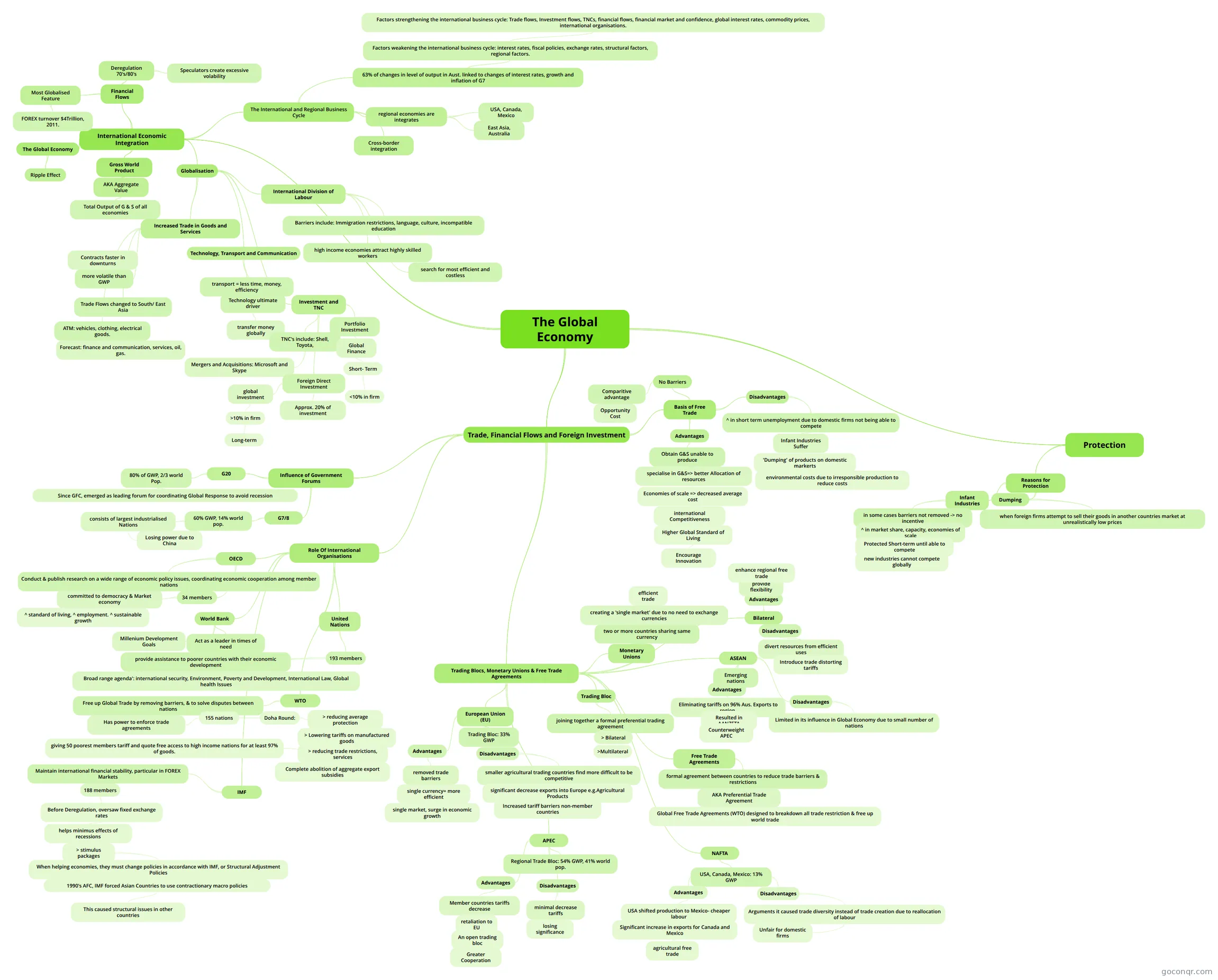
Mind map: The global economy
Map content
The Global Economy
International Economic Integration
- Gross World Product
- AKA Aggregate Value
- Total Output of G & S of all economies
- AKA Aggregate Value
- The Global Economy
- Ripple Effect
- Globalisation
- International Division of Labour
- high income economies attract highly skilled workers
- Barriers include: Immigration restrictions, language, culture, incompatible education
- search for most efficient and costless
- Technology, Transport and Communication
- Technology ultimate driver
- transfer money globally
- transport = less time, money, efficiency
- Technology ultimate driver
- Investment and TNC
- TNC's include: Shell, Toyota,
- Mergers and Acquisitions: Microsoft and Skype
- Foreign Direct Investment
- global investment
- >10% in firm
- Long-term
- >10% in firm
- Approx. 20% of investment
- global investment
- Portfolio Investment
- Global Finance
- Short- Term
- <10% in firm
- Short- Term
- Global Finance
- TNC's include: Shell, Toyota,
- Increased Trade in Goods and Services
- more volatile than GWP
- Contracts faster in downturns
- Trade Flows changed to South/ East Asia
- ATM: vehicles, clothing, electrical goods.
- Forecast: finance and communication, services, oil, gas.
- more volatile than GWP
- International Division of Labour
- Financial Flows
- Most Globalised Feature
- FOREX turnover $4Trillion, 2011.
- Deregulation 70's/80's
- Speculators create excessive volability
- Most Globalised Feature
- The International and Regional Business Cycle
- 63% of changes in level of output in Aust. linked to changes of interest rates, growth and inflation of G7
- Factors weakening the international business cycle: interest rates, fiscal policies, exchange rates, structural factors, regional factors.
- Factors strengthening the international business cycle: Trade flows, Investment flows, TNCs, financial flows, financial market and confidence, global interest rates, commodity prices, international organisations.
- Factors weakening the international business cycle: interest rates, fiscal policies, exchange rates, structural factors, regional factors.
- Cross-border integration
- regional economies are integrates
- USA, Canada, Mexico
- East Asia, Australia
- 63% of changes in level of output in Aust. linked to changes of interest rates, growth and inflation of G7
- Gross World Product
Trade, Financial Flows and Foreign Investment
- Basis of Free Trade
- No Barriers
- Comparitive advantage
- Opportunity Cost
- Comparitive advantage
- Advantages
- Obtain G&S unable to produce
- specialise in G&S=> better Allocation of resources
- Economies of scale => decreased average cost
- international Competitiveness
- Higher Global Standard of Living
- Encourage Innovation
- Higher Global Standard of Living
- international Competitiveness
- Economies of scale => decreased average cost
- specialise in G&S=> better Allocation of resources
- Obtain G&S unable to produce
- Disadvantages
- ^ in short term unemployment due to domestic firms not being able to compete
- Infant Industries Suffer
- 'Dumping' of products on domestic markerts
- environmental costs due to irresponsible production to reduce costs
- 'Dumping' of products on domestic markerts
- Infant Industries Suffer
- ^ in short term unemployment due to domestic firms not being able to compete
- No Barriers
- Influence of Government Forums
- G7/8
- 60% GWP, 14% world pop.
- consists of largest industrialised Nations
- Losing power due to China
- consists of largest industrialised Nations
- 60% GWP, 14% world pop.
- G20
- 80% of GWP, 2/3 world Pop.
- Since GFC, emerged as leading forum for coordinating Global Response to avoid recession
- 80% of GWP, 2/3 world Pop.
- G7/8
- Role Of International Organisations
- OECD
- 34 members
- committed to democracy & Market economy
- ^ standard of living, ^ employment. ^ sustainable growth
- committed to democracy & Market economy
- Conduct & publish research on a wide range of economic policy issues, coordinating economic cooperation among member nations
- 34 members
- World Bank
- provide assistance to poorer countries with their economic development
- Millenium Development Goals
- Act as a leader in times of need
- provide assistance to poorer countries with their economic development
- United Nations
- 193 members
- Broad range agenda': international security, Environment, Poverty and Development, International Law, Global health Issues
- 193 members
- IMF
- Maintain international financial stability, particular in FOREX Markets
- 188 members
- Before Deregulation, oversaw fixed exchange rates
- helps minimus effects of recessions
- > stimulus packages
- When helping economies, they must change policies in accordance with IMF, or Structural Adjustment Policies
- 1990's AFC, IMF forced Asian Countries to use contractionary macro policies
- This caused structural issues in other countries
- 1990's AFC, IMF forced Asian Countries to use contractionary macro policies
- When helping economies, they must change policies in accordance with IMF, or Structural Adjustment Policies
- > stimulus packages
- helps minimus effects of recessions
- Before Deregulation, oversaw fixed exchange rates
- 188 members
- Maintain international financial stability, particular in FOREX Markets
- WTO
- Free up Global Trade by removing barriers, & to solve disputes between nations
- Has power to enforce trade agreements
- 155 nations
- Doha Round:
- > reducing average protection
- > Lowering tariffs on manufactured goods
- > reducing trade restrictions, services
- Complete abolition of aggregate export subsidies
- giving 50 poorest members tariff and quote free access to high income nations for at least 97% of goods.
- Complete abolition of aggregate export subsidies
- > reducing trade restrictions, services
- > Lowering tariffs on manufactured goods
- > reducing average protection
- Doha Round:
- 155 nations
- Has power to enforce trade agreements
- Free up Global Trade by removing barriers, & to solve disputes between nations
- OECD
- Trading Blocs, Monetary Unions & Free Trade Agreements
- Trading Bloc
- joining together a formal preferential trading agreement
- > Bilateral
- >Multilateral
- > Bilateral
- joining together a formal preferential trading agreement
- Free Trade Agreements
- formal agreement between countries to reduce trade barriers & restrictions
- AKA Preferential Trade Agreement
- Global Free Trade Agreements (WTO) designed to breakdown all trade restriction & free up world trade
- AKA Preferential Trade Agreement
- formal agreement between countries to reduce trade barriers & restrictions
- Monetary Unions
- two or more countries sharing same currency
- creating a 'single market' due to no need to exchange currencies
- efficient trade
- creating a 'single market' due to no need to exchange currencies
- two or more countries sharing same currency
- European Union (EU)
- Trading Bloc: 33% GWP
- Advantages
- removed trade barriers
- single currency= more efficient
- single market, surge in economic growth
- single currency= more efficient
- removed trade barriers
- Disadvantages
- smaller agricultural trading countries find more difficult to be competitive
- significant decrease exports into Europe e.g.Agricultural Products
- Increased tariff barriers non-member countries
- significant decrease exports into Europe e.g.Agricultural Products
- smaller agricultural trading countries find more difficult to be competitive
- APEC
- Regional Trade Bloc: 54% GWP, 41% world pop.
- Advantages
- Member countries tariffs decrease
- retaliation to EU
- An open trading bloc
- Greater Cooperation
- An open trading bloc
- retaliation to EU
- Member countries tariffs decrease
- Disadvantages
- minimal decrease tariffs
- losing significance
- minimal decrease tariffs
- NAFTA
- USA, Canada, Mexico: 13% GWP
- Advantages
- USA shifted production to Mexico- cheaper labour
- Significant increase in exports for Canada and Mexico
- agricultural free trade
- Significant increase in exports for Canada and Mexico
- USA shifted production to Mexico- cheaper labour
- Disadvantages
- Arguments it caused trade diversity instead of trade creation due to reallocation of labour
- Unfair for domestic firms
- Arguments it caused trade diversity instead of trade creation due to reallocation of labour
- Advantages
- USA, Canada, Mexico: 13% GWP
- ASEAN
- Emerging nations
- Advantages
- Eliminating tariffs on 96% Aus. Exports to region.
- Resulted in AANZFTA
- Counterweight APEC
- Resulted in AANZFTA
- Eliminating tariffs on 96% Aus. Exports to region.
- Disadvantages
- Limited in its influence in Global Economy due to small number of nations
- Bilateral
- Advantages
- provide flexibility
- enhance regional free trade
- provide flexibility
- Disadvantages
- divert resources from efficient uses
- Introduce trade distorting tariffs
- divert resources from efficient uses
- Advantages
- Trading Bloc
- Basis of Free Trade
Protection
- Reasons for Protection
- Infant Industries
- in some cases barriers not removed -> no incentive
- ^ in market share, capacity, economies of scale
- Protected Short-term until able to compete
- new industries cannot compete globally
- Protected Short-term until able to compete
- ^ in market share, capacity, economies of scale
- in some cases barriers not removed -> no incentive
- Dumping
- when foreign firms attempt to sell their goods in another countries market at unrealistically low prices
- Infant Industries
- Reasons for Protection
Information
- Description
- Mind Map on The Global Economy, created by swelch_96 on 22/08/2014.
- Created by
- swelch_96
- Views
- 105
- Rating