
Mind map
Research characteristics
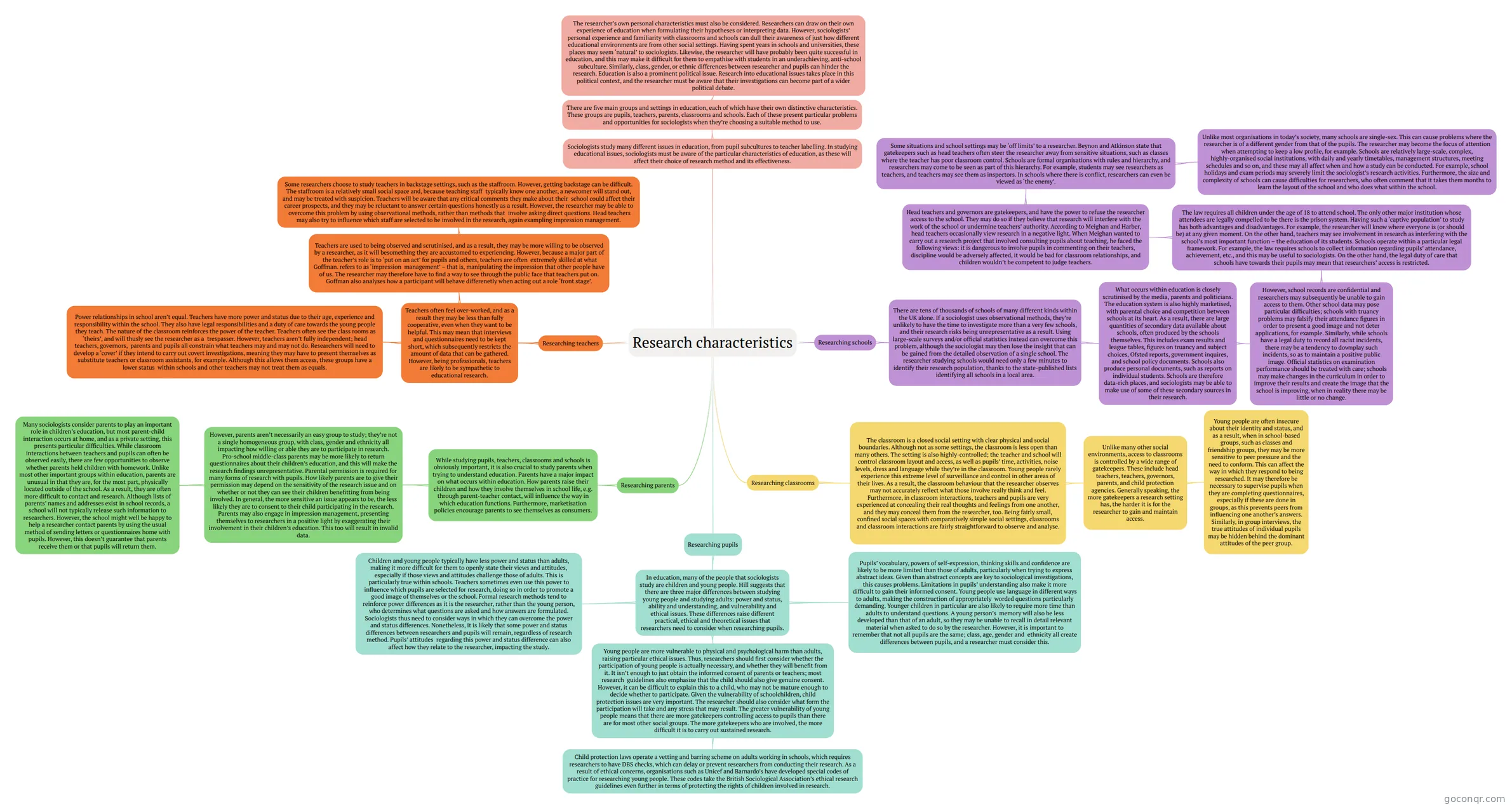
Mind map: Research characteristics in education
Map content
Research characteristics
Sociologists study many different issues in education, from pupil subcultures to teacher labelling. In studying educational issues, sociologists must be aware of the particular characteristics of education, as these will affect their choice of research method and its effectiveness.
- There are five main groups and settings in education, each of which have their own distinctive characteristics. These groups are pupils, teachers, parents, classrooms and schools. Each of these present particular problems and opportunities for sociologists when they’re choosing a suitable method to use.
- The researcher’s own personal characteristics must also be considered. Researchers can draw on their own experience of education when formulating their hypotheses or interpreting data. However, sociologists’ personal experience and familiarity with classrooms and schools can dull their awareness of just how different educational environments are from other social settings. Having spent years in schools and universities, these places may seem ‘natural’ to sociologists. Likewise, the researcher will have probably been quite successful in education, and this may make it difficult for them to empathise with students in an underachieving, anti-school subculture. Similarly, class, gender, or ethnic differences between researcher and pupils can hinder the research. Education is also a prominent political issue. Research into educational issues takes place in this political context, and the researcher must be aware that their investigations can become part of a wider political debate.
- There are five main groups and settings in education, each of which have their own distinctive characteristics. These groups are pupils, teachers, parents, classrooms and schools. Each of these present particular problems and opportunities for sociologists when they’re choosing a suitable method to use.
Researching pupils
- In education, many of the people that sociologists study are children and young people. Hill suggests that there are three major differences between studying young people and studying adults: power and status, ability and understanding, and vulnerability and ethical issues. These differences raise different practical, ethical and theoretical issues that researchers need to consider when researching pupils.
- Children and young people typically have less power and status than adults, making it more difficult for them to openly state their views and attitudes, especially if those views and attitudes challenge those of adults. This is particularly true within schools. Teachers sometimes even use this power to influence which pupils are selected for research, doing so in order to promote a good image of themselves or the school. Formal research methods tend to reinforce power differences as it is the researcher, rather than the young person, who determines what questions are asked and how answers are formulated. Sociologists thus need to consider ways in which they can overcome the power and status differences. Nonetheless, it is likely that some power and status differences between researchers and pupils will remain, regardless of research method. Pupils’ attitudes regarding this power and status difference can also affect how they relate to the researcher, impacting the study.
- Pupils’ vocabulary, powers of self-expression, thinking skills and confidence are likely to be more limited than those of adults, particularly when trying to express abstract ideas. Given than abstract concepts are key to sociological investigations, this causes problems. Limitations in pupils’ understanding also make it more difficult to gain their informed consent. Young people use language in different ways to adults, making the construction of appropriately worded questions particularly demanding. Younger children in particular are also likely to require more time than adults to understand questions. A young person’s memory will also be less developed than that of an adult, so they may be unable to recall in detail relevant material when asked to do so by the researcher. However, it is important to remember that not all pupils are the same; class, age, gender and ethnicity all create differences between pupils, and a researcher must consider this.
- Young people are more vulnerable to physical and psychological harm than adults, raising particular ethical issues. Thus, researchers should first consider whether the participation of young people is actually necessary, and whether they will benefit from it. It isn’t enough to just obtain the informed consent of parents or teachers; most research guidelines also emphasise that the child should also give genuine consent. However, it can be difficult to explain this to a child, who may not be mature enough to decide whether to participate. Given the vulnerability of schoolchildren, child protection issues are very important. The researcher should also consider what form the participation will take and any stress that may result. The greater vulnerability of young people means that there are more gatekeepers controlling access to pupils than there are for most other social groups. The more gatekeepers who are involved, the more difficult it is to carry out sustained research.
- Child protection laws operate a vetting and barring scheme on adults working in schools, which requires researchers to have DBS checks, which can delay or prevent researchers from conducting their research. As a result of ethical concerns, organisations such as Unicef and Barnardo’s have developed special codes of practice for researching young people. These codes take the British Sociological Association’s ethical research guidelines even further in terms of protecting the rights of children involved in research.
- In education, many of the people that sociologists study are children and young people. Hill suggests that there are three major differences between studying young people and studying adults: power and status, ability and understanding, and vulnerability and ethical issues. These differences raise different practical, ethical and theoretical issues that researchers need to consider when researching pupils.
Researching classrooms
- The classroom is a closed social setting with clear physical and social boundaries. Although not as some settings, the classroom is less open than many others. The setting is also highly-controlled; the teacher and school will control classroom layout and access, as well as pupils’ time, activities, noise levels, dress and language while they’re in the classroom. Young people rarely experience this extreme level of surveillance and control in other areas of their lives. As a result, the classroom behaviour that the researcher observes may not accurately reflect what those involve really think and feel. Furthermore, in classroom interactions, teachers and pupils are very experienced at concealing their real thoughts and feelings from one another, and they may conceal them from the researcher, too. Being fairly small, confined social spaces with comparatively simple social settings, classrooms and classroom interactions are fairly straightforward to observe and analyse.
- Unlike many other social environments, access to classrooms is controlled by a wide range of gatekeepers. These include head teachers, teachers, governors, parents, and child protection agencies. Generally speaking, the more gatekeepers a research setting has, the harder it is for the researcher to gain and maintain access.
- Young people are often insecure about their identity and status, and as a result, when in school-based groups, such as classes and friendship groups, they may be more sensitive to peer pressure and the need to conform. This can affect the way in which they respond to being researched. It may therefore be necessary to supervise pupils when they are completing questionnaires, especially if these are done in groups, as this prevents peers from influencing one another’s answers. Similarly, in group interviews, the true attitudes of individual pupils may be hidden behind the dominant attitudes of the peer group.
- Unlike many other social environments, access to classrooms is controlled by a wide range of gatekeepers. These include head teachers, teachers, governors, parents, and child protection agencies. Generally speaking, the more gatekeepers a research setting has, the harder it is for the researcher to gain and maintain access.
- The classroom is a closed social setting with clear physical and social boundaries. Although not as some settings, the classroom is less open than many others. The setting is also highly-controlled; the teacher and school will control classroom layout and access, as well as pupils’ time, activities, noise levels, dress and language while they’re in the classroom. Young people rarely experience this extreme level of surveillance and control in other areas of their lives. As a result, the classroom behaviour that the researcher observes may not accurately reflect what those involve really think and feel. Furthermore, in classroom interactions, teachers and pupils are very experienced at concealing their real thoughts and feelings from one another, and they may conceal them from the researcher, too. Being fairly small, confined social spaces with comparatively simple social settings, classrooms and classroom interactions are fairly straightforward to observe and analyse.
Researching parents
- While studying pupils, teachers, classrooms and schools is obviously important, it is also crucial to study parents when trying to understand education. Parents have a major impact on what occurs within education. How parents raise their children and how they involve themselves in school life, e.g. through parent-teacher contact, will influence the way in which education functions. Furthermore, marketisation policies encourage parents to see themselves as consumers.
- However, parents aren’t necessarily an easy group to study; they’re not a single homogeneous group, with class, gender and ethnicity all impacting how willing or able they are to participate in research. Pro-school middle-class parents may be more likely to return questionnaires about their children’s education, and this will make the research findings unrepresentative. Parental permission is required for many forms of research with pupils. How likely parents are to give their permission may depend on the sensitivity of the research issue and on whether or not they can see their children benefitting from being involved. In general, the more sensitive an issue appears to be, the less likely they are to consent to their child participating in the research. Parents may also engage in impression management, presenting themselves to researchers in a positive light by exaggerating their involvement in their children’s education. This too will result in invalid data.
- Many sociologists consider parents to play an important role in children’s education, but most parent-child interaction occurs at home, and as a private setting, this presents particular difficulties. While classroom interactions between teachers and pupils can often be observed easily, there are few opportunities to observe whether parents held children with homework. Unlike most other important groups within education, parents are unusual in that they are, for the most part, physically located outside of the school. As a result, they are often more difficult to contact and research. Although lists of parents’ names and addresses exist in school records, a school will not typically release such information to researchers. However, the school might well be happy to help a researcher contact parents by using the usual method of sending letters or questionnaires home with pupils. However, this doesn’t guarantee that parents receive them or that pupils will return them.
- However, parents aren’t necessarily an easy group to study; they’re not a single homogeneous group, with class, gender and ethnicity all impacting how willing or able they are to participate in research. Pro-school middle-class parents may be more likely to return questionnaires about their children’s education, and this will make the research findings unrepresentative. Parental permission is required for many forms of research with pupils. How likely parents are to give their permission may depend on the sensitivity of the research issue and on whether or not they can see their children benefitting from being involved. In general, the more sensitive an issue appears to be, the less likely they are to consent to their child participating in the research. Parents may also engage in impression management, presenting themselves to researchers in a positive light by exaggerating their involvement in their children’s education. This too will result in invalid data.
- While studying pupils, teachers, classrooms and schools is obviously important, it is also crucial to study parents when trying to understand education. Parents have a major impact on what occurs within education. How parents raise their children and how they involve themselves in school life, e.g. through parent-teacher contact, will influence the way in which education functions. Furthermore, marketisation policies encourage parents to see themselves as consumers.
Researching schools
- There are tens of thousands of schools of many different kinds within the UK alone. If a sociologist uses observational methods, they’re unlikely to have the time to investigate more than a very few schools, and their research risks being unrepresentative as a result. Using large-scale surveys and/or official statistics instead can overcome this problem, although the sociologist may then lose the insight that can be gained from the detailed observation of a single school. The researcher studying schools would need only a few minutes to identify their research population, thanks to the state-published lists identifying all schools in a local area.
- What occurs within education is closely scrutinised by the media, parents and politicians. The education system is also highly marketised, with parental choice and competition between schools at its heart. As a result, there are large quantities of secondary data available about schools, often produced by the schools themselves. This includes exam results and league tables, figures on truancy and subject choices, Ofsted reports, government inquires, and school policy documents. Schools also produce personal documents, such as reports on individual students. Schools are therefore data-rich places, and sociologists may be able to make use of some of these secondary sources in their research.
- However, school records are confidential and researchers may subsequently be unable to gain access to them. Other school data may pose particular difficulties; schools with truancy problems may falsify their attendance figures in order to present a good image and not deter applications, for example. Similarly, while schools have a legal duty to record all racist incidents, there may be a tendency to downplay such incidents, so as to maintain a positive public image. Official statistics on examination performance should be treated with care; schools may make changes in the curriculum in order to improve their results and create the image that the school is improving, when in reality there may be little or no change.
- The law requires all children under the age of 18 to attend school. The only other major institution whose attendees are legally compelled to be there is the prison system. Having such a ‘captive population’ to study has both advantages and disadvantages. For example, the researcher will know where everyone is (or should be) at any given moment. On the other hand, teachers may see involvement in research as interfering with the school’s most important function – the education of its students. Schools operate within a particular legal framework. For example, the law requires schools to collect information regarding pupils’ attendance, achievement, etc., and this may be useful to sociologists. On the other hand, the legal duty of care that schools have towards their pupils may mean that researchers’ access is restricted.
- Head teachers and governors are gatekeepers, and have the power to refuse the researcher access to the school. They may do so if they believe that research will interfere with the work of the school or undermine teachers’ authority. According to Meighan and Harber, head teachers occasionally view research in a negative light. When Meighan wanted to carry out a research project that involved consulting pupils about teaching, he faced the following views: it is dangerous to involve pupils in commenting on their teachers, discipline would be adversely affected, it would be bad for classroom relationships, and children wouldn’t be competent to judge teachers.
- Some situations and school settings may be ‘off limits’ to a researcher. Beynon and Atkinson state that gatekeepers such as head teachers often steer the researcher away from sensitive situations, such as classes where the teacher has poor classroom control. Schools are formal organisations with rules and hierarchy, and researchers may come to be seen as part of this hierarchy. For example, students may see researchers as teachers, and teachers may see them as inspectors. In schools where there is conflict, researchers can even be viewed as ‘the enemy’.
- Unlike most organisations in today’s society, many schools are single-sex. This can cause problems where the researcher is of a different gender from that of the pupils. The researcher may become the focus of attention when attempting to keep a low profile, for example. Schools are relatively large-scale, complex, highly-organised social institutions, with daily and yearly timetables, management structures, meeting schedules and so on, and these may all affect when and how a study can be conducted. For example, school holidays and exam periods may severely limit the sociologist’s research activities. Furthermore, the size and complexity of schools can cause difficulties for researchers, who often comment that it takes them months to learn the layout of the school and who does what within the school.
- Some situations and school settings may be ‘off limits’ to a researcher. Beynon and Atkinson state that gatekeepers such as head teachers often steer the researcher away from sensitive situations, such as classes where the teacher has poor classroom control. Schools are formal organisations with rules and hierarchy, and researchers may come to be seen as part of this hierarchy. For example, students may see researchers as teachers, and teachers may see them as inspectors. In schools where there is conflict, researchers can even be viewed as ‘the enemy’.
- Head teachers and governors are gatekeepers, and have the power to refuse the researcher access to the school. They may do so if they believe that research will interfere with the work of the school or undermine teachers’ authority. According to Meighan and Harber, head teachers occasionally view research in a negative light. When Meighan wanted to carry out a research project that involved consulting pupils about teaching, he faced the following views: it is dangerous to involve pupils in commenting on their teachers, discipline would be adversely affected, it would be bad for classroom relationships, and children wouldn’t be competent to judge teachers.
- The law requires all children under the age of 18 to attend school. The only other major institution whose attendees are legally compelled to be there is the prison system. Having such a ‘captive population’ to study has both advantages and disadvantages. For example, the researcher will know where everyone is (or should be) at any given moment. On the other hand, teachers may see involvement in research as interfering with the school’s most important function – the education of its students. Schools operate within a particular legal framework. For example, the law requires schools to collect information regarding pupils’ attendance, achievement, etc., and this may be useful to sociologists. On the other hand, the legal duty of care that schools have towards their pupils may mean that researchers’ access is restricted.
- However, school records are confidential and researchers may subsequently be unable to gain access to them. Other school data may pose particular difficulties; schools with truancy problems may falsify their attendance figures in order to present a good image and not deter applications, for example. Similarly, while schools have a legal duty to record all racist incidents, there may be a tendency to downplay such incidents, so as to maintain a positive public image. Official statistics on examination performance should be treated with care; schools may make changes in the curriculum in order to improve their results and create the image that the school is improving, when in reality there may be little or no change.
- What occurs within education is closely scrutinised by the media, parents and politicians. The education system is also highly marketised, with parental choice and competition between schools at its heart. As a result, there are large quantities of secondary data available about schools, often produced by the schools themselves. This includes exam results and league tables, figures on truancy and subject choices, Ofsted reports, government inquires, and school policy documents. Schools also produce personal documents, such as reports on individual students. Schools are therefore data-rich places, and sociologists may be able to make use of some of these secondary sources in their research.
- There are tens of thousands of schools of many different kinds within the UK alone. If a sociologist uses observational methods, they’re unlikely to have the time to investigate more than a very few schools, and their research risks being unrepresentative as a result. Using large-scale surveys and/or official statistics instead can overcome this problem, although the sociologist may then lose the insight that can be gained from the detailed observation of a single school. The researcher studying schools would need only a few minutes to identify their research population, thanks to the state-published lists identifying all schools in a local area.
Researching teachers
- Teachers often feel over-worked, and as a result they may be less than fully cooperative, even when they want to be helpful. This may mean that interviews and questionnaires need to be kept short, which subsequently restricts the amount of data that can be gathered. However, being professionals, teachers are likely to be sympathetic to educational research.
- Power relationships in school aren’t equal. Teachers have more power and status due to their age, experience and responsibility within the school. They also have legal responsibilities and a duty of care towards the young people they teach. The nature of the classroom reinforces the power of the teacher. Teachers often see the class rooms as ‘theirs’, and will thusly see the researcher as a trespasser. However, teachers aren’t fully independent; head teachers, governors, parents and pupils all constrain what teachers may and may not do. Researchers will need to develop a ‘cover’ if they intend to carry out covert investigations, meaning they may have to present themselves as substitute teachers or classroom assistants, for example. Although this allows them access, these groups have a lower status within schools and other teachers may not treat them as equals.
- Teachers are used to being observed and scrutinised, and as a result, they may be more willing to be observed by a researcher, as it will besomething they are accustomed to experiencing. However, because a major part of the teacher’s role is to ‘put on an act’ for pupils and others, teachers are often extremely skilled at what Goffman. refers to as ‘impression management’ – that is, manipulating the impression that other people have of us. The researcher may therefore have to find a way to see through the public face that teachers put on. Goffman also analyses how a participant will behave differenetly when acting out a role ‘front stage’.
- Some researchers choose to study teachers in backstage settings, such as the staffroom. However, getting backstage can be difficult. The staffroom is a relatively small social space and, because teaching staff typically know one another, a newcomer will stand out, and may be treated with suspicion. Teachers will be aware that any critical comments they make about their school could affect their career prospects, and they may be reluctant to answer certain questions honestly as a result. However, the researcher may be able to overcome this problem by using observational methods, rather than methods that involve asking direct questions. Head teachers may also try to influence which staff are selected to be involved in the research, again exampling impression management.
- Teachers often feel over-worked, and as a result they may be less than fully cooperative, even when they want to be helpful. This may mean that interviews and questionnaires need to be kept short, which subsequently restricts the amount of data that can be gathered. However, being professionals, teachers are likely to be sympathetic to educational research.
Information
- Description
- AS level Sociology AS - Research Methods (Education: The Research Context) Mind Map on Research characteristics, created by Em Maskrey on 22/12/2017.
- Created by
- Em Maskrey
- Views
- 1
- Rating