
Mind map
Glossary of knowledge management
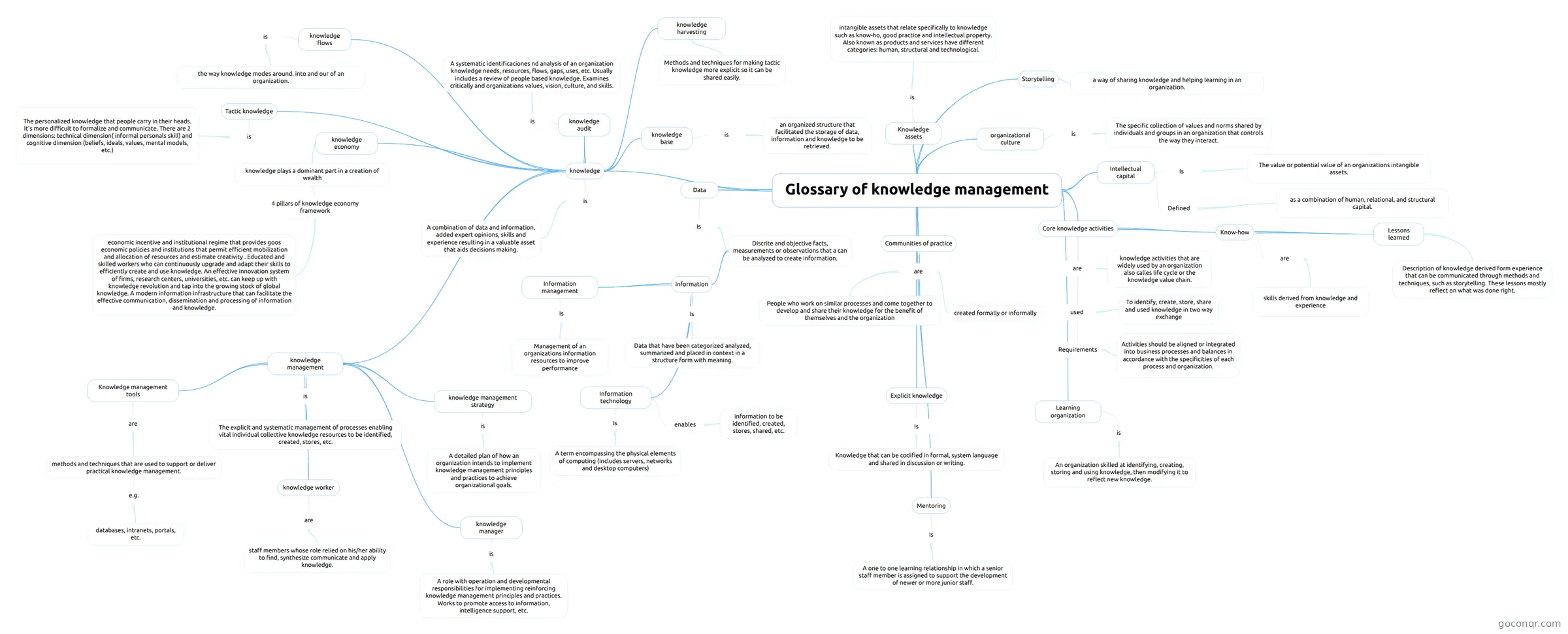
Mind map: Glossary of knowledge management
Map content
Glossary of knowledge management
Communities of practice
- are
- People who work on similar processes and come together to develop and share their knowledge for the benefit of themselves and the organization
- created formally or informally
- Mentoring
- Is
- A one to one learning relationship in which a senior staff member is assigned to support the development of newer or more junior staff.
- Is
- are
Core knowledge activities
- are
- knowledge activities that are widely used by an organization also calles life cycle or the knowledge value chain.
- used
- To identify, create, store, share and used knowledge in two way exchange
- Requirements
- Activities should be aligned or integrated into business processes and balances in accordance with the specificities of each process and organization.
- Know-how
- are
- skills derived from knowledge and experience
- Lessons learned
- Description of knowledge derived form experience that can be communicated through methods and techniques, such as storytelling. These lessons mostly reflect on what was done right.
- are
- are
Data
- Is
- Discrite and objective facts, measurements or observations that a can be analyzed to create information.
- information
- Is
- Data that have been categorized analyzed, summarized and placed in context in a structure form with meaning.
- Information management
- Is
- Management of an organizations information resources to improve performance
- Is
- Information technology
- Is
- A term encompassing the physical elements of computing (includes servers, networks and desktop computers)
- enables
- information to be identified, created, stores, shared, etc.
- Is
- Is
- information
- Discrite and objective facts, measurements or observations that a can be analyzed to create information.
- Is
Explicit knowledge
- Is
- Knowledge that can be codified in formal, system language and shared in discussion or writing.
- Is
Intellectual capital
- Is
- The value or potential value of an organizations intangible assets.
- Defined
- as a combination of human, relational, and structural capital.
- Is
knowledge
- is
- A combination of data and information, added expert opinions, skills and experience resulting in a valuable asset that aids decisions making.
- knowledge audit
- is
- A systematic identificaciones nd analysis of an organization knowledge needs, resources, flows, gaps, uses, etc. Usually includes a review of people based knowledge. Examines critically and organizations values, vision, culture, and skills.
- is
- knowledge base
- is
- an organized structure that facilitated the storage of data, information and knowledge to be retrieved.
- is
- knowledge economy
- knowledge plays a dominant part in a creation of wealth
- 4 pillars of knowledge economy framework
- economic incentive and institutional regime that provides goos economic policies and institutions that permit efficient mobilization and allocation of resources and estimate creativity . Educated and skilled workers who can continuously upgrade and adapt their skills to efficiently create and use knowledge. An effective innovation system of firms, research centers, universities, etc. can keep up with knowledge revolution and tap into the growing stock of global knowledge. A modern information infrastructure that can facilitate the effective communication, dissemination and processing of information and knowledge.
- 4 pillars of knowledge economy framework
- knowledge plays a dominant part in a creation of wealth
- knowledge flows
- is
- the way knowledge modes around. into and our of an organization.
- is
- knowledge harvesting
- Methods and techniques for making tactic knowledge more explicit so it can be shared easily.
- knowledge management
- is
- The explicit and systematic management of processes enabling vital individual collective knowledge resources to be identified, created, stores, etc.
- Knowledge management tools
- are
- methods and techniques that are used to support or deliver practical knowledge management.
- e.g.
- databases, intranets, portals, etc.
- e.g.
- methods and techniques that are used to support or deliver practical knowledge management.
- are
- knowledge management strategy
- is
- A detailed plan of how an organization intends to implement knowledge management principles and practices to achieve organizational goals.
- is
- knowledge worker
- are
- staff members whose role relied on his/her ability to find, synthesize communicate and apply knowledge.
- are
- knowledge manager
- is
- A role with operation and developmental responsibilities for implementing reinforcing knowledge management principles and practices. Works to promote access to information, intelligence support, etc.
- is
- is
- Tactic knowledge
- is
- The personalized knowledge that people carry in their heads. It's more difficult to formalize and communicate. There are 2 dimensions: technical dimension( informal personals skill) and cognitive dimension (beliefs, ideals, values, mental models, etc.)
- is
- is
Knowledge assets
- is
- intangible assets that relate specifically to knowledge such as know-ho, good practice and intellectual property. Also known as products and services have different categories: human, structural and technological.
- is
Learning organization
- is
- An organization skilled at identifying, creating, storing and using knowledge, then modifying it to reflect new knowledge.
- is
organizational culture
- is
- The specific collection of values and norms shared by individuals and groups in an organization that controls the way they interact.
- is
Storytelling
- a way of sharing knowledge and helping learning in an organization.
Information
- Description
- Mind Map on Glossary of knowledge management, created by Ana C on 11/01/2018.
- Created by
- Ana C
- Views
- 6
- Rating