
Mind map
Ecosystems
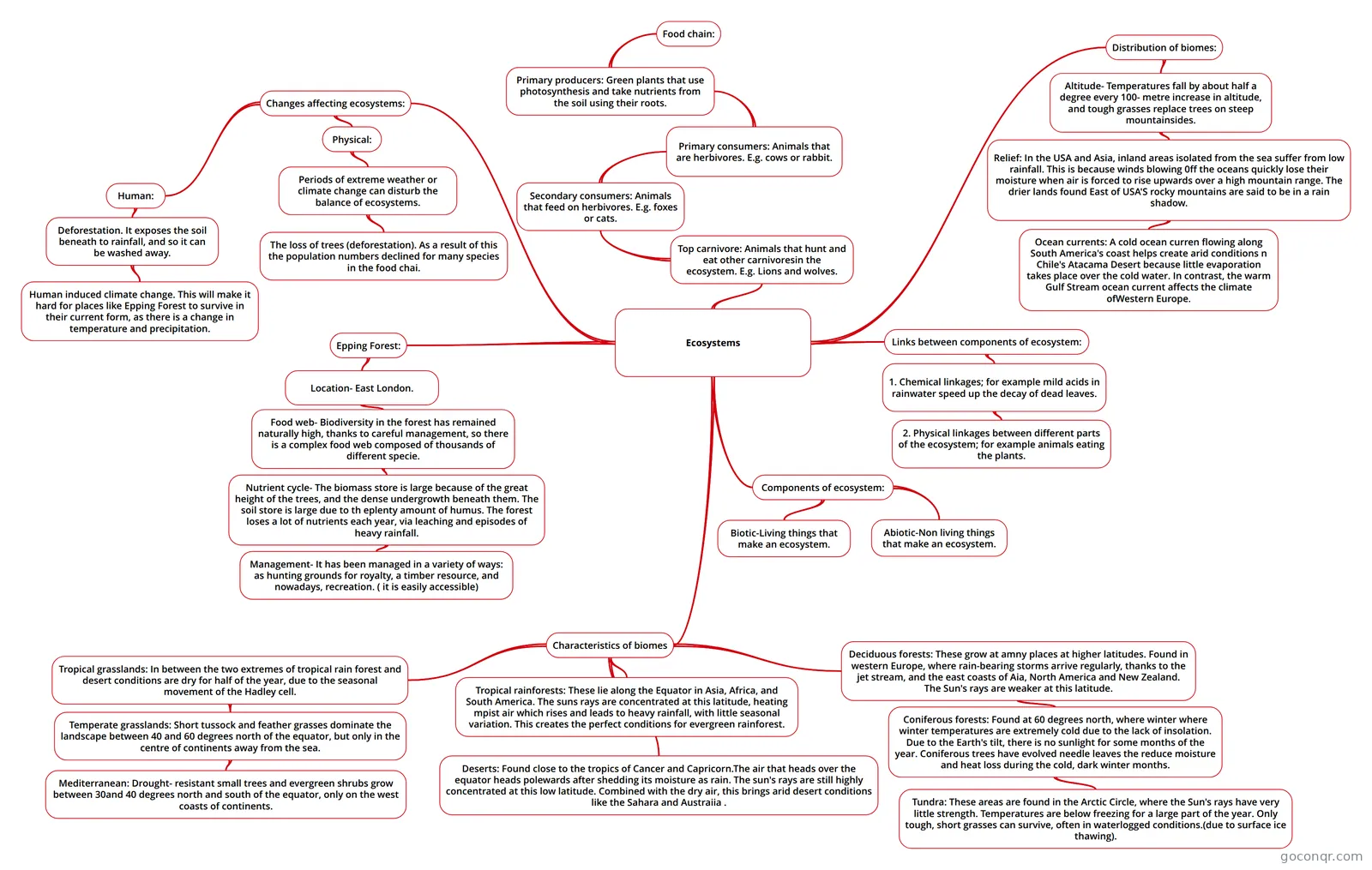
Mind map: ecosystems and biomes
Map content
Ecosystems
Components of ecosystem:
- Abiotic-Non living things that make an ecosystem.
- Biotic-Living things that make an ecosystem.
Top carnivore: Animals that hunt and eat other carnivoresin the ecosystem. E.g. Lions and wolves.
- Secondary consumers: Animals that feed on herbivores. E.g. foxes or cats.
- Primary consumers: Animals that are herbivores. E.g. cows or rabbit.
- Primary producers: Green plants that use photosynthesis and take nutrients from the soil using their roots.
- Food chain:
- Primary producers: Green plants that use photosynthesis and take nutrients from the soil using their roots.
- Primary consumers: Animals that are herbivores. E.g. cows or rabbit.
- Secondary consumers: Animals that feed on herbivores. E.g. foxes or cats.
Epping Forest:
- Location- East London.
- Food web- Biodiversity in the forest has remained naturally high, thanks to careful management, so there is a complex food web composed of thousands of different specie.
- Nutrient cycle- The biomass store is large because of the great height of the trees, and the dense undergrowth beneath them. The soil store is large due to th eplenty amount of humus. The forest loses a lot of nutrients each year, via leaching and episodes of heavy rainfall.
- Management- It has been managed in a variety of ways: as hunting grounds for royalty, a timber resource, and nowadays, recreation. ( it is easily accessible)
- Nutrient cycle- The biomass store is large because of the great height of the trees, and the dense undergrowth beneath them. The soil store is large due to th eplenty amount of humus. The forest loses a lot of nutrients each year, via leaching and episodes of heavy rainfall.
- Food web- Biodiversity in the forest has remained naturally high, thanks to careful management, so there is a complex food web composed of thousands of different specie.
- Location- East London.
Links between components of ecosystem:
- 1. Chemical linkages; for example mild acids in rainwater speed up the decay of dead leaves.
- 2. Physical linkages between different parts of the ecosystem; for example animals eating the plants.
- 1. Chemical linkages; for example mild acids in rainwater speed up the decay of dead leaves.
Changes affecting ecosystems:
- Physical:
- Periods of extreme weather or climate change can disturb the balance of ecosystems.
- The loss of trees (deforestation). As a result of this the population numbers declined for many species in the food chai.
- Periods of extreme weather or climate change can disturb the balance of ecosystems.
- Human:
- Deforestation. It exposes the soil beneath to rainfall, and so it can be washed away.
- Human induced climate change. This will make it hard for places like Epping Forest to survive in their current form, as there is a change in temperature and precipitation.
- Deforestation. It exposes the soil beneath to rainfall, and so it can be washed away.
- Physical:
Distribution of biomes:
- Altitude- Temperatures fall by about half a degree every 100- metre increase in altitude, and tough grasses replace trees on steep mountainsides.
- Relief: In the USA and Asia, inland areas isolated from the sea suffer from low rainfall. This is because winds blowing 0ff the oceans quickly lose their moisture when air is forced to rise upwards over a high mountain range. The drier lands found East of USA'S rocky mountains are said to be in a rain shadow.
- Ocean currents: A cold ocean curren flowing along South America's coast helps create arid conditions n Chile's Atacama Desert because little evaporation takes place over the cold water. In contrast, the warm Gulf Stream ocean current affects the climate ofWestern Europe.
- Relief: In the USA and Asia, inland areas isolated from the sea suffer from low rainfall. This is because winds blowing 0ff the oceans quickly lose their moisture when air is forced to rise upwards over a high mountain range. The drier lands found East of USA'S rocky mountains are said to be in a rain shadow.
- Altitude- Temperatures fall by about half a degree every 100- metre increase in altitude, and tough grasses replace trees on steep mountainsides.
Characteristics of biomes
- Tropical rainforests: These lie along the Equator in Asia, Africa, and South America. The suns rays are concentrated at this latitude, heating mpist air which rises and leads to heavy rainfall, with little seasonal variation. This creates the perfect conditions for evergreen rainforest.
- Deserts: Found close to the tropics of Cancer and Capricorn.The air that heads over the equator heads polewards after shedding its moisture as rain. The sun's rays are still highly concentrated at this low latitude. Combined with the dry air, this brings arid desert conditions like the Sahara and Austraiia .
- Tropical grasslands: In between the two extremes of tropical rain forest and desert conditions are dry for half of the year, due to the seasonal movement of the Hadley cell.
- Temperate grasslands: Short tussock and feather grasses dominate the landscape between 40 and 60 degrees north of the equator, but only in the centre of continents away from the sea.
- Mediterranean: Drought- resistant small trees and evergreen shrubs grow between 30and 40 degrees north and south of the equator, only on the west coasts of continents.
- Temperate grasslands: Short tussock and feather grasses dominate the landscape between 40 and 60 degrees north of the equator, but only in the centre of continents away from the sea.
- Deciduous forests: These grow at amny places at higher latitudes. Found in western Europe, where rain-bearing storms arrive regularly, thanks to the jet stream, and the east coasts of Aia, North America and New Zealand. The Sun's rays are weaker at this latitude.
- Coniferous forests: Found at 60 degrees north, where winter where winter temperatures are extremely cold due to the lack of insolation. Due to the Earth's tilt, there is no sunlight for some months of the year. Coniferous trees have evolved needle leaves the reduce moisture and heat loss during the cold, dark winter months.
- Tundra: These areas are found in the Arctic Circle, where the Sun's rays have very little strength. Temperatures are below freezing for a large part of the year. Only tough, short grasses can survive, often in waterlogged conditions.(due to surface ice thawing).
- Coniferous forests: Found at 60 degrees north, where winter where winter temperatures are extremely cold due to the lack of insolation. Due to the Earth's tilt, there is no sunlight for some months of the year. Coniferous trees have evolved needle leaves the reduce moisture and heat loss during the cold, dark winter months.