
Mind map
VICARIOUS LIABILITY
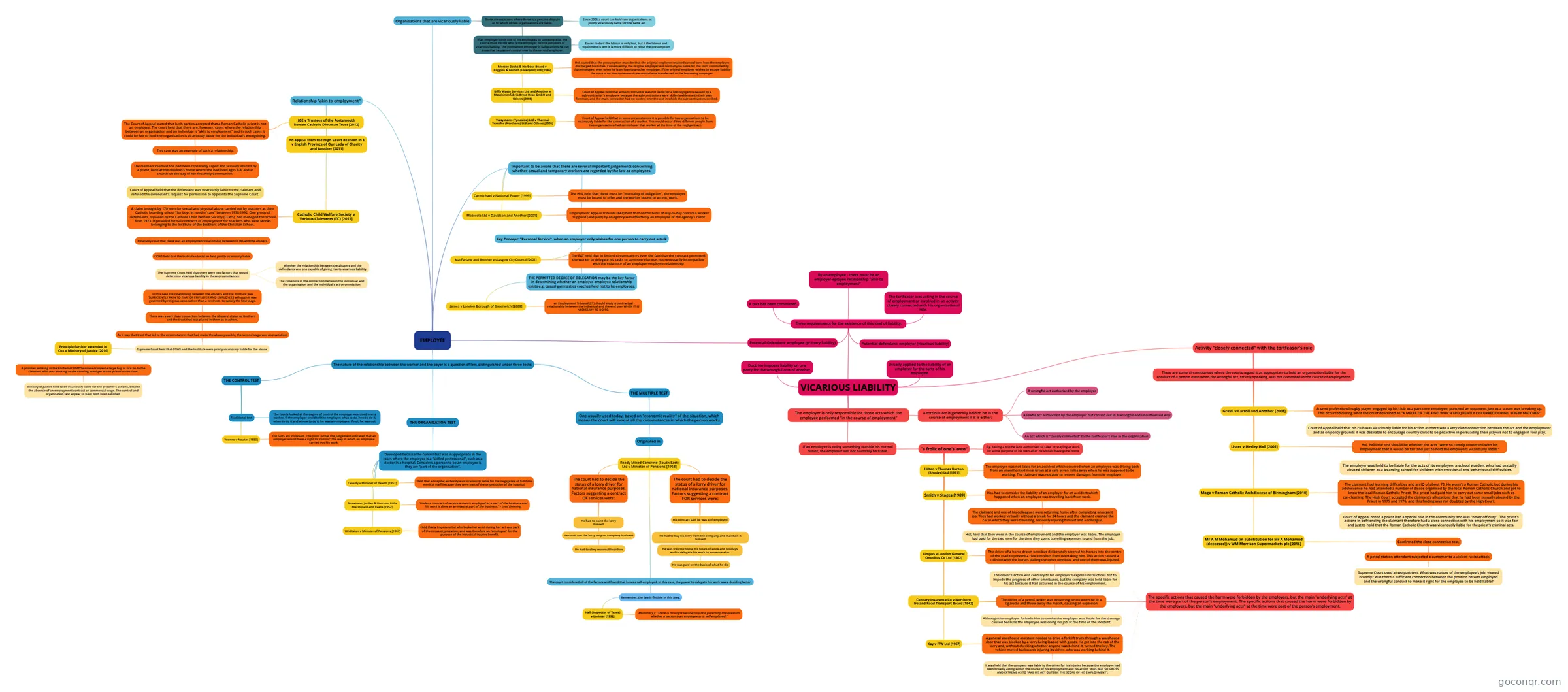
Mind map: Vicarious liability
Map content
VICARIOUS LIABILITY
Doctrine imposes liability on one party for the wrongful acts of another.
Usually applied to the liability of an employer for the torts of his employee.
Three requirements for the existence of this kind of liability:
- A tort has been committed.
- By an employee - there must be an employer-eployee relationship "akin to employment"
- The tortfeasor was acting in the course of employment or involved in an activity closely connected with his organizational role.
- Potential defendant: employee (primary liability)
- EMPLOYEE
- The nature of the relationship between the worker and the payer is a question of law, distinguished under three tests:
- THE CONTROL TEST
- Traditional test
- The courts looked at the degree of control the employer exercised over a worker. If the employer could tell the employee what to do, how to do it, when to do it and where to do it, he was an employee. If not, he was not.
- Yewens v Noakes [1880]
- The facts are irrelevant. The point is that the judgement indicated that an employer would have a right to "control" the way in which an employee carried out his work.
- Traditional test
- THE ORGANIZATION TEST
- Developed because the control test was inappropriate in the cases where the employee is a "skilled professional", such as a doctor in a hospital. Considers a person to be an employee is they are "part of the organisation".
- Cassidy v Minister of Health [1951]
- Held that a hospital authority was vicariously liable for the negligence of full-time medical staff because they were part of the organization of the hospital.
- Stevenson, Jordan & Harrison Ltd v MacDonald and Evans [1952]
- "Under a contract of service a man is employed as a part of the business and his work is done as an integral part of the business." - Lord Denning
- Whittaker v Minister of Pensions [1967]
- Held that a trapeze artist who broke her wrist during her act was part of the circus organization, and was therefore an "employee" for the purpose of the industrial injuries benefit.
- Cassidy v Minister of Health [1951]
- Developed because the control test was inappropriate in the cases where the employee is a "skilled professional", such as a doctor in a hospital. Considers a person to be an employee is they are "part of the organisation".
- THE MULTIPLE TEST
- One usually used today, based on "economic reality" of the situation, which means the court will look at all the circumstances in which the person works.
- Originated in:
- Ready Mixed Concrete (South East) Ltd v Minister of Pensions [1968]
- The court had to decide the status of a lorry driver for national insurance purposes. Factors suggesting a contract FOR services were:
- His contract said he was self employed
- He had to buy his lorry from the company and maintain it himself
- He was free to choose his hours of work and holidays and to delegate his work to someone else.
- He was paid on the basis of what he did
- The court had to decide the status of a lorry driver for national insurance purposes. Factors suggesting a contract OF services were:
- He had to paint the lorry himself
- He could use the lorry only on company business
- He had to obey reasonable orders
- He had to paint the lorry himself
- The court considered all of the factors and found that he was self-employed. In this case, the power to delegate his work was a deciding factor.
- Remember, the law is flexible in this area.
- Hall (Inspector of Taxes) v Lorimer [1992]
- Mummery J: "There is no single satisfactory test governing the question whether a person is an employee or is self-employed."
- Hall (Inspector of Taxes) v Lorimer [1992]
- Remember, the law is flexible in this area.
- The court had to decide the status of a lorry driver for national insurance purposes. Factors suggesting a contract FOR services were:
- Ready Mixed Concrete (South East) Ltd v Minister of Pensions [1968]
- Originated in:
- One usually used today, based on "economic reality" of the situation, which means the court will look at all the circumstances in which the person works.
- THE CONTROL TEST
- Important to be aware that there are several important judgements concerning whether casual and temporary workers are regarded by the law as employees.
- Carmichael v National Power [1999]
- The HoL held that there must be "mutuality of obligation", the employer must be bound to offer and the worker bound to accept, work.
- Motorola Ltd v Davidson and Another [2001]
- Employment Appeal Tribunal (EAT) held that on the basis of day-to-day control a worker supplied (and paid) by an agency was effectively an employee of the agency's client.
- Key Concept: "Personal Service", when an employer only wishes for one person to carry out a task
- MacFarlane and Another v Glasgow City Council [2001]
- The EAT held that in limited circumstances even the fact that the contract permitted the worker to delegate his tasks to someone else was not necessarily incompatible with the existence of an employer-employee relationship
- THE PERMITTED DEGREE OF DELEGATION may be the key factor in determining whether an employer-employee relationship exists e.g. casual gymnastics coaches held not to be employees.
- James v London Borough of Greenwich [2008]
- an Employment Tribunal (ET) should imply a contractual relationship between the individual and the end user WHEN IT IS NECESSARY TO DO SO.
- James v London Borough of Greenwich [2008]
- MacFarlane and Another v Glasgow City Council [2001]
- Carmichael v National Power [1999]
- Relationship "akin to employment"
- JGE v Trustees of the Portsmouth Roman Catholic Diocesan Trust [2012]
- The Court of Appeal stated that both parties accepted that a Roman Catholic priest is not an employee. The court held that there are, however, cases where the relationship between an organisation and an individual is "akin to employment" and in such cases it could be fair to hold the organisation is vicariously liable for the individual's wrongdoing.
- This case was an example of such a relationship.
- The claimant claimed she had been repeatedly raped and sexually abused by a priest, both at the children's home where she had lived ages 6-8, and in church on the day of her first Holy Communion.
- Court of Appeal held that the defendant was vicariously liable to the claimant and refused the defendant's request for permission to appeal to the Supreme Court.
- The claimant claimed she had been repeatedly raped and sexually abused by a priest, both at the children's home where she had lived ages 6-8, and in church on the day of her first Holy Communion.
- This case was an example of such a relationship.
- An appeal from the High Court decision in E v English Province of Our Lady of Charity and Another [2011]
- The Court of Appeal stated that both parties accepted that a Roman Catholic priest is not an employee. The court held that there are, however, cases where the relationship between an organisation and an individual is "akin to employment" and in such cases it could be fair to hold the organisation is vicariously liable for the individual's wrongdoing.
- Catholic Child Welfare Society v Various Claimants (FC) [2012]
- A claim brought by 170 men for sexual and physical abuse carried out by teachers at their Catholic boarding school "for boys in need of care" between 1958-1992. One group of defendants, replaced by the Catholic Child Welfare Society (CCWS), had managed the school from 1973. It provided formal contracts of employment for teachers who were Monks belonging to the Institute of the Brothers of the Christian School.
- Relatively clear that there was an employment relationship between CCWS and the abusers.
- CCWS held that the Institute should be held jointly vicariously liable.
- The Supreme Court held that there were two factors that would determine vicarious liability in these circumstances:
- Whether the relationship between the abusers and the defendants was one capable of giving rise to vicarious liability
- The closeness of the connection between the individual and the organisation and the individual's act or ommission
- In this case the relationship between the abusers and the Institute was SUFFICIENTLY AKIN TO THAT OF EMPLOYER AND EMPLOYEES although it was governed by religious vows rather than a contract - to satisfy the first stage.
- There was a very close connection between the abusers' status as Brothers and the trust that was placed in them as teachers.
- As it was that trust that led to the circumstances that had made the abuse possible, the second stage was also satisfied.
- Supreme Court held that CCWS and the Institute were jointly vicariously liable for the abuse.
- Principle further extended in Cox v Ministry of Justice [2016]
- A prisoner working in the kitchen of HMP Swansea dropped a large bag of rice on to the claimant, who was working as the catering manager at the prison at the time.
- Ministry of Justice held to be vicariously liable for the prisoner's actions, despite the absence of an employment contract or commercial wage. The control and organisation test appear to have both been satisfied.
- A prisoner working in the kitchen of HMP Swansea dropped a large bag of rice on to the claimant, who was working as the catering manager at the prison at the time.
- Principle further extended in Cox v Ministry of Justice [2016]
- Supreme Court held that CCWS and the Institute were jointly vicariously liable for the abuse.
- As it was that trust that led to the circumstances that had made the abuse possible, the second stage was also satisfied.
- The Supreme Court held that there were two factors that would determine vicarious liability in these circumstances:
- CCWS held that the Institute should be held jointly vicariously liable.
- Relatively clear that there was an employment relationship between CCWS and the abusers.
- A claim brought by 170 men for sexual and physical abuse carried out by teachers at their Catholic boarding school "for boys in need of care" between 1958-1992. One group of defendants, replaced by the Catholic Child Welfare Society (CCWS), had managed the school from 1973. It provided formal contracts of employment for teachers who were Monks belonging to the Institute of the Brothers of the Christian School.
- JGE v Trustees of the Portsmouth Roman Catholic Diocesan Trust [2012]
- Organisations that are vicariously liable
- There are occasions where there is a genuine dispute as to which of two organisations are liable.
- Since 2005 a court can hold two organisations as jointly vicariously liable for the same act.
- If an employer lends one of his employees to someone else, the courts must decide who is the employer for the purposes of vicarious liability. The permanent employer is liable unless he can show that he passed control over to the second employer.
- Easier to do if the labour is only lent, but if the labour and equipment is lent it is more difficult to rebut the presumption
- Mersey Docks & Harbour Board v Coggins & Griffith (Liverpool) Ltd [1946]
- HoL stated that the presumption must be that the original employer retained control over how the employee discharged his duties. Consequently, the original employer will normally be liable for the torts committed by that employee, even when he is on loan to another employer. If the original employer wishes to escape liability the onus is on him to demonstrate control was transferred to the borrowing employer.
- Biffa Waste Services Ltd and Another v Maschinenfabrik Ernst Hese GmbH and Others [2008]
- Court of Appeal held that a main contractor was not liable for a fire negligently caused by a sub-contractor's employee because the sub-contractors were skilled welders with their own foreman, and the main contractor had no control over the wat in which the sub-contractors worked.
- Viasystems (Tyneside) Ltd v Thermal Transfer (Northern) Ltd and Others [2005]
- Court of Appeal held that in some circumstances it is possible for two organisations to be vicariously liable for the same action of a worker. This would occur if two different people from two organisations had control over that worker at the time of the negligent act.
- There are occasions where there is a genuine dispute as to which of two organisations are liable.
- The nature of the relationship between the worker and the payer is a question of law, distinguished under three tests:
- EMPLOYEE
- Potential defendant: employer (vicarious liability)
The employer is only responsible for those acts which the employee performed "in the course of employment"
- A tortious act is generally held to be in the course of employment if it is either:
- A wrongful act authorised by the employer
- A lawful act authorised by the employer but carried out in a wrongful and unauthorised way
- An act which is "closely connected" to the tortfeasor's role in the organisation
- A tortious act is generally held to be in the course of employment if it is either:
If an employee is doing something outside his normal duties, the employer will not normally be liable.
- "a frolic of one's' own"
- E.g. taking a trip he isn't authorised to take, or staying at work for some purpose of his own after he should have gone home
- Hilton v Thomas Burton (Rhodes) Ltd [1961]
- The employer was not liable for an accident which occurred when an employee was driving back from an unauthorised meal break at a café seven miles away when he was supposed to be working. The claimant was not able to recover damages from the employer.
- Smith v Stages [1989]
- HoL had to consider the liability of an employer for an accident which happened when an employee was travelling back from work.
- The claimant and one of his colleagues were returning home after completing an urgent job. They had worked virtually without a break for 24 hours and the claimant crashed the car in which they were travelling, seriously injuring himself and a colleague.
- HoL held that they were in the course of employment and the employer was liable. The employer had paid for the two men for the time they spent travelling expenses to and from the job.
- The claimant and one of his colleagues were returning home after completing an urgent job. They had worked virtually without a break for 24 hours and the claimant crashed the car in which they were travelling, seriously injuring himself and a colleague.
- HoL had to consider the liability of an employer for an accident which happened when an employee was travelling back from work.
- Limpus v London General Omnibus Co Ltd [1862]
- The driver of a horse drawn omnibus deliberately steered his horses into the centre of the road to prevent a rival omnibus from overtaking him. This action caused a collision with the horses pulling the other omnibus, and one of them was injured.
- The driver's action was contrary to his employer's express instructions not to impede the progress of other omnibuses, but the company was held liable for his act because it had occurred in the course of his employment.
- The driver of a horse drawn omnibus deliberately steered his horses into the centre of the road to prevent a rival omnibus from overtaking him. This action caused a collision with the horses pulling the other omnibus, and one of them was injured.
- Century Insurance Co v Northern Ireland Road Transport Board [1942]
- The driver of a petrol tanker was delivering petrol when he lit a cigarette and threw away the match, causing an explosion
- Although the employer forbade him to smoke the employer was liable for the damage caused because the employee was doing his job at the time of the incident.
- The specific actions that caused the harm were forbidden by the employers, but the main "underlying acts" at the time were part of the person's employment. The specific actions that caused the harm were forbidden by the employers, but the main "underlying acts" at the time were part of the person's employment.
- The driver of a petrol tanker was delivering petrol when he lit a cigarette and threw away the match, causing an explosion
- Kay v ITW Ltd [1967]
- A general warehouse assistant needed to drive a forklift truck through a warehouse door that was blocked by a lorry being loaded with goods. He got into the cab of the lorry and, without checking whether anyone was behind it, turned the key. The vehicle moved backwards injuring its driver, who was working behind it.
- It was held that the company was liable to the driver for his injuries because the employee had been broadly acting within the course of his employment and his action "WAS NOT SO GROSS AND EXTREME AS TO TAKE HIS ACT OUTSIDE THE SCOPE OF HIS EMPLOYMENT".
- A general warehouse assistant needed to drive a forklift truck through a warehouse door that was blocked by a lorry being loaded with goods. He got into the cab of the lorry and, without checking whether anyone was behind it, turned the key. The vehicle moved backwards injuring its driver, who was working behind it.
- "a frolic of one's' own"
Activity "closely connected" with the tortfeasor's role
- There are some circumstances where the courts regard it as appropriate to hold an organisation liable for the conduct of a person even when the wrongful act, strictly speaking, was not commited in the course of employment.
- Gravil v Carroll and Another [2008]
- A semi professional rugby player engaged by his club as a part-time employee, punched an opponent just as a scrum was breaking up. This occurred during what the court described as "A MELEE OF THE KIND WHICH FREQUENTLY OCCURRED DURING RUGBY MATCHES".
- Court of Appeal held that his club was vicariously liable for his action as there was a very close connection between the act and the employment and as on policy grounds it was desirable to encourage country clubs to be proactive in persuading their players not to engage in foul play.
- A semi professional rugby player engaged by his club as a part-time employee, punched an opponent just as a scrum was breaking up. This occurred during what the court described as "A MELEE OF THE KIND WHICH FREQUENTLY OCCURRED DURING RUGBY MATCHES".
- Lister v Hesley Hall [2001]
- HoL held the test should be whether the acts "were so closely connected with his employment that it would be fair and just to hold the employers vicariously liable."
- The employer was held to be liable for the acts of its employee, a school warden, who had sexually abused children at a boarding school for children with emotional and behavioural difficulties.
- HoL held the test should be whether the acts "were so closely connected with his employment that it would be fair and just to hold the employers vicariously liable."
- Gravil v Carroll and Another [2008]
- Maga v Roman Catholic Archdiocese of Birmingham [2010]
- The claimant had learning difficulties and an IQ of about 70. He wasn't a Roman Catholic but during his adolescence he had attended a number of discos organised by the local Roman Catholic Church and got to know the local Roman Catholic Priest. The priest had paid him to carry out some small jobs such as car-cleaning. The High Court accepted the claimant's allegations that he had been sexually abused by the Priest in 1975 and 1976, and this finding was not doubted by the High Court.
- Court of Appeal noted a priest had a special role in the community and was "never off duty". The priest's actions in befriending the claimant therefore had a close connection with his employment so it was fair and just to hold that the Roman Catholic Church was vicariously liable for the priest's criminal acts.
- The claimant had learning difficulties and an IQ of about 70. He wasn't a Roman Catholic but during his adolescence he had attended a number of discos organised by the local Roman Catholic Church and got to know the local Roman Catholic Priest. The priest had paid him to carry out some small jobs such as car-cleaning. The High Court accepted the claimant's allegations that he had been sexually abused by the Priest in 1975 and 1976, and this finding was not doubted by the High Court.
- Mr A M Mohamud (in substitution for Mr A Mohamud (deceased)) v WM Morrison Supermarkets plc [2016]
- Confirmed the close connection test.
- A petrol station attendant subjected a customer to a violent racist attack.
- Supreme Court used a two part test. What was nature of the employee's job, viewed broadly? Was there a sufficient connection between the position he was employed and the wrongful conduct to make it right for the employee to be held liable?
- A petrol station attendant subjected a customer to a violent racist attack.
- Confirmed the close connection test.
- There are some circumstances where the courts regard it as appropriate to hold an organisation liable for the conduct of a person even when the wrongful act, strictly speaking, was not commited in the course of employment.
Information
- Description
- Mind Map on VICARIOUS LIABILITY, created by Hannah Thompson on 23/03/2018.
- Created by
- Hannah Thompson
- Views
- 1
- Rating