
Mind map
B5 - Homeostasis & Response
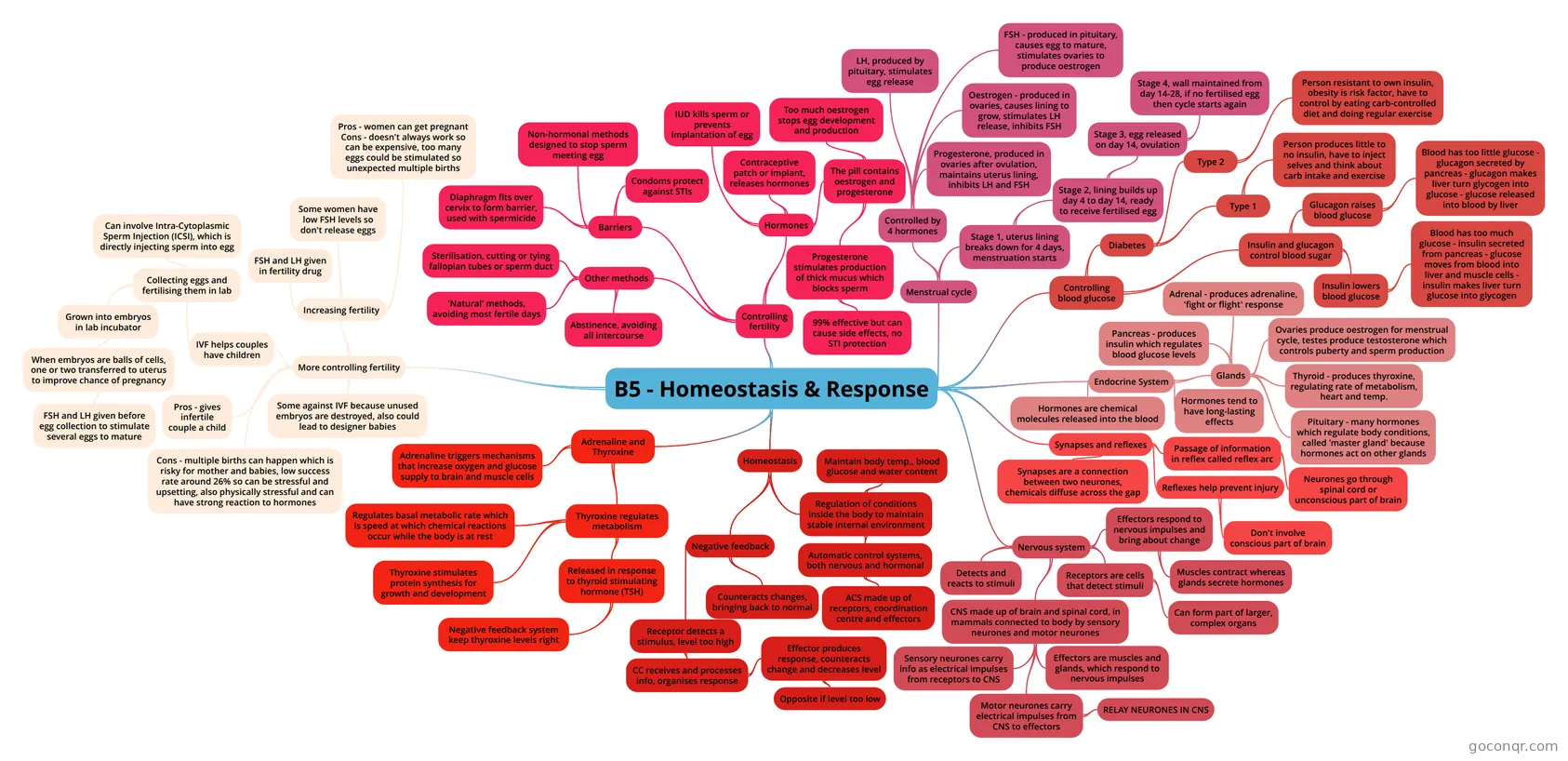
Mind map: Homeostasis and response
Map content
B5 - Homeostasis & Response
Homeostasis
- Regulation of conditions inside the body to maintain stable internal environment
- Automatic control systems, both nervous and hormonal
- ACS made up of receptors, coordination centre and effectors
- Maintain body temp., blood glucose and water content
- Automatic control systems, both nervous and hormonal
- Negative feedback
- Counteracts changes, bringing back to normal
- Receptor detects a stimulus, level too high
- CC receives and processes info, organises response
- Effector produces response, counteracts change and decreases level
- Opposite if level too low
- Effector produces response, counteracts change and decreases level
- CC receives and processes info, organises response
- Regulation of conditions inside the body to maintain stable internal environment
Nervous system
- Detects and reacts to stimuli
- CNS made up of brain and spinal cord, in mammals connected to body by sensory neurones and motor neurones
- Sensory neurones carry info as electrical impulses from receptors to CNS
- Motor neurones carry electrical impulses from CNS to effectors
- RELAY NEURONES IN CNS
- Effectors are muscles and glands, which respond to nervous impulses
- Receptors are cells that detect stimuli
- Can form part of larger, complex organs
- Effectors respond to nervous impulses and bring about change
- Muscles contract whereas glands secrete hormones
Synapses and reflexes
- Synapses are a connection between two neurones, chemicals diffuse across the gap
- Reflexes help prevent injury
- Don't involve conscious part of brain
- Passage of information in reflex called reflex arc
- Neurones go through spinal cord or unconscious part of brain
Endocrine System
- Hormones are chemical molecules released into the blood
- Hormones tend to have long-lasting effects
- Glands
- Pituitary - many hormones which regulate body conditions, called 'master gland' because hormones act on other glands
- Thyroid - produces thyroxine, regulating rate of metabolism, heart and temp.
- Adrenal - produces adrenaline, 'fight or flight' response
- Ovaries produce oestrogen for menstrual cycle, testes produce testosterone which controls puberty and sperm production
- Pancreas - produces insulin which regulates blood glucose levels
Controlling blood glucose
- Insulin and glucagon control blood sugar
- Insulin lowers blood glucose
- Blood has too much glucose - insulin secreted from pancreas - glucose moves from blood into liver and muscle cells - insulin makes liver turn glucose into glycogen
- Glucagon raises blood glucose
- Blood has too little glucose - glucagon secreted by pancreas - glucagon makes liver turn glycogen into glucose - glucose released into blood by liver
- Insulin lowers blood glucose
- Diabetes
- Type 1
- Person produces little to no insulin, have to inject selves and think about carb intake and exercise
- Type 2
- Person resistant to own insulin, obesity is risk factor, have to control by eating carb-controlled diet and doing regular exercise
- Type 1
- Insulin and glucagon control blood sugar
Menstrual cycle
- Stage 1, uterus lining breaks down for 4 days, menstruation starts
- Stage 2, lining builds up day 4 to day 14, ready to receive fertilised egg
- Stage 3, egg released on day 14, ovulation
- Stage 4, wall maintained from day 14-28, if no fertilised egg then cycle starts again
- Stage 3, egg released on day 14, ovulation
- Stage 2, lining builds up day 4 to day 14, ready to receive fertilised egg
- Controlled by 4 hormones
- FSH - produced in pituitary, causes egg to mature, stimulates ovaries to produce oestrogen
- Oestrogen - produced in ovaries, causes lining to grow, stimulates LH release, inhibits FSH
- LH, produced by pituitary, stimulates egg release
- Progesterone, produced in ovaries after ovulation, maintains uterus lining, inhibits LH and FSH
- Stage 1, uterus lining breaks down for 4 days, menstruation starts
Controlling fertility
- Hormones
- The pill contains oestrogen and progesterone
- Too much oestrogen stops egg development and production
- Progesterone stimulates production of thick mucus which blocks sperm
- 99% effective but can cause side effects, no STI protection
- Contraceptive patch or implant, releases hormones
- IUD kills sperm or prevents implantation of egg
- The pill contains oestrogen and progesterone
- Barriers
- Non-hormonal methods designed to stop sperm meeting egg
- Condoms protect against STIs
- Diaphragm fits over cervix to form barrier, used with spermicide
- Other methods
- Sterilisation, cutting or tying fallopian tubes or sperm duct
- 'Natural' methods, avoiding most fertile days
- Abstinence, avoiding all intercourse
- Hormones
More controlling fertility
- Increasing fertility
- Some women have low FSH levels so don't release eggs
- FSH and LH given in fertility drug
- Pros - women can get pregnant Cons - doesn't always work so can be expensive, too many eggs could be stimulated so unexpected multiple births
- IVF helps couples have children
- Collecting eggs and fertilising them in lab
- Can involve Intra-Cytoplasmic Sperm Injection (ICSI), which is directly injecting sperm into egg
- Grown into embryos in lab incubator
- When embryos are balls of cells, one or two transferred to uterus to improve chance of pregnancy
- FSH and LH given before egg collection to stimulate several eggs to mature
- When embryos are balls of cells, one or two transferred to uterus to improve chance of pregnancy
- Collecting eggs and fertilising them in lab
- Pros - gives infertile couple a child
- Cons - multiple births can happen which is risky for mother and babies, low success rate around 26% so can be stressful and upsetting, also physically stressful and can have strong reaction to hormones
- Some against IVF because unused embryos are destroyed, also could lead to designer babies
- Increasing fertility
Adrenaline and Thyroxine
- Adrenaline triggers mechanisms that increase oxygen and glucose supply to brain and muscle cells
- Thyroxine regulates metabolism
- Regulates basal metabolic rate which is speed at which chemical reactions occur while the body is at rest
- Thyroxine stimulates protein synthesis for growth and development
- Released in response to thyroid stimulating hormone (TSH)
- Negative feedback system keep thyroxine levels right
Information
- Description
- GCSE Nat: Biology Mind Map on B5 - Homeostasis & Response, created by Lilac Potato on 05/04/2018.
- Created by
- Lilac Potato
- Views
- 5
- Rating