
Mind map
Models of Working Memory
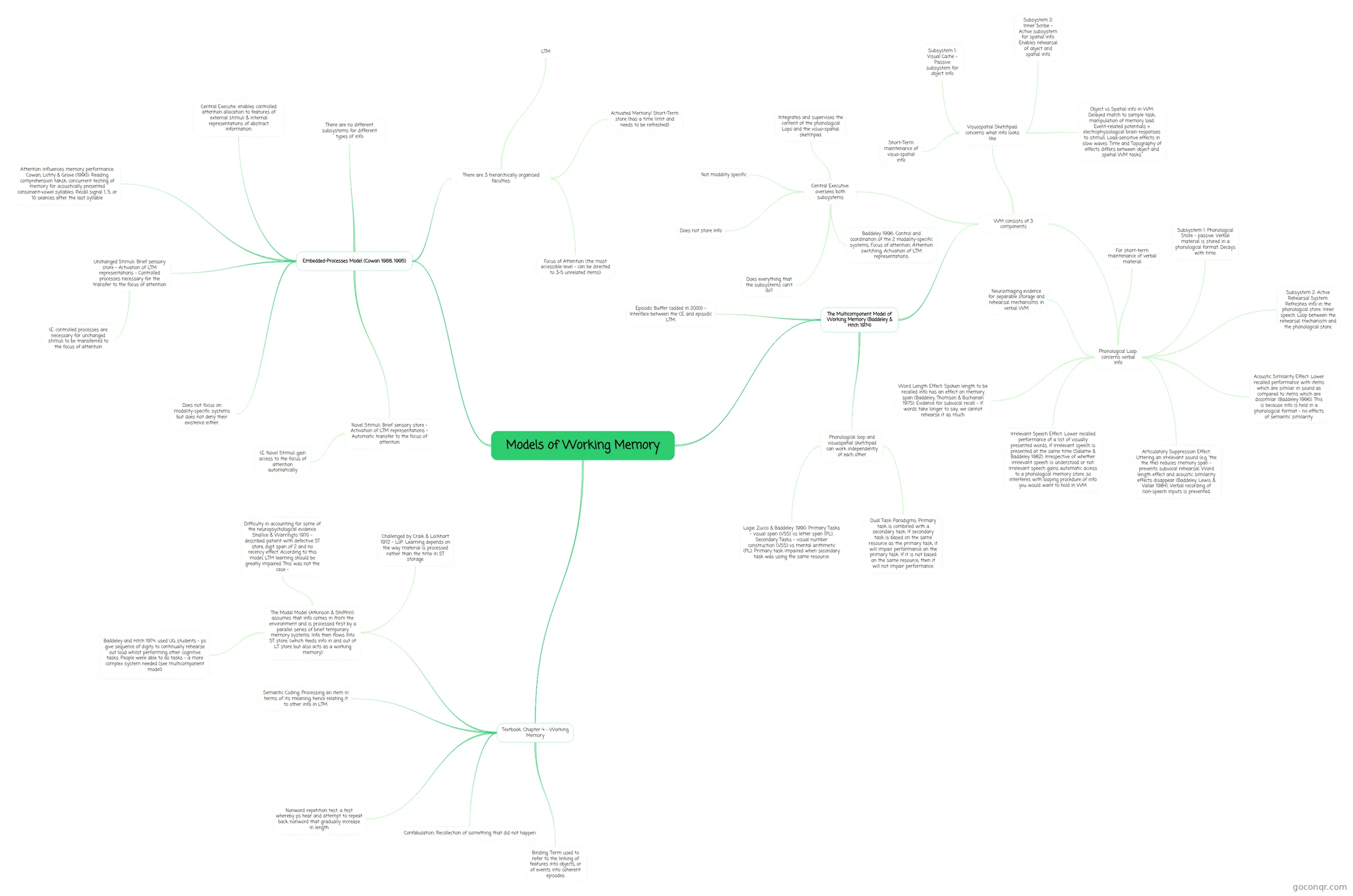
Mind map: Models of working memory
Map content
Models of Working Memory
The Multicomponent Model of Working Memory (Baddeley & Hitch 1974)
- WM consists of 3 components
- Visuospatial Sketchpad: concerns what info looks like
- Short-Term maintenance of visuo-spatial info
- Subsystem 1: Visual Cache - Passive subsystem for object info
- Subsystem 2: Inner Scribe - Active subsystem for spatial info. Enables rehearsal of object and spatial info.
- Object vs Spatial info in WM: Delayed match to sample task, manipulation of memory load. Event-related potentials = electrophysiological brain responses to stimuli. Load-sensitive effects in slow waves. Time and Topography of effects differs between object and spatial WM tasks.
- Phonological Loop: concerns verbal info
- For short-term maintenance of verbal material
- Subsystem 1: Phonological Store - passive. Verbal material is stored in a phonological format. Decays with time.
- Subsystem 2: Active Rehearsal System: Refreshes info in the phonological store. Inner speech. Loop between the rehearsal mechanism and the phonological store.
- Acoustic Similarity Effect: Lower recalled performance with items which are similar in sound as compared to items which are dissimilar (Baddeley 1996). This is because info is held in a phonological format - no effects of semantic similarity.
- Irrelevant Speech Effect: Lower recalled performance of a list of visually presented words, if irrelevant speech is presented at the same time (Salame & Baddeley 1982). Irrespective of whether irrelevant speech is understood or not. Irrelevant speech gains automatic access to a phonological memory store, so interferes with looping procedure of info you would want to hold in WM.
- Word Length Effect: Spoken length to be recalled info has an effect on memory span (Baddeley, Thomson & Buchanan 1975). Evidence for subvocal recall - if words take longer to say, we cannot rehearse it as much.
- Articulatory Suppression Effect: Uttering an irrelevant sound (e.g. 'the the the) reduces memory span - prevents subvocal rehearsal. Word length effect and acoustic similarity effects disappear (Baddeley, Lewis & Vallar 1984). Verbal recording of non-speech inputs is prevented,
- Neuroimaging evidence for separable storage and rehearsal mechanisms in verbal WM
- Central Executive: oversees both subsystems
- Integrates and supervises the content of the phonological Lopo and the visuo-spatial. sketchpad.
- Not modality specific
- Does not store info
- Does everything that the subsystems can't do?
- Baddeley 1996: Control and coordination of the 2 modality-specific systems; Focus of attention; Attention switching; Activation of LTM representations.
- Visuospatial Sketchpad: concerns what info looks like
- Phonological loop and visuospatial sketchpad can work independently of each other
- Dual Task Paradigms: Primary task is combined with a secondary task. If secondary task is based on the same resource as the primary task, it will impair performance on the primary task. If it is not based on the same resource, then it will not impair performance.
- Logie, Zucco & Baddeley. 1990: Primary Tasks - visual span (VSS) vs letter span (PL). Secondary Tasks - visual number construction (VSS) vs mental arithmetic (PL). Primary task impaired when secondary task was using the same resource.
- Episodic Buffer (added in 2000) - Interface between the CE and episodic LTM.
- WM consists of 3 components
Embedded-Processes Model (Cowan 1988, 1995)
- There are no different subsystems for different types of info
- There are 3 hierarchically organised faculties:
- LTM
- Activated Memory/ Short-Term store (has a time limit and needs to be refreshed)
- Focus of Attention (the most accessible level - can be directed to 3-5 unrelated items)
- Novel Stimuli: Brief sensory store - Activation of LTM representations - Automatic transfer to the focus of attention
- I.E. Novel Stimuli gain access to the focus of attention automatically
- Unchanged Stimuli: Brief sensory store - Activation of LTM representations - Controlled processes necessary for the transfer to the focus of attention
- I.E. controlled processes are necessary for unchanged stimuli to be transferred to the focus of attention
- Central Executie: enables controlled attention allocation to features of external stimuli & internal representations of abstract information.
- Does not focus on modality-specific systems but does not deny their existence either.
- Attention influences memory performance: Cowan, Lichty & Grove (1990): Reading comprehension taksk, concurrent testing of memory for acoustically presented consonant-vowel syllables. Recall signal 1, 5, or 10 seances after the last syllable
Textbook: Chapter 4 - Working Memory
- The Modal Model (Atkinson & Shiffrin): assumes that info comes in from the environment and is processed first by a parallel series of brief temporary memory systems. Info then flows into ST store, (which feeds info in and out of LT store but also acts as a working memory)
- Challenged by Craik & Lockhart 1972 - LoP. Learning depends on the way material is processed rather than the time in ST storage.
- Difficulty in accounting for some of the neuropsychological evidence. Shallice & Warringto 1970 - described patient with defective ST store, digit span of 2 and no recency effect. According to this model, LTM learning should be greatly impaired. This was not the case -
- Baddeley and Hitch 1974: used UG students - ps give sequence of digits to continually rehearse out loud whilst performing other cognitive tasks. People were able to do tasks - a more complex system needed (see multicomponent model)
- Semantic Coding: Processing an item in terms of its meaning, hence relating it to other info in LTM.
- Nonword repetition test: a test whereby ps hear and attempt to repeat back nonword that gradually increase in length
- Confabulation: Recollection of something that did not happen
- Binding: Term used to refer to the linking of features into objects, or of events into coherent episodes
- The Modal Model (Atkinson & Shiffrin): assumes that info comes in from the environment and is processed first by a parallel series of brief temporary memory systems. Info then flows into ST store, (which feeds info in and out of LT store but also acts as a working memory)
Information
- Description
- Mind Map on Models of Working Memory, created by Emily Collyer on 16/05/2018.
- Created by
- Emily Collyer
- Views
- 0
- Rating