
Mind map
Microbiology Part 2
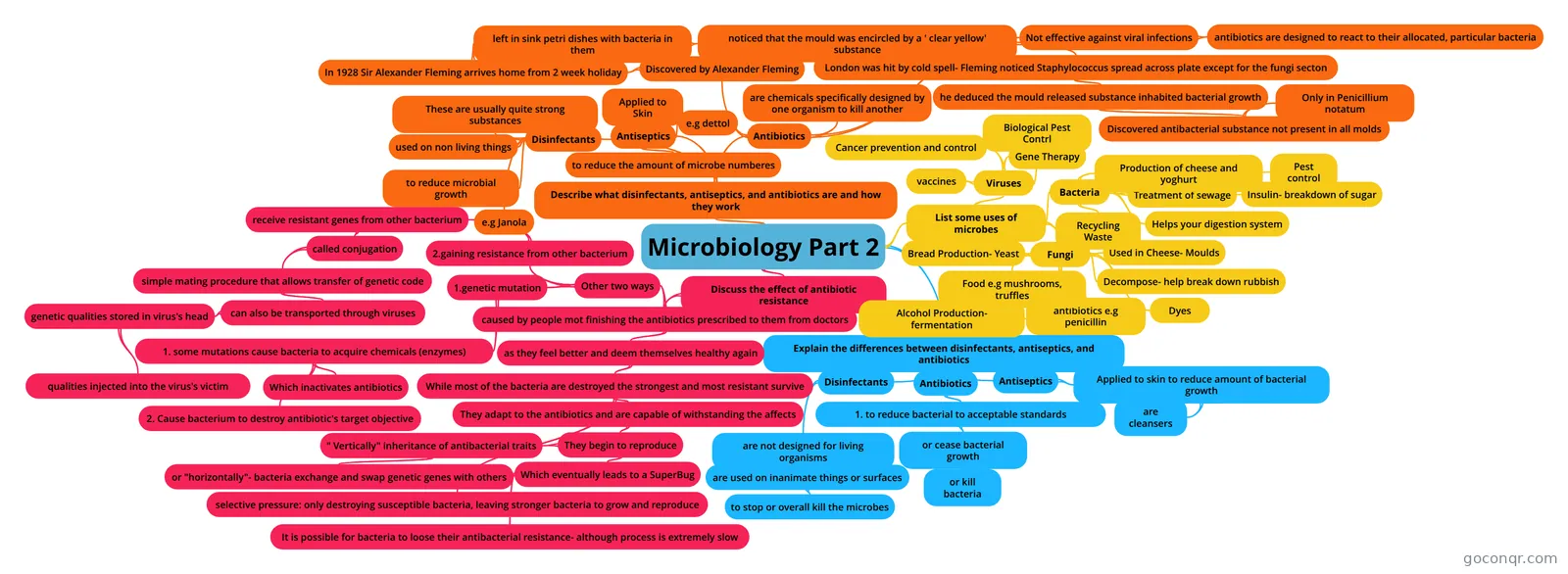
Mind map: Microbiology part 2
Map content
Microbiology Part 2
Describe what disinfectants, antiseptics, and antibiotics are and how they work
- Disinfectants
- These are usually quite strong substances
- used on non living things
- to reduce microbial growth
- e.g Janola
- Antiseptics
- Applied to Skin
- to reduce the amount of microbe numberes
- e.g dettol
- Antibiotics
- are chemicals specifically designed by one organism to kill another
- Discovered by Alexander Fleming
- In 1928 Sir Alexander Fleming arrives home from 2 week holiday
- left in sink petri dishes with bacteria in them
- noticed that the mould was encircled by a ' clear yellow' substance
- London was hit by cold spell- Fleming noticed Staphylococcus spread across plate except for the fungi secton
- he deduced the mould released substance inhabited bacterial growth
- Discovered antibacterial substance not present in all molds
- Only in Penicillium notatum
- Discovered antibacterial substance not present in all molds
- he deduced the mould released substance inhabited bacterial growth
- London was hit by cold spell- Fleming noticed Staphylococcus spread across plate except for the fungi secton
- noticed that the mould was encircled by a ' clear yellow' substance
- left in sink petri dishes with bacteria in them
- In 1928 Sir Alexander Fleming arrives home from 2 week holiday
- Not effective against viral infections
- antibiotics are designed to react to their allocated, particular bacteria
- Disinfectants
List some uses of microbes
- Viruses
- http://www.garlandscience.com/res/pdf/9780815341505_ch02.pdf
- Gene Therapy
- Cancer prevention and control
- vaccines
- Biological Pest Contrl
- Bacteria
- http://www.livestrong.com/article/29090-good-uses-bacteria/
- Recycling Waste
- Helps your digestion system
- Treatment of sewage
- Production of cheese and yoghurt
- Insulin- breakdown of sugar
- Pest control
- Fungi
- http://www.livestrong.com/article/174197-uses-of-fungus/
- antibiotics e.g penicillin
- Food e.g mushrooms, truffles
- Bread Production- Yeast
- Alcohol Production- fermentation
- Used in Cheese- Moulds
- Decompose- help break down rubbish
- Dyes
- Viruses
Explain the differences between disinfectants, antiseptics, and antibiotics
- Antibiotics
- 1. to reduce bacterial to acceptable standards
- or cease bacterial growth
- or kill bacteria
- or cease bacterial growth
- 1. to reduce bacterial to acceptable standards
- Disinfectants
- are not designed for living organisms
- are used on inanimate things or surfaces
- to stop or overall kill the microbes
- are used on inanimate things or surfaces
- are not designed for living organisms
- Antiseptics
- Applied to skin to reduce amount of bacterial growth
- are cleansers
- Applied to skin to reduce amount of bacterial growth
- Antibiotics
Discuss the effect of antibiotic resistance
- http://www.tufts.edu/med/apua/about_issue/about_antibioticres.shtml
- caused by people mot finishing the antibiotics prescribed to them from doctors
- as they feel better and deem themselves healthy again
- While most of the bacteria are destroyed the strongest and most resistant survive
- They adapt to the antibiotics and are capable of withstanding the affects
- They begin to reproduce
- Which eventually leads to a SuperBug
- It is possible for bacteria to loose their antibacterial resistance- although process is extremely slow
- " Vertically" inheritance of antibacterial traits
- or "horizontally"- bacteria exchange and swap genetic genes with others
- Which eventually leads to a SuperBug
- They begin to reproduce
- selective pressure: only destroying susceptible bacteria, leaving stronger bacteria to grow and reproduce
- They adapt to the antibiotics and are capable of withstanding the affects
- While most of the bacteria are destroyed the strongest and most resistant survive
- Other two ways
- http://www.tufts.edu/med/apua/about_issue/about_antibioticres.shtml
- 1.genetic mutation
- 1. some mutations cause bacteria to acquire chemicals (enzymes)
- Which inactivates antibiotics
- 2. Cause bacterium to destroy antibiotic's target objective
- 1. some mutations cause bacteria to acquire chemicals (enzymes)
- 2.gaining resistance from other bacterium
- receive resistant genes from other bacterium
- called conjugation
- simple mating procedure that allows transfer of genetic code
- can also be transported through viruses
- genetic qualities stored in virus's head
- qualities injected into the virus's victim
- genetic qualities stored in virus's head
- can also be transported through viruses
- simple mating procedure that allows transfer of genetic code
- called conjugation
- receive resistant genes from other bacterium
- as they feel better and deem themselves healthy again