
Mind map
CD - how children learn words
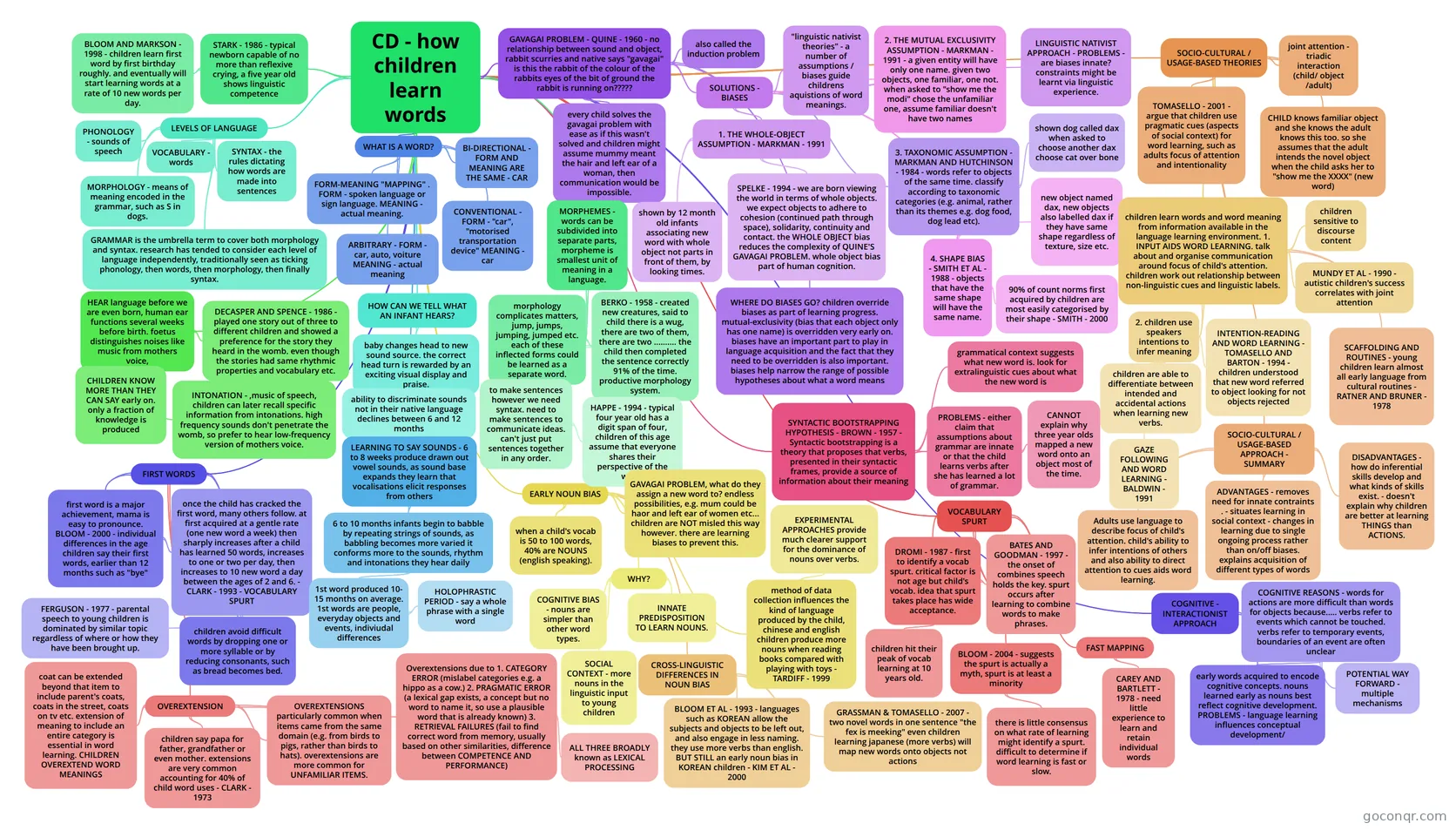
Mind map: how children learn words
Map content
CD - how children learn words
STARK - 1986 - typical newborn capable of no more than reflexive crying, a five year old shows linguistic competence
- BLOOM AND MARKSON - 1998 - children learn first word by first birthday roughly. and eventually will start learning words at a rate of 10 new words per day.
LEVELS OF LANGUAGE
- PHONOLOGY - sounds of speech
- MORPHOLOGY - means of meaning encoded in the grammar, such as S in dogs.
- VOCABULARY - words
- SYNTAX - the rules dictating how words are made into sentences
- GRAMMAR is the umbrella term to cover both morphology and syntax. research has tended to consider each level of language independently, traditionally seen as ticking phonology, then words, then morphology, then finally syntax.
HEAR language before we are even born, human ear functions several weeks before birth. foetus distinguishes noises like music from mothers voice,
- DECASPER AND SPENCE - 1986 - played one story out of three to different children and showed a preference for the story they heard in the womb. even though the stories had same rhythmic properties and vocabulary etc.
- INTONATION - ,music of speech, children can later recall specific information from intonations. high frequency sounds don't penetrate the womb, so prefer to hear low-frequency version of mothers voice.
- CHILDREN KNOW MORE THAN THEY CAN SAY early on. only a fraction of knowledge is produced
WHAT IS A WORD?
- FORM-MEANING "MAPPING" . FORM - spoken language or sign language. MEANING - actual meaning.
- ARBITRARY - FORM - car, auto, voiture MEANING - actual meaning
- BI-DIRECTIONAL - FORM AND MEANING ARE THE SAME - CAR
- CONVENTIONAL - FORM - "car", "motorised transportation device" MEANING - car
HOW CAN WE TELL WHAT AN INFANT HEARS?
- baby changes head to new sound source. the correct head turn is rewarded by an exciting visual display and praise.
- ability to discriminate sounds not in their native language declines between 6 and 12 months
- baby changes head to new sound source. the correct head turn is rewarded by an exciting visual display and praise.
LEARNING TO SAY SOUNDS - 6 to 8 weeks produce drawn out vowel sounds, as sound base expands they learn that vocalisations elicit responses from others
- 6 to 10 months infants begin to babble by repeating strings of sounds, as babbling becomes more varied it conforms more to the sounds, rhythm and intonations they hear daily
- 1st word produced 10- 15 months on average. 1st words are people, everyday objects and events, indiviudal differences
- HOLOPHRASTIC PERIOD - say a whole phrase with a single word
- 1st word produced 10- 15 months on average. 1st words are people, everyday objects and events, indiviudal differences
- 6 to 10 months infants begin to babble by repeating strings of sounds, as babbling becomes more varied it conforms more to the sounds, rhythm and intonations they hear daily
GAVAGAI PROBLEM - QUINE - 1960 - no relationship between sound and object, rabbit scurries and native says "gavagai" is this the rabbit of the colour of the rabbits eyes of the bit of ground the rabbit is running on?????
- every child solves the gavagai problem with ease as if this wasn't solved and children might assume mummy meant the hair and left ear of a woman, then communication would be impossible.
- also called the induction problem
- SOLUTIONS - BIASES
- "linguistic nativist theories" - a number of assumptions / biases guide childrens aquistions of word meanings.
- 1. THE WHOLE-OBJECT ASSUMPTION - MARKMAN - 1991
- SPELKE - 1994 - we are born viewing the world in terms of whole objects. we expect objects to adhere to cohesion (continued path through space), solidarity, continuity and contact. the WHOLE OBJECT bias reduces the complexity of QUINE'S GAVAGAI PROBLEM. whole object bias part of human cognition.
- shown by 12 month old infants associating new word with whole object not parts in front of them, by looking times.
- 2. THE MUTUAL EXCLUSIVITY ASSUMPTION - MARKMAN - 1991 - a given entity will have only one name. given two objects, one familiar, one not. when asked to "show me the modi" chose the unfamiliar one, assume familiar doesn't have two names
- 3. TAXONOMIC ASSUMPTION - MARKMAN AND HUTCHINSON - 1984 - words refer to objects of the same time. classify according to taxonomic categories (e.g. animal, rather than its themes e.g. dog food, dog lead etc).
- shown dog called dax when asked to choose another dax choose cat over bone
- 4. SHAPE BIAS - SMITH ET AL - 1988 - objects that have the same shape will have the same name.
- new object named dax, new objects also labelled dax if they have same shape regardless of texture, size etc.
- 90% of count norms first acquired by children are most easily categorised by their shape - SMITH - 2000
- LINGUISTIC NATIVIST APPROACH - PROBLEMS - are biases innate? constraints might be learnt via linguistic experience.
- WHERE DO BIASES GO? children override biases as part of learning progress. mutual-exclusivity (bias that each object only has one name) is overridden very early on. biases have an important part to play in language acquisition and the fact that they need to be overridden is also important. biases help narrow the range of possible hypotheses about what a word means
MORPHEMES - words can be subdivided into separate parts, morpheme is smallest unit of meaning in a language.
- morphology complicates matters, jump, jumps, jumping, jumped etc. each of these inflected forms could be learned as a separate word.
- BERKO - 1958 - created new creatures, said to child there is a wug, there are two of them, there are two .......... the child then completed the sentence correctly 91% of the time. productive morphology system.
- to make sentences however we need syntax. need to make sentences to communicate ideas. can't just put sentences together in any order.
- HAPPE - 1994 - typical four year old has a digit span of four, children of this age assume that everyone shares their perspective of the world
- to make sentences however we need syntax. need to make sentences to communicate ideas. can't just put sentences together in any order.
- BERKO - 1958 - created new creatures, said to child there is a wug, there are two of them, there are two .......... the child then completed the sentence correctly 91% of the time. productive morphology system.
- morphology complicates matters, jump, jumps, jumping, jumped etc. each of these inflected forms could be learned as a separate word.
EARLY NOUN BIAS
- when a child's vocab is 50 to 100 words, 40% are NOUNS (english speaking).
- GAVAGAI PROBLEM, what do they assign a new word to? endless possibilities, e.g. mum could be haor and left ear of women etc... children are NOT misled this way however. there are learning biases to prevent this.
- method of data collection influences the kind of language produced by the child, chinese and english children produce more nouns when reading books compared with playing with toys - TARDIFF - 1999
- EXPERIMENTAL APPROACHES provide much clearer support for the dominance of nouns over verbs.
- WHY?
- COGNITIVE BIAS - nouns are simpler than other word types.
- INNATE PREDISPOSITION TO LEARN NOUNS.
- SOCIAL CONTEXT - more nouns in the linguistic input to young children
- CROSS-LINGUISTIC DIFFERENCES IN NOUN BIAS
- BLOOM ET AL - 1993 - languages such as KOREAN allow the subjects and objects to be left out, and also engage in less naming. they use more verbs than english. BUT STILL an early noun bias in KOREAN children - KIM ET AL - 2000
- GRASSMAN & TOMASELLO - 2007 - two novel words in one sentence "the fex is meeking" even children learning japanese (more verbs) will map new words onto objects not actions
FIRST WORDS
- first word is a major achievement, mama is easy to pronounce. BLOOM - 2000 - individual differences in the age children say their first words, earlier than 12 months such as "bye"
- once the child has cracked the first word, many others follow. at first acquired at a gentle rate (one new word a week) then sharply increases after a child has learned 50 words, increases to one or two per day, then increases to 10 new word a day between the ages of 2 and 6. - CLARK - 1993 - VOCABULARY SPURT
- FERGUSON - 1977 - parental speech to young children is dominated by similar topic regardless of where or how they have been brought up.
- once the child has cracked the first word, many others follow. at first acquired at a gentle rate (one new word a week) then sharply increases after a child has learned 50 words, increases to one or two per day, then increases to 10 new word a day between the ages of 2 and 6. - CLARK - 1993 - VOCABULARY SPURT
- children avoid difficult words by dropping one or more syllable or by reducing consonants, such as bread becomes bed.
- OVEREXTENSION
- coat can be extended beyond that item to include parent's coats, coats in the street, coats on tv etc. extension of meaning to include an entire category is essential in word learning. CHILDREN OVEREXTEND WORD MEANINGS
- children say papa for father, grandfather or even mother. extensions are very common accounting for 40% of child word uses - CLARK - 1973
- OVEREXTENSIONS particularly common when items came from the same domain (e.g. from birds to pigs, rather than birds to hats). overextensions are more common for UNFAMILIAR ITEMS.
- Overextensions due to 1. CATEGORY ERROR (mislabel categories e.g. a hippo as a cow.) 2. PRAGMATIC ERROR (a lexical gap exists, a concept but no word to name it, so use a plausible word that is already known) 3. RETRIEVAL FAILURES (fail to find correct word from memory, usually based on other similarities, difference between COMPETENCE AND PERFORMANCE)
- ALL THREE BROADLY known as LEXICAL PROCESSING
- first word is a major achievement, mama is easy to pronounce. BLOOM - 2000 - individual differences in the age children say their first words, earlier than 12 months such as "bye"
VOCABULARY SPURT
- DROMI - 1987 - first to identify a vocab spurt. critical factor is not age but child's vocab. idea that spurt takes place has wide acceptance.
- BATES AND GOODMAN - 1997 - the onset of combines speech holds the key. spurt occurs after learning to combine words to make phrases.
- children hit their peak of vocab learning at 10 years old.
- BLOOM - 2004 - suggests the spurt is actually a myth, spurt is at least a minority
- there is little consensus on what rate of learning might identify a spurt. difficult to determine if word learning is fast or slow.
- FAST MAPPING
- CAREY AND BARTLETT - 1978 - need little experience to learn and retain individual words
- DROMI - 1987 - first to identify a vocab spurt. critical factor is not age but child's vocab. idea that spurt takes place has wide acceptance.
SYNTACTIC BOOTSTRAPPING HYPOTHESIS - BROWN - 1957 - Syntactic bootstrapping is a theory that proposes that verbs, presented in their syntactic frames, provide a source of information about their meaning
- grammatical context suggests what new word is. look for extralinguistic cues about what the new word is
- PROBLEMS - either claim that assumptions about grammar are innate or that the child learns verbs after she has learned a lot of grammar.
- CANNOT explain why three year olds mapped a new word onto an object most of the time.
SOCIO-CULTURAL / USAGE-BASED THEORIES
- TOMASELLO - 2001 - argue that children use pragmatic cues (aspects of social context) for word learning, such as adults focus of attention and intentionality
- joint attention - triadic interaction (child/ object /adult)
- CHILD knows familiar object and she knows the adult knows this too. so she assumes that the adult intends the novel object when the child asks her to "show me the XXXX" (new word)
- children learn words and word meaning from information available in the language learning environment. 1. INPUT AIDS WORD LEARNING. talk about and organise communication around focus of child's attention. children work out relationship between non-linguistic cues and linguistic labels.
- 2. children use speakers intentions to infer meaning
- GAZE FOLLOWING AND WORD LEARNING - BALDWIN - 1991
- INTENTION-READING AND WORD LEARNING - TOMASELLO AND BARTON - 1994 - children understood that new word referred to object looking for not objects rejected
- children are able to differentiate between intended and accidental actions when learning new verbs.
- children sensitive to discourse content
- MUNDY ET AL - 1990 - autistic children's success correlates with joint attention
- SCAFFOLDING AND ROUTINES - young children learn almost all early language from cultural routines - RATNER AND BRUNER - 1978
- 2. children use speakers intentions to infer meaning
- SOCIO-CULTURAL / USAGE-BASED APPROACH - SUMMARY
- Adults use language to describe focus of child's attention. child's ability to infer intentions of others and also ability to direct attention to cues aids word learning.
- ADVANTAGES - removes need for innate contraints . - situates learning in social context - changes in learning due to single ongoing process rather than on/off biases. explains acquisition of different types of words
- DISADVANTAGES - how do inferential skills develop and what kinds of skills exist. - doesn't explain why children are better at learning THINGS than ACTIONS.
COGNITIVE - INTERACTIONIST APPROACH
- early words acquired to encode cognitive concepts. nouns learned early as nouns best reflect cognitive development. PROBLEMS - language learning influences conceptual development/
- COGNITIVE REASONS - words for actions are more difficult than words for objects because..... verbs refer to events which cannot be touched. verbs refer to temporary events, boundaries of an event are often unclear
- POTENTIAL WAY FORWARD - multiple mechanisms
- COGNITIVE REASONS - words for actions are more difficult than words for objects because..... verbs refer to events which cannot be touched. verbs refer to temporary events, boundaries of an event are often unclear
- early words acquired to encode cognitive concepts. nouns learned early as nouns best reflect cognitive development. PROBLEMS - language learning influences conceptual development/
Information
- Description
- Mind Map on CD - how children learn words, created by becky.waine on 07/07/2013.
- Created by
- becky.waine
- Views
- 126
- Rating