
14829557
Description

Created by Jake Bailey

|
Created by Jake Bailey
about 8 years ago
|
|
Key Issues and
Debates in Psychology
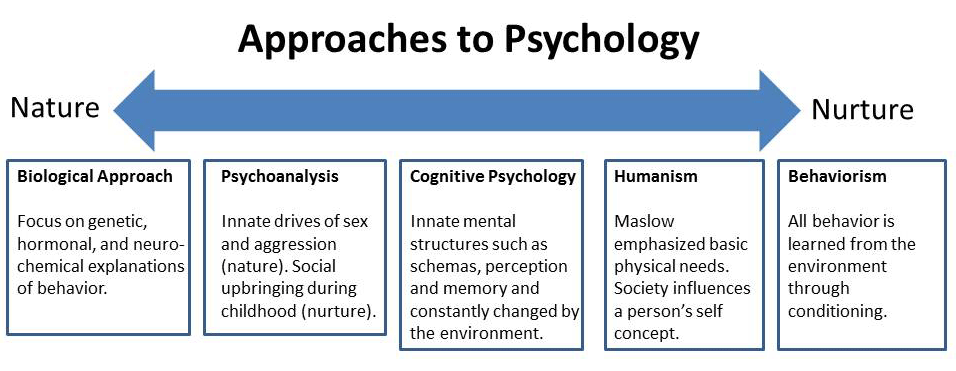
- Nature vs Nurture
- The Nature Nurture debate in
psychology is concerned with the
extent to which some aspects of
different behaviour are either a
product of inheritance or have been
learned/ aquired
- This is used to explain
how some behaviours
are genetically inherited
whereas some may be
learned throughout the
person's life
- Characteristics and
differences that aren't
observable at birth are
said to emerge later in life
due to maturation
- Some say we have a
sort of "biological
clock" which switches
on and off certain
behaviours in a
pre-programmed way
- An example of
physical maturation
would be puberty
- Nativists believe in this
approach, believing that there
isn't just biological maturation
(e.g. puberty) but that there is
also psychological maturation
- Nativists adopt an
extreme belief on the
hereditary argument
in this debate
- Nativists adopt an
extreme belief on the
hereditary argument
in this debate
- Nativists believe in this
approach, believing that there
isn't just biological maturation
(e.g. puberty) but that there is
also psychological maturation
- An example of
physical maturation
would be puberty
- Some say we have a
sort of "biological
clock" which switches
on and off certain
behaviours in a
pre-programmed way
- Characteristics and
differences that aren't
observable at birth are
said to emerge later in life
due to maturation
- Environmentalists make the
assumption that at birth the
mind is a blank slate and over
time it's filled due to an
increasing amount of
experience
- This is the argument
where it's believed that
psychological
characteristics and
differences in behaviour
are learned over time
and not necessarily
inherited
- They believe that it's how you are brought
up in your childhood in which governs the
psychologically significant aspects of child
development
- This argues that the concept of
maturation applies only to the
biological not psychological
- This argues that the concept of
maturation applies only to the
biological not psychological
- They believe that it's how you are brought
up in your childhood in which governs the
psychologically significant aspects of child
development
- This is the argument
where it's believed that
psychological
characteristics and
differences in behaviour
are learned over time
and not necessarily
inherited
- This is used to explain
how some behaviours
are genetically inherited
whereas some may be
learned throughout the
person's life
- The Nature Nurture debate in
psychology is concerned with the
extent to which some aspects of
different behaviour are either a
product of inheritance or have been
learned/ aquired
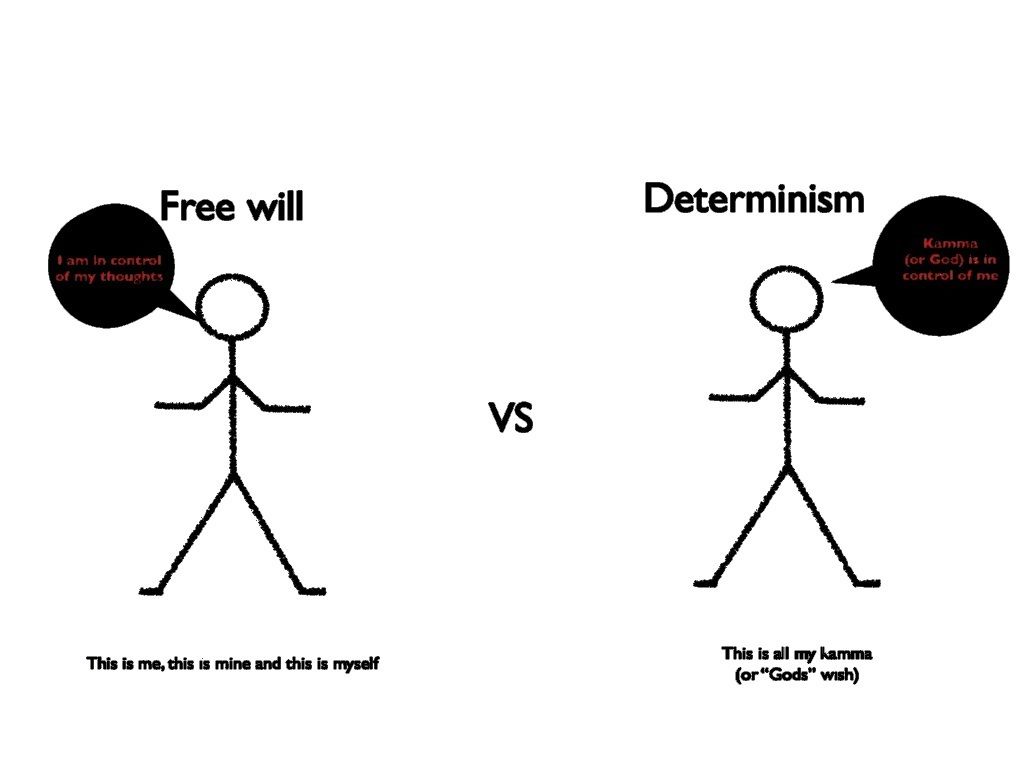
- Free Will vs Determinism
- The Determinist approach proposes
that all types of behavioure is the
product of preceding factors and is
therefore predictable
- The casual/basic
laws of
determinism
forms the basis
of science
- The casual/basic
laws of
determinism
forms the basis
of science
- Free will is the idea
that each person is
able to have some
choice in how we
act
- This assumes that we
are free to choose our
behaviour and in fact
that we are self
determined
- This assumes that we
are free to choose our
behaviour and in fact
that we are self
determined
- Determinism
- Some approaches
within psychology see
this source as being
beyond the individual
- This is known as
environmental
determinism
- Other approaches
would see it as
coming from the
inside of the
human
- This would be in the
form of unconscious
motivation or
genetic determinism
- This would be in the
form of unconscious
motivation or
genetic determinism
- This is known as
environmental
determinism
- Some approaches
within psychology see
this source as being
beyond the individual
- Free Will
- This is a main
assumption of
the humanistic
approach and it's
that humans
have free will
- This means that
not all behaviour
is determined
- This means that
not all behaviour
is determined
- For humanistic psychologists,
freedom is not only possible,
however it's also necessary for
each individual to become fully
functional human beings
- Cognitive psychologists
are also inclined to
attribute importance to
free will and adopt only a
small determinist view
- They focus more on the choice of
means rather than focussing on our
choice of ends in which humanists do
- They focus on making a
decision that has their
main interest
- They focus on making a
decision that has their
main interest
- They focus more on the choice of
means rather than focussing on our
choice of ends in which humanists do
- This is a main
assumption of
the humanistic
approach and it's
that humans
have free will
- The Determinist approach proposes
that all types of behavioure is the
product of preceding factors and is
therefore predictable
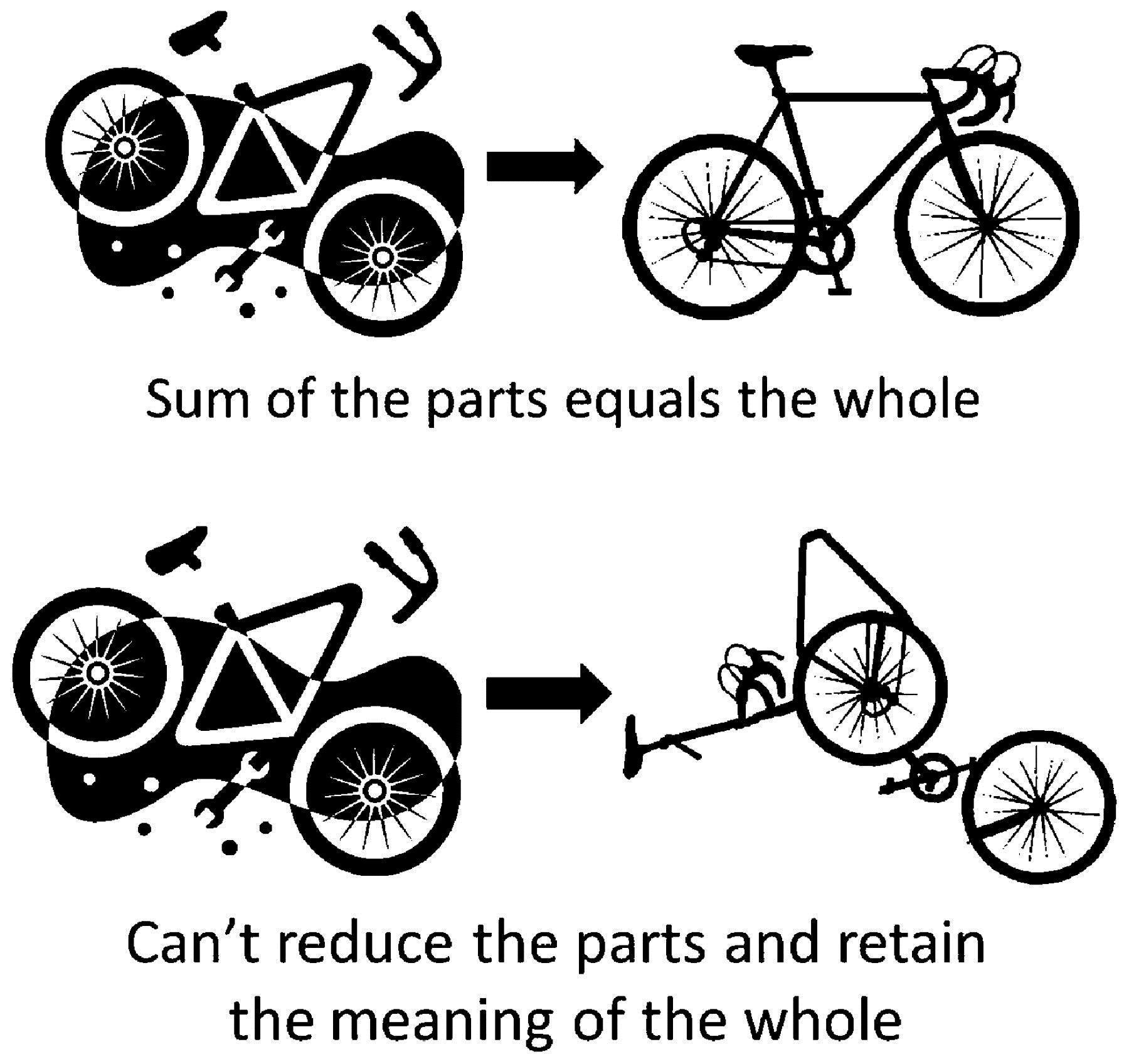
- Reductionism vs Holism
- The reductionist would
say that "the simple is the
source of complex"
- Essentially, to explain a complex
phenomenon, the person must
reduce the large, complex idea to
more constituent elements
- Essentially, to explain a complex
phenomenon, the person must
reduce the large, complex idea to
more constituent elements
- The Holist believes
that the whole is
much more than
just many parts
- This debate is a large controversy
in which raises many questions
about the nature of explanation
- Reductionism
- The belief that human behaviour
can be explained if it's broken down
into smaller component parts in
which cause the end result
- They look at the very simplest parts that make
up our systems and use the simplest
explanations to understand how they then work
- It's based on the
scientific assumption
of parsimony
- This means
theta the
complex
phenomena is
easiest explained
by the simplest
underlying
principles
- This means
theta the
complex
phenomena is
easiest explained
by the simplest
underlying
principles
- It's based on the
scientific assumption
of parsimony
- The belief that human behaviour
can be explained if it's broken down
into smaller component parts in
which cause the end result
- Holism
- This refers to any approach
in which emphasized the
whole rather than the
smaller constituent parts
- This approach therefore suggests that
there is to be many different levels of
explanation and that at each level there
are emergent properties
- These emergent properties cannot be
reduced as used in reductionism
- These emergent properties cannot be
reduced as used in reductionism
- This approach therefore suggests that
there is to be many different levels of
explanation and that at each level there
are emergent properties
- This refers to any approach
in which emphasized the
whole rather than the
smaller constituent parts
- The reductionist would
say that "the simple is the
source of complex"
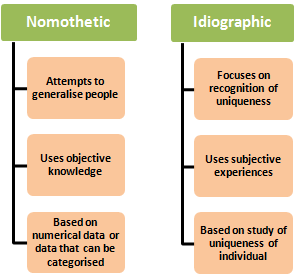
- Ideographic vs Nomothetic
- Psychologists who
adopt the
nomothetic
approach are
concerned with
studying what we
share with others
- That is to say in
establishing laws
or generalizations
- That is to say in
establishing laws
or generalizations
- Psychologists who adopt the
idiographic idea are more interested
in discovering what makes ever
human unique and individual
- Personality
- Personality has been
split into 5 parts and
that all these small
traits sum up to make
our overall personality
- From a nomothetic
point of view these
parts are considered
to adequately describe
the psychologically
significant aspects of
any individual
personality
- From a Idiographic
point of view, the 5
parts don't
adequately explain
the personality, for
example Gordon
Allport found over
18,000 separate
terms in which
described personal
characteristics
- From a nomothetic
point of view these
parts are considered
to adequately describe
the psychologically
significant aspects of
any individual
personality
- Personality has been
split into 5 parts and
that all these small
traits sum up to make
our overall personality
- Psychologists who
adopt the
nomothetic
approach are
concerned with
studying what we
share with others
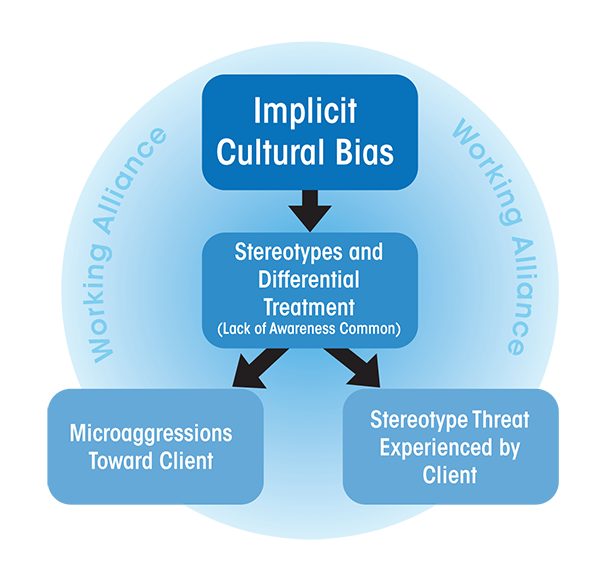
- Culture Bias
- Culture bias is when someone or a
group of people have the tendency
to judge other people based on their
cultural assumptions
- Ethocentrism
- This is when someone will see the world from their
own singular cultural perspective and believing that
one's own belief is normal and correct
- Ethnocentrism tends to be referred to as a lack of awareness of the fact
that other cultural perspectives and beliefs are just as valid as one's own
- Ethnocentrism tends to be referred to as a lack of awareness of the fact
that other cultural perspectives and beliefs are just as valid as one's own
- Rack (1984) claims how
African-Caribbeans in Britain are
sometimes diagnosed as being so
called mentally ill, this is becauase oif
their behaviour in which is normal for
their subculture but not Britain's
- This is when someone will see the world from their
own singular cultural perspective and believing that
one's own belief is normal and correct
- Cultural
Relativism
- Cultural relativism says how
behaviour can only be fully
understood if all cultural context
is taken into consideration
- This viewpoint believes
that the meaning of
intelligence is different
depending on each culture
- Cultural relativism says how
behaviour can only be fully
understood if all cultural context
is taken into consideration
- Culture bias is when someone or a
group of people have the tendency
to judge other people based on their
cultural assumptions
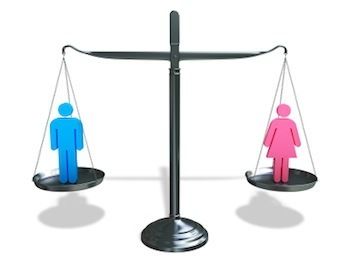
- Gender Bias
- The Gender bias in society
causes differential treatments
of both males and females
throughout society
- These are mainly
based on stereotypes
- Some typical stereotypes as
found by Maccoboy and
Jacklin in 1974 would be:
- Girls
- Less
aggressive
- Greater
verbal
ability
- Greater
verbal
ability
- Less
aggressive
- Boys
- Greater
arithmetical
ability
- Greater
visual/spacial
abilities
- Greater
visual/spacial
abilities
- Greater
arithmetical
ability
- Girls
- Some typical stereotypes as
found by Maccoboy and
Jacklin in 1974 would be:
- These are mainly
based on stereotypes
- Androcentrism
- Means
centred/dominated
by males and can be
both conscious and
unconscious
- Most psychologists
used to be males so
there tended to be a
highly male point of
view within their
research
- Most psychologists
used to be males so
there tended to be a
highly male point of
view within their
research
- Means
centred/dominated
by males and can be
both conscious and
unconscious
- Alpha Bias
- This is when the differences between males
and females are highly exaggerated
- The evolutionary approach in
psychology is highly criticised
because of this as it was used
to explain why men were
more "dominant"
- This is when the differences between males
and females are highly exaggerated
- Beta Bias
- Beta bias
ignores all
differences
between
females and
males
- Findings are often
assumed to apply
to both males
and females
- Findings are often
assumed to apply
to both males
and females
- Beta bias
ignores all
differences
between
females and
males
- The Gender bias in society
causes differential treatments
of both males and females
throughout society
- Ethical Implications
- Ethical Implications
of Research Studies
- An example would
be Milgram's
research in 1963
- In this research the participants
were deceived and were unable
to give any fully formed consent
- The participants were
forced to continue
against their own will
- The participants were then debriefed
after the research and a year later
showed no signs of long term effects
- The participants were
forced to continue
against their own will
- In this research the participants
were deceived and were unable
to give any fully formed consent
- An example would
be Milgram's
research in 1963
- Ethical implications
of Theories
- Bowlby's
Theory of
Attatchment
- This theory suggests that children form
one special attatchment bond, which is
usually with their mother
- This takes place in a
critical period and can
affect future relationships
- This encourages that a women's
place is at home with her
children in which could make
some motheres feel guilty for
goint back to work
- This encourages that a women's
place is at home with her
children in which could make
some motheres feel guilty for
goint back to work
- This takes place in a
critical period and can
affect future relationships
- This theory suggests that children form
one special attatchment bond, which is
usually with their mother
- Bowlby's
Theory of
Attatchment
- These implications are
the effects or
consequences of
research and theories
within psychology
- Ethical Implications
of Research Studies
Media attachments
Want to create your own Mind Maps for free with GoConqr? Learn more.